Chanakya’s Administrative Policies: The blueprint for a strong Indian state
October 11, 2026
  • Read Ecopy
  • Circulation
  • Advertise
  • Careers
  • About Us
  • Contact Us
Android AppiPhone AppArattai
Organiser
  • ‌
  • Bharat
    • Assam
    • Bihar
    • Chhattisgarh
    • Jharkhand
    • Maharashtra
    • View All States
  • World
    • Asia
    • Europe
    • North America
    • South America
    • Africa
    • Australia
  • Editorial
  • International
  • Opinion
  • RSS @ 100
  • More
    • World Hindu Congress 2026
    • Op Sindoor
    • Analysis
    • Sports
    • Defence
    • Politics
    • Business
    • Economy
    • Culture
    • Special Report
    • Sci & Tech
    • Entertainment
    • G20
    • Azadi Ka Amrit Mahotsav
    • Vocal4Local
    • Web Stories
    • Education
    • Employment
    • Books
    • Interviews
    • Travel
    • Law
    • Health
    • Obituary
  • Subscribe
    • Subscribe Print Edition
    • Subscribe Ecopy
    • Read Ecopy
  • ‌
  • Bharat
    • Assam
    • Bihar
    • Chhattisgarh
    • Jharkhand
    • Maharashtra
    • View All States
  • World
    • Asia
    • Europe
    • North America
    • South America
    • Africa
    • Australia
  • Editorial
  • International
  • Opinion
  • RSS @ 100
  • More
    • World Hindu Congress 2026
    • Op Sindoor
    • Analysis
    • Sports
    • Defence
    • Politics
    • Business
    • Economy
    • Culture
    • Special Report
    • Sci & Tech
    • Entertainment
    • G20
    • Azadi Ka Amrit Mahotsav
    • Vocal4Local
    • Web Stories
    • Education
    • Employment
    • Books
    • Interviews
    • Travel
    • Law
    • Health
    • Obituary
  • Subscribe
    • Subscribe Print Edition
    • Subscribe Ecopy
    • Read Ecopy
Organiser
  • Home
  • Bharat
  • World
  • Operation Sindoor
  • Editorial
  • Analysis
  • Opinion
  • Culture
  • Defence
  • International Edition
  • RSS @ 100
  • Magazine
  • Read Ecopy
Home Bharat

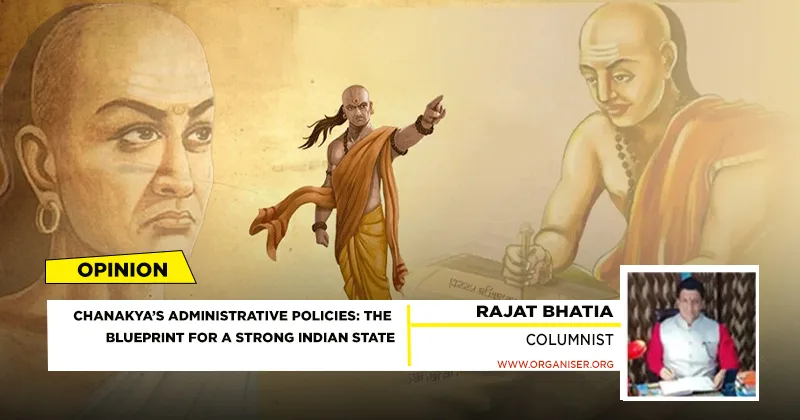
Chanakya’s Administrative Policies: The blueprint for a strong Indian state

Acharya Chanakya, the brilliant strategist and statesman of ancient India, laid the foundation for a unified and powerful nation through his visionary administrative policies

Rajat BhatiaRajat Bhatia
Jan 30, 2025, 05:45 pm IST
inBharat, Opinion
Follow on Google News
Facebook
Twitter
WhatsAppTelegramEmail

At the end of Dwaparyug, after the disappearance of Bhagwan Krishna, Yugabdha started in India, in the fourth century of the third millennium, Mahakavi Bhas was born, who established many facts by presenting the idea of ​​Bharat Rashtra in the drama art.

The main sentence of Mahakavi Bhas’s plays Dutvakayam, Bal Charitam, Swapnavasavadattam is- Imam Sagarparyantam Himavad Vindhyakundalam Mahimekaatpatradangaam Rajsingh: Prashastu. That is, the land which extends till the sea, whose Himalayas and Vindhyachal are the ear rings, the one Chhatrapati who rules, should be our Rajsingh. As per the estimation, during Mahakavi Bhas’s time, Maharaja Rajsingh would have ruled on the land of Bharat Rashtra. The facts of the nation which Mahakavi Bhas presented in his plays are-

  • Bharat Rashtra is spread till the sea.
  • The Himalayas and Vindhyachal mountains of this country enhance the beauty like earring
  • The administration here is of a Chhatrapati.

In the then India, this feeling of patriotism was not only in the rulers but also in the poet society whose creations show it directly. Due to the influence of these creations, there was an ideological flow of patriotism in the whole of India which kept the entire Indian land in harmony.

Kautilya Chanakya was born three centuries after the great poet Bhas, at that time the Greeks had attacked twice on the northeastern border of India. During that time the social system supported the nation, due to which the enemy got stuck at the border of India. But this method proved that in future small states should be combined to form a big polity in the form of a nation so that foreign powers can be faced. According to some facts, Chanakya was born in Tamil Nadu, a state in the southern part of India. If we accept that Chanakya is from the south, then we will also have to accept that Chanakya of south India was worried about the foreign invasions in north-east India, which was resolved by going to Pataliputra later on. This fact refutes Periyar’s false narrative of north vs south, which divides India.

It was not possible for India, which was divided into small states, to maintain its existence as a single country up to the seas under the shadow of foreign invasions. His intention to solve this difficult task was the idea of ​​a united India. For which, with the help of his ability to duty, prosperity, suitability of physical strength, and firm resolve to do his work, Chanakya made Magadh his centre and established the Maurya Empire by making Chandragupta his weapon. The tradition of establishing empires through yagyas like Rajsuya, Ashvamedha etc. existed in those days, the exact definition of which is given by Chanakya in the ninth chapter of ‘Kautilya Arthashastra’ that –  India is considered to be a country spread from mountainous regions to the sea, the goal is to establish dominance under one roof, which is called Chakravarti region. The criteria established by Chanakya at the global level became the first definition related to Chakravarti, which is an India-centric definition.

In Chanakya’s opinion, nation and state were different, but complementary to each other. According to Chanakya, nation was Janapada related units. The group of people living on the earth, who are endowed with the qualities of sustaining, truth, penance, ability etc. was considered to be the nation. Chanakya in his book ‘Shashtamdhikaranam Mandalayoni:’ explains seven reactions of revenue – life related (king, amatya, district and friends), system related (fort, treasury, punishment).

Swamyamatyajanapadadurga koshadandmitrani parkratya.

Like the present times, there was a rule of octroi on entry into the cities, which was decided by Chanakya under a well thought out policy.

Rashtra peedakaram bhandam uchchindayad phalan cha yat mahopakar muchchulkam kuriyad bijam cha durlabham.

That is, there was a ban on goods that were harmful or injurious to the nation and the progress and prosperity of the nation was to be achieved without investing capital on goods that were very beneficial for the nation.

Chanakya organized the tax system for the nation and focused it on agriculture and transport-

Sita Bhogo Balih Karo Vaanik Nadipalastaro Naavh Pattanam Vivitam Vartani Rajjuschorajusch Rashtram.

That is, agricultural tax, enjoyment of agricultural produce, sacrifice (for religious purposes), fruit-related tax, commercial income tax, river palanquin for protection of pilgrimage sites, tax for crossing the river, tax for doing border trade, Pattan- tax taken from the cities on the banks, Vivitam, Vartani- tax taken for protection of roads, Rajju(rope),  Chor Rajju (Rope used for tying thieves) ( Translated from the book: Bharat Rashtra ka Anant Pravah, Writer: Ranga Hari, Page no. 69)

Chanakya was a philosopher, hardworking, active scholar. He, understanding national security, made a capable, dutiful person wise under the policy and deepened the scene of the Chakravarti region and made the nation safe. As a result, he defeated the pleasure-seeking, directionless king Nanda of Magadh and made the mighty Chandragupta the king, who stood like a Himalaya in front of foreign invaders. Seeing his dedication, the internal conflicts of the nation were also pacified and a prosperous state was formed.

Acharya Chanakya’s aim was to unify the entire nation like Magadha and make a strong state. During the rule of Chandragupta, coin became a dimension of economic level which strengthened the country by establishing the concept of new administration, due to which a uniform currency came into circulation in the entire state. The roads connecting the states were paved and widened, which resulted in faster traffic. Ease of travel led to ideological harmony, which ended many types of differences in social strata and the idea of ​​patriotism was spread throughout the nation. Administratively, Acharya Chanakya established the criteria for the appointment of secretaries, ministers, ambassadors, etc. so that the Varna system prevails over the caste system. The Penal Code was created, which does not discriminate on any basis (caste, sex, religion) while punishing the guilty. Acharya Chanakya emphasized on workability and not on birth-based ability.

In short, the social contribution of Acharya Chanakya, who brought Indian nationhood to fruition in the third millennium of Yugabda, is like a lamp that gave the light of knowledge to the entire nation. For the society, Chanakya is similar to the divine grace that Arjuna received in the form of Krishna in Mahabharata, whose teachings can pave the way for the nation’s prosperity by studying them.


Topics: BharatChanakyaChandragupta
Share
Tweet
SendShareSend
✮ Subscribe Organiser YouTube Channel. ✮
✮ Join Organiser's WhatsApp channel for Nationalist views beyond the news. ✮
Previous News

Quran-burning protester Salwan Momika shot dead in Sweden hours before court verdict, five arrested

Next News

Rajasthan: High Court orders to register all live-in relationships; asks for web portal

Related News

AI Generated Image

Ancient civilisational model of development for a prosperous Bharat!

Chinmaya Amrit Yatra meets Param Vir Chakra awardee Captain Bana Singh, highlighting his courage, simplicity and love for Bharat

Chinmaya Amrit Yatra: Captain Bana Singh recalls Siachen battle, his love for Jammu and message to youth

International media’s portrayal of Bharat often overlooks its economic and strategic transformation while relying on familiar stereotypes

Beyond the Bylines: Why International media’s coverage of Bharat demands a critical reappraisal

India’s falling fertility rate and changing Gen Z priorities are reshaping family structures and the country’s demographic future

India’s Demographic Paradox: How falling fertility rates and changing Gen Z priorities are reshaping family life

Bhakti Movement

Torches of Unity : The role of spiritual leaders in shaping the nation

Bharat’s 7.8% GDP growth amid global turmoil highlights the strength of its manufacturing, investment and domestic demand

From Global Turmoil to Economic Triumph: How Bharat sustained 7.8 per cent GDP growth despite geopolitical shocks

Load More

Latest News

Questions over voter eligibility, software failures and the handling of disputed registration records fuel a growing political battle over transparency and accountability in New Jersey’s electoral system.

US election safeguards under fire as New Jersey’s voter registration errors trigger daily audits ahead of midterm

Representative Image

Navratri 2026: Reverence, resistance and protection 

Delhi Police issues Traffic Advisory

CJP Protest Threat 2.0: Delhi Police issues traffic advisory; 30 key routes under watch amid law-and-order concerns

Bangla Sahib Controversy: HS Phoolka Alleges Plot Behind Protesters Using Holy Gurdwara

1984 anti-sikh riot lawyer HS Phoolka alleges conspiracy behind protesters’ entry into Bangla Sahib

Delhi Police Slams 'Malicious' Video of Cops Wearing Shoes Near Gurdwara Bangla Sahib

Delhi Police to take legal action over ‘malicious’ video showing cops wearing shoes inside Gurdwara Bangla Sahib

IEDs, AK Rifles Recovered in Sopore

J&K: Massive arms recovery in Sopore; Police bust terror hideout in Bomai, seize IEDs and AK rifles

Wrongful Confinement Plea Dismissed: Delhi Court Rejects CJP Legal Head’s Application

CJP Legal Head Ratna Singh’s plea for FIR against police rejected; Delhi Court flags missing affidavit and details

SC Quashes Polls in 50 Punjab Wards

Punjab: Supreme Court sets aside elections in 50 wards; Opposition candidates including blocked from contesting

DSGMC Chief Kalka Slams AAP for Dirty Politics, Using Gurdwara Bangla Sahib as Shield

‘CJP protesters, supported by AAP, hurt the sanctity of Gurudwara’, says DSGMC Chief Harmeet Singh Kalka

Keralam: Jamaat-e-Islami mouthpiece ‘Madhyamam’ targets Umar Ahmed Ilyasi with ‘Saffron Mullah’ label over CJP protests

Load More
  • Privacy
  • Terms
  • Cookie Policy
  • Refund and Cancellation
  • Delivery and Shipping

© Bharat Prakashan (Delhi) Limited.
Tech-enabled by Ananthapuri Technologies

  • Home
  • Search Organiser
  • Bharat
    • Assam
    • Bihar
    • Chhattisgarh
    • Jharkhand
    • Maharashtra
    • View All States
  • World
    • Asia
    • Africa
    • North America
    • South America
    • Europe
    • Australia
  • Editorial
  • Operation Sindoor
  • Opinion
  • Analysis
  • Defence
  • Culture
  • Sports
  • Business
  • RSS @ 100
  • Entertainment
  • More ..
    • Sci & Tech
    • Vocal4Local
    • Special Report
    • Education
    • Employment
    • Books
    • Interviews
    • Travel
    • Health
    • Politics
    • Law
    • Economy
    • Obituary
  • Subscribe Magazine
  • Read Ecopy
  • Advertise
  • Circulation
  • Careers
  • About Us
  • Contact Us
  • Policies & Terms
    • Privacy Policy
    • Cookie Policy
    • Refund and Cancellation
    • Terms of Use

© Bharat Prakashan (Delhi) Limited.
Tech-enabled by Ananthapuri Technologies