Ambedkar, Munshi, and Ayyar: Founding advocates of equality through Uniform Civil Code in the Constituent Assembly
June 10, 2026
  • Read Ecopy
  • Circulation
  • Advertise
  • Careers
  • About Us
  • Contact Us
Android AppiPhone AppArattai
Organiser
  • ‌
  • Bharat
    • Assam
    • Bihar
    • Chhattisgarh
    • Jharkhand
    • Maharashtra
    • View All States
  • World
    • Asia
    • Europe
    • North America
    • South America
    • Africa
    • Australia
  • Editorial
  • International
  • Opinion
  • RSS @ 100
  • More
    • Op Sindoor
    • Analysis
    • Sports
    • Defence
    • Politics
    • Business
    • Economy
    • Culture
    • Special Report
    • Sci & Tech
    • Entertainment
    • G20
    • Azadi Ka Amrit Mahotsav
    • Vocal4Local
    • Web Stories
    • Education
    • Employment
    • Books
    • Interviews
    • Travel
    • Law
    • Health
    • Obituary
  • Subscribe
    • Subscribe Print Edition
    • Subscribe Ecopy
    • Read Ecopy
  • ‌
  • Bharat
    • Assam
    • Bihar
    • Chhattisgarh
    • Jharkhand
    • Maharashtra
    • View All States
  • World
    • Asia
    • Europe
    • North America
    • South America
    • Africa
    • Australia
  • Editorial
  • International
  • Opinion
  • RSS @ 100
  • More
    • Op Sindoor
    • Analysis
    • Sports
    • Defence
    • Politics
    • Business
    • Economy
    • Culture
    • Special Report
    • Sci & Tech
    • Entertainment
    • G20
    • Azadi Ka Amrit Mahotsav
    • Vocal4Local
    • Web Stories
    • Education
    • Employment
    • Books
    • Interviews
    • Travel
    • Law
    • Health
    • Obituary
  • Subscribe
    • Subscribe Print Edition
    • Subscribe Ecopy
    • Read Ecopy
Organiser
  • Home
  • Bharat
  • World
  • Operation Sindoor
  • Editorial
  • Analysis
  • Opinion
  • Culture
  • Defence
  • International Edition
  • RSS @ 100
  • Magazine
  • Read Ecopy
Home Bharat

Ambedkar, Munshi, and Ayyar: Founding advocates of equality through Uniform Civil Code in the Constituent Assembly

On the eve of Republic Day, it is essential to look into the debate that took place in the Constituent Assembly with regard to the Uniform Civil Code and how the members voted overwhelmingly in favour of the UCC 

WEBDESKWEBDESK
Jan 26, 2025, 10:00 am IST
in Bharat
Follow on Google News
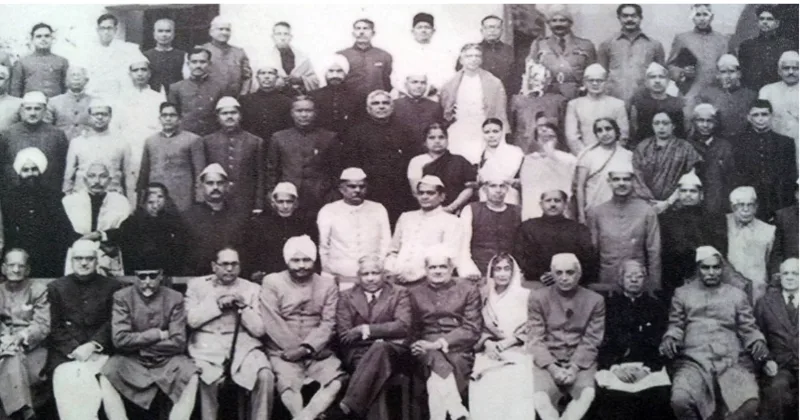
Members of the Constituent Assembly

Members of the Constituent Assembly

FacebookTwitterWhatsAppTelegramEmail

Debates on Uniform Civil Code in Constituent Assembly and the issues related to it were discussed at length at the Constituent Assembly on November 23, 1948. BR Ambedkar, KM Munshi and Alladi Krishnaswamy Ayyar were among those who were in favour of the UCC while the Muslim members of the constituent assembly were against it.

Opposing Arguments by Muslim Members

First, the Muslim members spoke and moved several amendments to Article 35, which had provisions related to a Uniform Civil Code. Muhammad Ismail, Naziruddin Ahmad, Mahboob Ali Baig Sahib Bahadur, Hussain Imam were among those who moved these amendments.

Naziruddin Ahmad moved the amendment, saying, “That to Article 35, the following provison be added, namely: ‘Provided that the personal law of any community which has been guaranteed by the statute shall not be changed except with the previous approval of the community, ascertained in such manner as the Union Legislature may determine by law’.”

“In moving this,” added Ahmad, “I do not wish to confine my remarks to the inconvenience felt by the Muslim community alone. I would put it on a much broader ground. In fact, each community…has certain religious laws, certain civil laws inseparably connected with religious beliefs and practices. I believe that in framing a uniform draft code these religious laws or semi-religious laws should be kept out of its way.”

Moving another amendment, Muhammad Ismail, the Muslim member from Madras, said, “I move that the following proviso be added to Article 35: ‘Provided that any group, section or community of people shall not be obliged to give up its own personal law in case it has such a law’.”

“The right of a group or a community of people to follow and adhere to its own personal law is among the fundamental rights and this provision should be made amongst the statutory and justiciable fundamental rights,” Ismail said.

“The right to follow personal law is part of the way of life of those people who are following such laws; it is part of their religion and culture. If anything is done affecting the personal laws, it will be tantamount to interference with the way of life of people who have been observing these laws for generations. This secular state which we are trying to create should not do anything to interfere with the way of life and religion of the people,” he added.

The counter-argument by B.R. Ambedkar, K.M. Munshi and Alladi Krishnaswamy Ayyar.

Strongly favouring a Uniform Civil Code, Ambedkar said, “I think most of my friends who have spoken on this amendment have quite forgotten that up to 1935 the North West Frontier Province was not subject to the Sharia. It followed the Hindu Law in the matter of succession and in other matters, so much so that it was in 1939 that the Central Legislature had to come… And abrogate the application of Hindu Law to Muslims of the North West Frontier Province and to apply the Sharia to them.”

He further added, “I quite realise their feelings in the matter, but I think they have read rather too much into Article 35, which merely proposes that the state shall endeavour to secure a civil code for the citizens of the country.”

Munshi, meanwhile, said: “Look at the disadvantages that you will perpetuate if there is no Civil Code. Take for instance the Hindus. We have the law of Mayukha applying in some parts of India, we have Mithakshara in others, and we have the Dayabagha law in Bengal. In this way, even the Hindus themselves have separate laws and most of our provinces and states have started making separate Hindu law for themselves. Are we going to permit this piecemeal legislation on the ground that it affects the personal law of the country? It is therefore not merely a question for minorities, but also affects the majority.”

“This attitude perpetuated under the British rule that personal law is part of religion has been fostered by British courts. We must, therefore, outgrow it,” exhorted Munshi.

“If I may just remind the honourable member who spoke last of a particular incident from Fereshta, which comes to my mind, Allauddin Khilji made several changes to the Sharia… The Kazi of Delhi objected to some of his reforms, and his reply was, ‘I am an ignorant man and I am ruling this country in its best interests. I am sure, looking at my ignorance and my good intentions, the Almighty will forgive me, when he finds that I have not acted according to the Sharia’. If Allauddin could not, much less can a modern government accept the proposition that religious rights cover personal law or several other matters which we have been unfortunately trained to consider as part of our religion.”

Speaking in favour of a Uniform Civil Code and opposing the amendments proposed by the Muslim members, Alladi Krishnaswamy Ayyar said, “The second objection was that religion was in danger, that communities cannot live in amity if there is to be a uniform civil code. The article actually aims at amity. It does not destroy amity. The idea is that differential systems of inheritance and other matters are some of the factors which contribute to the differences among the different peoples of India. What it aims at is to try to arrive at a common measure of agreement in regard to these matters.”

At the end of the arguments, the members voted overwhelmingly in favour of a Uniform Civil Code being part of the Constitution.

Topics: BR AmbedkarConstituent AssemblyKM MunshiAlladi Krishnaswamy Ayyar
ShareTweetSendShareSend
✮ Subscribe Organiser YouTube Channel. ✮
✮ Join Organiser's WhatsApp channel for Nationalist views beyond the news. ✮
Previous News

Panch-Parivartan: Nurturing roots of republic

Next News

Birth Anniversary of Rani Gaidinliu: Daughter of the hills who played a pivotal role in the freedom struggle 

Related News

Dr Ambedkar: The architect who prevented India from becoming a communist state

Ambedkar’s Views on Islam in Focus at ‘Naanu Kafir’ Book Launch

Karnataka: ‘Naanu Kafir’ book launch in Bengaluru triggers debate on Ambedkar’s views on Islam and freedom of speech

The then-President Dr Rajendra Prasad and other leaders attending the opening of Somnath Mandir in Gujarat

1000 years of Somnath Attack: Unconquered soul of Bharat

Prime Minister Narendra Modi at Somnath Mandir

“Somnath defined by unbreakable courage of children of Bharat Mata”: PM Modi on 1000 years of invasion of temple

Constituent Assembly (File Image)

Inside the Constituent Assembly: The committees, minds and milestones

How Nehru Torpedoed Vande Mataram: The Untold Story

Load More

Latest News

India Deploys 12 Nuclear Warheads: Heralds doctrinal shift to script strategic deterrence against multi-front threat

J&K: Zojila tunnel clears key hurdle; Signals new era of connectivity for Ladakh

How Cockroach politics is hollowing out Bharatiya democratic culture

RSS centenary year is a time for renewed resolve and greater commitment to nation-building: Dr Mohan Bhagwat

Ex-DMK Minister Senthil Balaji (Right Side-File Photo)

Tamil Nadu: CBI books Rs 397 cr transformer tender scam from ex-DMK Minister Senthil Balaji’s tenure (2021-2023)

Border Security Force (BSF) officials inspect the Single Row Fencing (SRF) at a Border Out Post area (India-Bangladesh border)

Infiltration and Border Management: Saving the Siliguri corridor

External Affairs Ministry spokesperson Randhir Jaiswal, slams Pakistan over the recent killings in POJK

‘Hope Pakistan is held accountable’: India reacts after 20 killed in Pakistan Occupied Jammu & Kashmir

China’s anti-BLA offensive hits snag as UN members demand proof

UN Setback for China and Pakistan: US and allies stall move to ban Baloch Liberation Army

West Asia Conflict: Collective response to energy crisis

Atul Limaye Ji Sah Sarkaryavah, Rashtriya Swayamsevak Sangh while addressing a Pramukh Jan Gosthi Rashtriya at Raipur, Chhattisgarh

Chhattisgarh: Society must lead its own transformation through collective initiative: Atul Limaye

Load More
  • Privacy
  • Terms
  • Cookie Policy
  • Refund and Cancellation
  • Delivery and Shipping

© Bharat Prakashan (Delhi) Limited.
Tech-enabled by Ananthapuri Technologies

  • Home
  • Search Organiser
  • Bharat
    • Assam
    • Bihar
    • Chhattisgarh
    • Jharkhand
    • Maharashtra
    • View All States
  • World
    • Asia
    • Africa
    • North America
    • South America
    • Europe
    • Australia
  • Editorial
  • Operation Sindoor
  • Opinion
  • Analysis
  • Defence
  • Culture
  • Sports
  • Business
  • RSS @ 100
  • Entertainment
  • More ..
    • Sci & Tech
    • Vocal4Local
    • Special Report
    • Education
    • Employment
    • Books
    • Interviews
    • Travel
    • Health
    • Politics
    • Law
    • Economy
    • Obituary
  • Subscribe Magazine
  • Read Ecopy
  • Advertise
  • Circulation
  • Careers
  • About Us
  • Contact Us
  • Policies & Terms
    • Privacy Policy
    • Cookie Policy
    • Refund and Cancellation
    • Terms of Use

© Bharat Prakashan (Delhi) Limited.
Tech-enabled by Ananthapuri Technologies