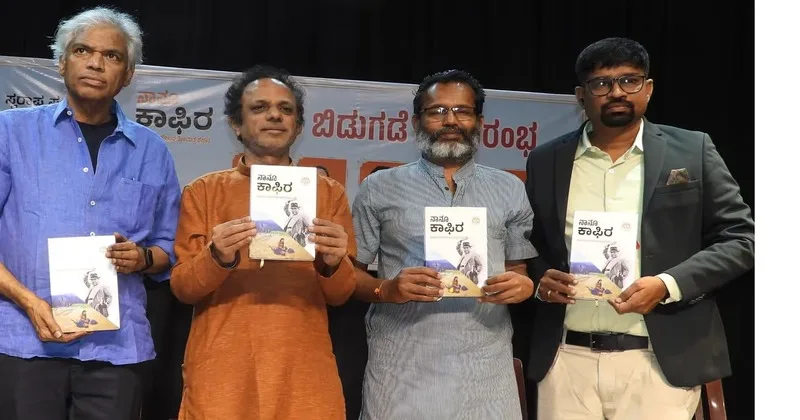
BENGALURU: The launch of the Kannada book “Naanu Kafir” (Me Kafir) in Bengaluru has sparked a strong intellectual debate around the views of B. R. Ambedkar on Islam, freedom of expression and the need to examine historical writings without fear or political bias. Speakers at the event argued that Ambedkar had expressed critical views on various religions, including Islam, and that such discussions should be examined in an academic and historical context.
The book, authored by Dr. Sudhakar Hosalli and published by Swarashtra Prakashana, was released at a programme held at Suchitra Cinema Academy in Banashankari. Writers, scholars and members of literary organisations attended the event and discussed Ambedkar’s writings on religion, social reform and constitutional values.
Speaking on the occasion, poet and novelist Dr. G.B. Harish said the book presents Ambedkar’s observations on Islam with courage and intellectual honesty. According to him, there is often hesitation in society when it comes to discussing sensitive religious issues, but Ambedkar had addressed them openly during his time.
Harish pointed out that Ambedkar, while studying different religions during his search for social justice and equality, had critically examined Islam as well. In his writings, Ambedkar had observed that certain social practices and political interpretations of Islam created challenges for social harmony and national unity. He had also analysed the historical relationship between religion and politics in Islamic societies.
Ambedkar’s views on Islam were extensively discussed in his writings such as “Pakistan or the Partition of India,” where he examined issues like communal politics, social structures and the role of religious identity in political mobilisation. According to Harish, these writings reflected Ambedkar’s attempt to study religions from a sociological and political perspective rather than from a purely theological standpoint.
Harish also said that the book attempts to highlight these lesser-discussed aspects of Ambedkar’s intellectual legacy. “There is a climate of fear in society when it comes to speaking about certain truths. However, Ambedkar never hesitated to examine social realities critically. This book brings attention to those aspects of his writings,” he said.
The speaker added that the Hindu society which produced thinkers like Swami Vivekananda and Ambedkar should not feel hesitant to discuss complex issues openly. According to him, constitutional values remain one of the strongest tools for protecting India’s cultural and civilisational traditions.
Renowned theatre personality Prakash Belawadi said that the concept of “insider criticism” has always been part of Indian intellectual tradition. He argued that thinkers within the civilisation have historically questioned social practices and religious interpretations in order to bring reform.
Belawadi also said that many followers of Ambedkar have confined his legacy only within the framework of caste politics. “Ambedkar was a thinker who wrote on economics, federalism, religion and governance. We must understand him in a broader intellectual sense,” he said.
According to him, society must rediscover Ambedkar beyond the narrow boundaries of identity politics and recognise the depth of his scholarship on social and political issues.
Narayan Shevire, State Organising Secretary of the Akhil Bharatiya Sahitya Parishad, said there continues to be an environment where people are instructed on how to speak about Ambedkar. In such a situation, he said, the publication of books that present his original writings and interpretations becomes important.
He noted that the emergence of such works in Kannada literature shows that intellectual debates are expanding in the state. “Books like this encourage readers to engage with Ambedkar’s writings directly rather than relying on selective interpretations,” he said.
Author Dr. Sudhakar Hosalli said that over the years several individuals have spread incorrect claims by attributing statements to Ambedkar without proper references. However, he said the trend is changing as researchers increasingly cite original texts with page numbers and documented sources.
Hosalli said the purpose of the book is to encourage readers to study Ambedkar’s writings in their original form and understand his views on religion, society and politics in a historical context.