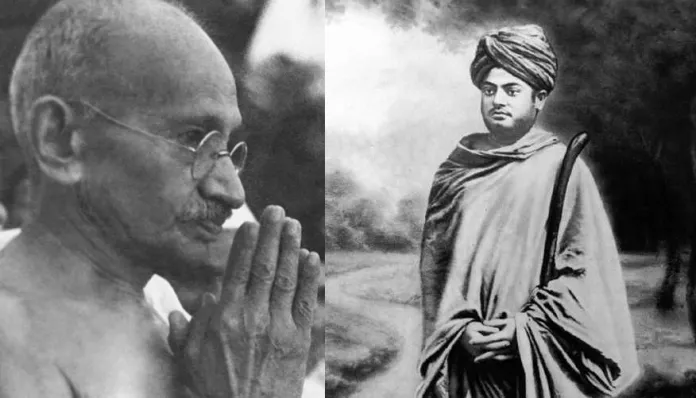
Swami Vivekananda and Mahatma Gandhi are two towering figures who have profoundly influenced and inspired generations both during and after their lifetimes. Swami Vivekananda, born on 12 January 1863, and Mahatma Gandhi, born on 2 October 1869, were somewhat contemporaneous. However, since Swami Vivekananda passed away at a young age of just 39 years and 5 months in 1902, he revolutionized the Indian freedom movement, spreading the message of Vedanta and Indian wisdom to a global audience. During this period, Mahatma Gandhi was in South Africa, making occasional visits to India. He focused on building his career and advocating for the rights of the Indian community in Africa.
The relationship between Swami Vivekananda and Mahatma Gandhi is seldom discussed or written about. The connection they shared, the influence the Swami had on the Mahatma, and how Gandhi perceived Vivekananda’s teachings and work remain largely unexplored.
In 1893, both Swami Vivekananda and Mahatma Gandhi left India for different purposes. Swami Vivekananda travelled to Chicago, America to participate in the World Parliament of Religions, while Mahatma Gandhi went to South Africa to work as a lawyer. It should be made clear that Swami Vivekananda was unaware of who Gandhi was, as the latter was abroad and had not yet gained widespread recognition. However, Swami Vivekananda had already achieved considerable fame and respect both in the Western world and at home, with admirers and followers spread across every continent. Meanwhile, Gandhiji, who was in South Africa at the time, was well acquainted with the Swami and his teachings.
The collected works of Mahatma Gandhi, spanning 98 volumes and available online, reveal several facts and insights that demonstrate the close connection between Gandhi and Swami Vivekananda. Although they never met in person, Gandhi had a deep desire to meet the Swami. He regularly read Vivekananda’s literary works, studied his teachings, and visited the Ramakrishna Mission, which was founded by the Swami, on numerous occasions. Gandhi also delivered speeches about Swami Vivekananda, quoting him and incorporating his teachings into lectures and letters on a wide range of subjects. Through these primary documents of Mahatma Gandhi, we gain insight into the untold legacy of these two great figures of India.
Gandhi wanted to meet the Swami
There were two instances when Swami Vivekananda and Mahatma Gandhi could have met. The first occurred in 1898, when Gandhiji expressed his desire for Swami Vivekananda to visit South Africa and preach his spiritual message there. This is revealed in a letter that Gandhiji wrote to his friend Mr. B. N. Bhajekar in February 1898, in which he stated:
“A religious preacher is very badly wanted here but he must tower above all the priests here. He must be absolutely pure minded and unselfish & must not require money to support him…………Could not Swami himself be induced to pay us a visit? I shall do everything I can to make his mission a success. He can work both among Indians & Europeans. I take it he moves freely among the Indians the highest as well as the lowest. He is sure to do one thing if he comes. He will electrify the Europeans by his eloquence & possibly hypnotize [sic] them into liking the ‘Coolies’ in spite of themselves. ………….. I very rarely write unreservedly but I thought this was one of those occasions when it is allowed to & even obligatory on a man to throw off his reserve. You may place this letter before the Swami if you so wish it.”
However, it is not clear whether Mahatma Gandhi’s letter ever reached Swami Vivekananda, but it is certain that the Swami never visited South Africa. The second instance occurred a couple of years later, when Gandhiji was in India for a few months and visited Calcutta in 1901. Gandhiji was eager to meet the Swami, and to do so, he went to Belur Math. However, since the Swami was unwell, they could not meet. In The Story of My Experiments with Truth, Gandhi writes: “Having seen enough of the Brahmo Samaj, it was impossible to be satisfied without seeing Swami Vivekanand. So with great enthusiasm I went to Belur Math, mostly, or maybe all the way, on foot. I loved the sequestered site of the Math. I was disappointed and sorry to be told that the Swami was at his Calcutta house, lying ill, and could not be seen”.
In both of these instances, despite Gandhiji’s strong desire to meet the Swami, he was unable to do so. The second instance was especially close, as Gandhiji was in Calcutta and went to Belur Math, but the Swami’s illness and his absence at the time prevented their meeting.
Gandhi reading Swami Vivekananda writings
To truly know someone, their writings play a crucial role, and this was certainly the case for Gandhiji in his understanding of Swami Vivekananda. Through the Swami’s literature, Gandhiji came closer to India’s cultural traditions and wisdom. Rajyoga, the only book that Swami Vivekananda wrote during his first visit to the West, was a work that Gandhiji kept with him throughout his life. In a letter to Tiruppur Subrahmanya Avinashilingam (1903–1991) on July 22, 1941, Gandhiji expressed his thoughts on the Swami’s writings, where he wrote: “Surely Swami Vivekananda’s writings need no introduction from anybody. They make their own irresistible appeal.”
Gandhiji, who began reading Rajyoga during his days in South Africa, continued to study it throughout his life. Even as late as 1923, he noted in his Jail Diary on September 28 (Friday) that he had completed reading Swamiji’s Rajyoga. Later, in 1932, Gandhiji turned to the biographies of Swami Vivekananda, titled “The Life of Vivekananda”, and his Guru, Sri Ramakrishna Paramhansa, in “The Life of Ramakrishna”, both written by Nobel laureate Romain Rolland. In May 1932, Gandhiji mentioned this in a letter to Kusum Desai, writing, “If you intend to write to Pyarelal, inform him that I am still reading Ramakrishna’s and Vivekananda’s books. I will send them over to Rameshwardas when I finish them.”
The significance and impact of Swami Vivekananda’s work on Gandhiji can be seen in the speech Gandhiji delivered at Belur Math, the headquarters of the Ramakrishna Mission, in 1921. Gandhiji said, “I have gone through his works very thoroughly, and after having gone through them, the love that I had for my country became a thousand fold. I ask you, young men, not to go away empty-handed, without imbibing something of the spirit of the place where Swami Vivekananda lived and died”.
Mahatma Gandhi Visits to Ramakrishna Mission
To express his admiration for Swami Vivekananda and his Guru Sri Ramakrishna, Gandhiji visited the Ramakrishna Mission, an organization founded by the Swami on May 1, 1897. In addition to Belur Math in Calcutta, Gandhiji visited several other centres of the mission, including Vrindavan and Rangoon, among others. While delivering a speech at the Ramakrishna Mission in Rangoon (1929) on the special occasion of the birth anniversary celebration of Sri Ramakrishna Paramhansa, Gandhiji said:
“My Sisters and Brothers, I thank the Ramakrishna Mission for the address they have so kindly presented to me. I want to tell you something about Ramakrishna Paramahamsa and his mission. He has left for us a great work. I have faith in his mission and I would ask you to follow him. Wherever I go the followers of Ramakrishna invite me and I know their blessings are on my work. Ramakrishna Sevashrams (people’s service centres) and Hospitals are spread throughout India. There is no such place where their work is not being carried on a small or large scale. Hospitals are opened and the poor are given medicine and treatment. I do not like to say much because I have hardly any time at my disposal. When I remember Ramakrishna’s name I cannot forget Vivekananda. Sevashrams have been largely spread by Vivekananda’s activity and it was he who made his Master known throughout the world. I pray to God to increase such Sevashrams. I hope such people will join them who are pure and who have love for India. Let them do the work inspired with the love of India”.
Gandhiji’s words about Swami Vivekananda, his Guru Sri Ramakrishna, and the Ramakrishna Mission reflect his deep admiration and respect for them. In addition to the aforementioned information about Swamiji and Mahatma Gandhi, there is much more revealed in the 98 collected works of Mahatma Gandhi. These works include Gandhiji recommending literature based on Swami Vivekananda to his foreign friends, advocating Swami Vivekananda’s teachings in public lectures, and visiting societies and organizations named after the great saint. This has been documented in my book titled “Influence of the Ramakrishna-Vivekananda Movement on Gandhi”. Thus, the relationship between these two titans of India should also influence and inspire academicians, scholars, and others who read and write about them, encouraging them to develop a more holistic understanding of both.
(Dr. Nikhil Yadav is the Deputy Head of Vivekananda Kendra, North Zone, holds a Ph.D. from JNU, New Delhi and is the writer of the book “Influence of the Ramakrishna-Vivekananda Movement on Gandhi” )