Manusmriti, Savarkar, and Ambedkar: Unveiling the truth behind historical narratives & modern misinterpretations
September 30, 2026
  • Read Ecopy
  • Circulation
  • Advertise
  • Careers
  • About Us
  • Contact Us
Android AppiPhone AppArattai
Organiser
  • ‌
  • Bharat
    • Assam
    • Bihar
    • Chhattisgarh
    • Jharkhand
    • Maharashtra
    • View All States
  • World
    • Asia
    • Europe
    • North America
    • South America
    • Africa
    • Australia
  • Editorial
  • International
  • Opinion
  • RSS @ 100
  • More
    • World Hindu Congress 2026
    • Op Sindoor
    • Analysis
    • Sports
    • Defence
    • Politics
    • Business
    • Economy
    • Culture
    • Special Report
    • Sci & Tech
    • Entertainment
    • G20
    • Azadi Ka Amrit Mahotsav
    • Vocal4Local
    • Web Stories
    • Education
    • Employment
    • Books
    • Interviews
    • Travel
    • Law
    • Health
    • Obituary
  • Subscribe
    • Subscribe Print Edition
    • Subscribe Ecopy
    • Read Ecopy
  • ‌
  • Bharat
    • Assam
    • Bihar
    • Chhattisgarh
    • Jharkhand
    • Maharashtra
    • View All States
  • World
    • Asia
    • Europe
    • North America
    • South America
    • Africa
    • Australia
  • Editorial
  • International
  • Opinion
  • RSS @ 100
  • More
    • World Hindu Congress 2026
    • Op Sindoor
    • Analysis
    • Sports
    • Defence
    • Politics
    • Business
    • Economy
    • Culture
    • Special Report
    • Sci & Tech
    • Entertainment
    • G20
    • Azadi Ka Amrit Mahotsav
    • Vocal4Local
    • Web Stories
    • Education
    • Employment
    • Books
    • Interviews
    • Travel
    • Law
    • Health
    • Obituary
  • Subscribe
    • Subscribe Print Edition
    • Subscribe Ecopy
    • Read Ecopy
Organiser
  • Home
  • Bharat
  • World
  • Operation Sindoor
  • Editorial
  • Analysis
  • Opinion
  • Culture
  • Defence
  • International Edition
  • RSS @ 100
  • Magazine
  • Read Ecopy
Home Bharat

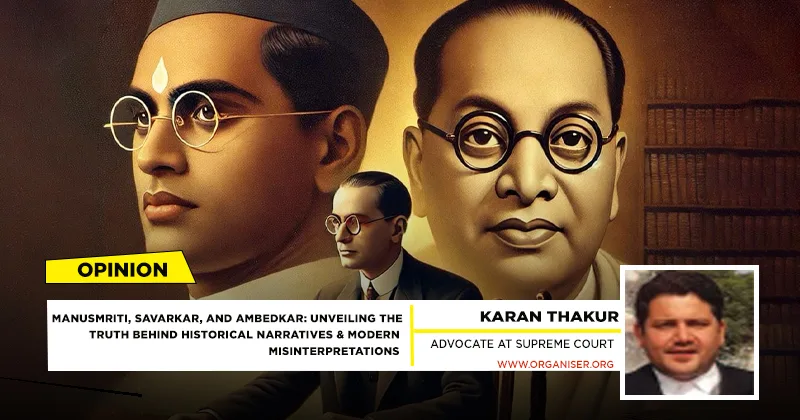
Manusmriti, Savarkar, and Ambedkar: Unveiling the truth behind historical narratives & modern misinterpretations

The narratives of the Manusmriti, Vinayak Damodar Savarkar, and Dr B R Ambedkar reveal efforts to challenge caste discrimination and promote social reform. Misinterpretations, especially from colonial influences, have obscured their true contributions to Bharat's unity and justice

Adv Karan ThakurAdv Karan Thakur
Jan 5, 2025, 11:00 am IST
inBharat, Opinion
Follow on Google News
Facebook
Twitter
WhatsAppTelegramEmail

Bharat’s rich and complex history has often been subjected to various interpretations, some of which have been shaped by colonial influence, ideological biases, and political agendas. Among the most misrepresented elements in Bharat’s cultural history are the Manusmriti, the contributions of Vinayak Damodar Savarkar, and Dr B R Ambedkar’s engagement with social reform. The narratives surrounding these figures have been clouded by modern interpretations, often distorting their true essence. This article seeks to uncover the truth behind these historical figures and their connections to Bharat’s caste system, social justice, and the path to a more unified and equitable society.

The Manusmriti: A Misunderstood Text

The Manusmriti, often vilified as a code that sanctioned caste discrimination, has been the subject of much debate. While it is true that the text contains guidelines for societal order, it is crucial to understand its original context and purpose. The Manusmriti was never a legal code in the way we understand modern laws; rather, it was a Dharmashastra—a philosophical and academic treatise on the concepts of Dharma (righteousness or duty). Contrary to popular belief, it was not a codified law book meant to govern kingdoms, nor was it intended to enforce rigid social stratification.

The text has been misinterpreted, especially by British colonialists who sought to use it as a tool for dividing Bharatiya society. The British, unfamiliar with the nuances of Bharatiya thought, translated the term “Varna” (which referred to a flexible classification based on occupation and qualities) as “caste,” thereby solidifying rigid social hierarchies. This colonial misinterpretation introduced a view of caste that was not originally inherent to Hindu society.

The British Role in Misrepresenting the Manusmriti

In the 18th century, the British sought to impose a common legal framework for Bharat, a land with diverse cultures, languages, and philosophies. In their effort, they misunderstood the concept of “Dharma” and translated it as “law,” which led to the incorrect notion that texts like Manusmriti were legal codes. British translations, often done by figures like Sir William Jones, misrepresented the fluid and context-driven nature of the text.

Rather than an endorsement of caste-based oppression, Manusmriti was a reflection on societal order and moral conduct. However, it was used by the British to divide and conquer Bharatiya society, fostering a rigid caste system that had not been as prevalent prior to colonial intervention. This misinterpretation persists today and is often used by various political groups to project a view of Hinduism that is out of step with its philosophical foundations.

Savarkar’s Vision: Eradicating Untouchability

Vinayak Damodar Savarkar, a prominent nationalist leader, revolutionized how Hindus viewed themselves and their society. Unlike the British colonialists who exploited caste for political gain, Savarkar sought to transcend caste divisions by advocating for Hindu unity. His vision was that of an inclusive Hindu society where caste divisions were not seen as insurmountable.

Savarkar’s work in social reform, especially his efforts to eradicate untouchability, is often overlooked in contemporary debates. He was deeply moved by the plight of the Dalits and worked tirelessly to improve their social standing. One of the most significant actions was his support for inter-caste dining and the opening of temples for Dalits, which were revolutionary at the time. Savarkar also founded the Patit Pawan Temple in Ratnagiri, where Dalits were allowed to perform religious rituals—a direct challenge to the prevailing caste orthodoxy.

His efforts were not limited to religious reform; he also worked to provide Dalits with practical skills, thus empowering them economically. Savarkar’s leadership in transforming Ratnagiri is a testament to his commitment to social justice, showing that true social reform can only be achieved by removing the barriers of caste and untouchability.

Ambedkar and Manusmriti: A Complex Engagement

Dr B R Ambedkar’s relationship with the Manusmriti is often reduced to the symbolic act of burning the text in 1927, seen as a denunciation of the caste system. While this act was undeniably significant, it did not outright reject all the ideas in the Manusmriti. Ambedkar’s engagement with the text was far more nuanced.

In his speeches and writings, Ambedkar acknowledged the progressive elements of the Manusmriti, particularly its provisions on women’s rights, such as inheritance. He emphasized that he was not merely fighting against the oppressive practices but seeking to restore the original provisions that gave women more rights. In his speech in the Constituent Assembly, Ambedkar referred to the Manusmriti’s provisions on inheritance rights for women, suggesting that his reforms in the Hindu Code Bill were in line with the original spirit of the Smritis.

Ambedkar’s engagement with Manusmriti was thus both critical and constructive. He did not view the text as an absolute source of law but rather as a reflection of certain values that could be interpreted and modernized. His rejection of the caste system was not a rejection of the entire Hindu tradition, but a call for reform within it—a call that sought to address the inequalities entrenched by both colonial rule and centuries of social oppression.

The Need for a Balanced View of Bharat’s History

The narratives surrounding Manusmriti, Savarkar, and Ambedkar have been manipulated to fit various ideological agendas. It is essential to reclaim the historical truth by recognizing the complexity of these figures and their contributions to Bharatiya society.

Manusmriti should be viewed not as a rigid legal code but as a philosophical treatise that offers insights into society’s moral and ethical governance. While the caste system was present in various forms, it was not as rigid and oppressive as it became under British colonial rule.

Savarkar’s vision of a united Hindu society, free from caste-based discrimination, is often overlooked in favour of his more controversial political ideas. His work in eradicating untouchability and promoting social reforms should be acknowledged as a pivotal part of Bharat’s fight for social justice.

Ambedkar’s engagement with Manusmriti reflects his deep understanding of the text’s contradictions. While he rejected certain aspects, he also saw the potential for reform within it. His efforts to create a more equitable society by drafting the Bharatiya Constitution are an extension of his belief in the need for social transformation.

In conclusion, the historical narratives of Manusmriti, Savarkar, and Ambedkar should be viewed through an understanding lens that appreciates the complexities of their ideas and the contexts in which they operate. The contemporary misinterpretations of these figures serve only to divide rather than unite. A balanced approach to Bharat’s history, recognizing its achievements and shortcomings, is essential for fostering a more just and harmonious society.

Topics: Vinayak Damodar Savarkarsavarkarcaste discriminationManusmritiDharmashastraAmbedkar
Share5
Tweet
SendShareSend
✮ Subscribe Organiser YouTube Channel. ✮
✮ Join Organiser's WhatsApp channel for Nationalist views beyond the news. ✮
Previous News

Jharkhand: NIA searches multiple locations linked with over ground workers of CPI (Maoist), key accused nabbed

Next News

“11-member SIT has been formed, will complete investigation in 4 weeks”: Chhattisgarh DyCM on Journalist murder

Related News

The SC/ST Act protects against caste-based atrocities, but its implementation must remain rooted in evidence and due process

SC/ST Act and Legal Advocacy: How prejudice and unsubstantiated claims can complicate cases and undermine justice

Sahil Wakode’s death at IIT Bombay has sparked debate over exam discipline, caste allegations and due process

IIT Bombay Tragedy: When discipline becomes “harassment”, and propaganda replaces facts

Madras High Court

Untouchability has no place in Mandir: Madras HC reaffirms Samajik Samarasata

(Left) VHP National President Vinod Bansal (Right) Congress Leader Rahul Gandhi

‘Why target only Hindu texts?’ VHP challenges Rahul Gandhi over Manusmriti remarks

Punjab’s rural religious landscape is shifting as Pentecostal churches gain ground among Dalit communities

From Gurdwaras to Pentecostal Churches: Understanding the changing religious landscape of rural Punjab

Outcry grows after Dalits in Theeyathur village carry deceased woman across paddy fields due to lack of burial access

Tamil Nadu: Dalits forced to carry deceased woman through paddy fields as Pudukkottai village lacks road access

Load More

Latest News

Asian Games 2026: India Wins Women’s 4x400m Gold; Pahal, Poovamma, Prachi, Vithya Shine

Asian Games 2026: How India’s women’s 4x400m relay team scripted Asian Games Glory; PM Modi hails the team

ABVP-led DUSU submits memorandum to Chief Minister on construction of hostels, safety audits, women’s safety and compensation for families affected by Satya Niketan incident

ABVP-led DUSU submits memorandum to Delhi CM on construction of hostels, safety audits, women’s safety

AI Generated Representative Image

India’s Himalayan Shield against China: Strategic Connectivity, tech & air power, civilian fusion to fortify security

IMK-JMB Expansion Plot? NIA Arrests 13, Searches 16 Locations

IMK-JMB Terror Conspiracy: NIA raids 16 locations, arrests 13 in Assam, Bengal, Keralam

Telangana CM Revanth Reddy Speaking at the Pratidin Conclave of an Assam daily in Delhi on September 29, 2026 (Left)

Telangana: Congress faces fire over CM Revanth Reddy’s Ram-Shiva remarks and North-South divide

Why Did Saleng Sangma Seek Foreign Appeals on FCRA Bill?

FCRA Amendment Bill: Meghalaya Congress MP sought foreign countries intervention to put pressure on government of India

Israel PM Benjamin Netanyahu and the President of UAE Sheikh Mohamed bin Zayed

Israel PM Netanyahu Visits UAE: Decoding the strategic stakes behind the surprise trip amid West Asia conflict

(From R to L)
Advocate Jayanta Kumar Bhowal, Secretary, ABGP West Bengal Prant
Sandip Banerjee, Secretary, ABGP Kolkata District,
Advocate Anjan Sinha, Sangathan Mantri, ABGP West Bengal Prant,
Prof. Dr. Pankaj Kumar Roy, President, ABGP West Bengal Prant,
Tushar Mukherjee, Treasurer, ABGP West Bengal Prant

Akhil Bharatiya Grahak Panchayat slams violent disruption of its programme on consumer awareness at SRFTI in Kolkata

DUSU 2026: Gen Z gives verdict – Credibility is the key

Bhagwan Sahay, Sah Sangathan Mantri of Akhil Bharatiya Vanvasi Kalyan Ashram, addressing the gathering at IGNCA to mark release of Janajati Sanskritik Samagam Special Issue, which highlighted contributions of Janjatiya heroes

The forests have always been centres of knowledge: Bhagwan Sahay

Load More
  • Privacy
  • Terms
  • Cookie Policy
  • Refund and Cancellation
  • Delivery and Shipping

© Bharat Prakashan (Delhi) Limited.
Tech-enabled by Ananthapuri Technologies

  • Home
  • Search Organiser
  • Bharat
    • Assam
    • Bihar
    • Chhattisgarh
    • Jharkhand
    • Maharashtra
    • View All States
  • World
    • Asia
    • Africa
    • North America
    • South America
    • Europe
    • Australia
  • Editorial
  • Operation Sindoor
  • Opinion
  • Analysis
  • Defence
  • Culture
  • Sports
  • Business
  • RSS @ 100
  • Entertainment
  • More ..
    • Sci & Tech
    • Vocal4Local
    • Special Report
    • Education
    • Employment
    • Books
    • Interviews
    • Travel
    • Health
    • Politics
    • Law
    • Economy
    • Obituary
  • Subscribe Magazine
  • Read Ecopy
  • Advertise
  • Circulation
  • Careers
  • About Us
  • Contact Us
  • Policies & Terms
    • Privacy Policy
    • Cookie Policy
    • Refund and Cancellation
    • Terms of Use

© Bharat Prakashan (Delhi) Limited.
Tech-enabled by Ananthapuri Technologies