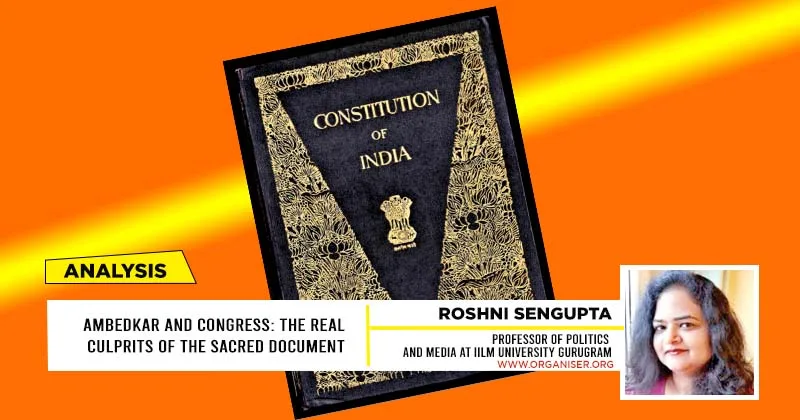
The controversy around whether or not the incumbent Government led by the BJP is guilty of attempting to change the Constitution is one that refuses to die down. Some of the charges made by the Opposition I.N.D.I. Alliance led by the Congress are almost laughable but sanity demands a serious consideration of the larger charge being levelled. So, is the Government trying to change the Constitution? The answer is a resounding no and let me explain why. I will do so with the help of two key instances from Bharat’s contemporary political history.
How Congress betrayed Constitution
The first is the almost insidious insertion of the words ‘secular’ and ‘socialist’ in the Preamble of the Constitution in 1976. Prime Minister Indira Gandhi introduced the two words for pure political expediency through the 42nd Constitutional Amendment, wherein the word ‘socialist’ was added to send out a clear political message that she and her Government stood for the poor. The word ‘secular’ was obviously meant to jettison support from the minorities, primarily in view of the birth control programmes of the Emergency period which had disproportionately affected the Muslims. Therefore, it was not as if the Constitution did not care about citizens of other faiths before the words were added. Bharat is a pluralistic civilisation and the modern state has espoused social welfarism even before the 42nd Amendment and continues in the same vein after it.
What is even more devious is that the words were added to the Preamble to the Constitution even as the Kesavananda Bharati vs. State of Kerala case just three years prior – in 1973 – had established firmly where the SC stood with regard to the basic structure doctrine. In including ‘secular’ and ‘socialist’ in the Preamble, the basic structure itself was sought to be amended.
It is also imperative that we understand the meaning of the word ‘secularism’ – which has a distinct enlightenment era in the European context – as opposed to the singularly Eastern (read Bharatiya) ethos of pluralism. Secularism typically implies a separation of religion from the state, emphasising neutrality and equal treatment of all religions. In a secular framework, religion is often seen as a private matter; the state maintains a neutral stance toward different religions; and religious institutions and practices are separate from state institutions and policies.
The principle of secularism has been – primarily in the context of Bharat – quite distinct from the ‘practice’ of the same, which has primarily been in the form of pandering to the Muslim minority rather than upholding the uniquely Bharatiya principal of a plural society based on Sarva Pantha Samabhava. To clarify, Bharat never really needed the inclusion of European enlightenment thought on secularism. In fact, the relegation of religion to the inner sanctum or private sphere by the colonising British Raj was trenchantly dismissed by figures like Bal Gangadhar Tilak as an attack on the plurality that signified Bharat, advocating for public celebration of religious and cultural festivals like the Ganpati festival and Shivaji Jayanti.
Pluralism, on the other hand, acknowledges and celebrates the diversity of religious, cultural and social traditions within a society. Not only is diversity recognised and valued, different religious and cultural traditions are seen as contributing to the richness. More importantly, the state is allowed to acknowledge and support various religious and cultural practices, without exception. That Bharat remains a pluralistic society is evidenced by the fact that diversity is not just tolerated, but celebrated and valued. The state acknowledges and supports various religious and cultural traditions, rather than maintaining a strict neutrality; and pluralism recognises the interconnectedness of different religious and cultural traditions, whereas secularism often emphasises separation. Pluralism, as a concept, remains true to Bharat’s unique system of tolerance owing to civilisational diversity.
Ambedkar opposed ‘secular’ word in Constitution
BR Ambedkar summarily objected to the inclusion of the word ‘secular’ in the original draft during the Constituent Assembly debates. His objection could be summarised in his acknowledgement of Bharat’s plural character wherein he felt that secularism was inherent to the Constitution’s structure and mentioning it in the preamble would amount to stating the obvious. Furthermore, Dr Ambedkar also was of the firm opinion that the Constitution was a mechanism for the purpose of regulating the work of various organs of the state and the principle and practice of religion fell outside of its purview. He held the firm view that the policies of the state and the organisation of the society are matters which must be decided by the people themselves according to time and circumstances and cannot be laid down in the Constitution itself which would be tantamount to destroying democracy.
BR Ambedkar had objected to the inclusion of the word ‘secular’ in the original draft during the Constituent Assembly debates
The second instance wherein the Constitution was actually under severe strain was the foisting on a supra-Constitutional body – the National Advisory Council – to oversee policy making by the Dr Manmohan Singh-led Union Cabinet more recently in 2004. The Council was – no actual guesses, headed by Sonia Gandhi – and remained the force behind badly conceived and terribly rolled out schemes like the MNREGA and the Food Security Act. Both MNREGA and the Food Security Act notwithstanding, however, the NAC itself can be perceived as nothing more than a command and control centre. As per the Constitution, it is the sole prerogative of the Union Cabinet to frame policy which is then tabled in the lower and upper houses for parliamentary validation. The real requirement, therefore, of a body such as the NAC remains in question. The Congress-led UPA probably envisaged the NAC as a review and feedback committee but the actual role played by it remains unclear, almost shrouded in mystery.
What do we know about the NAC? It was made up of well-known names from academia and the non-governmental sector and was directly serviced by the prime minister’s office (PMO), all expenditure being borne by the central government. It was vested with powers to obtain information from any ministry through the PMO, with its chairperson holding the rank of a union cabinet minister. Since the NAC functioned like a shadow cabinet, it remained sans all responsibility for the policy steps it formulated and sought to be implemented. The Prime Minister, Dr Singh, and his cabinet, therefore, were responsible for policymaking that may or may not have been vetted by him or members of his cabinet. Little or no information was available on the functioning of the NAC before close to 710 files were made public in 2017. The files show how “suggestions” were given by the NAC and officers summoned. File notings clearly reveal Sonia Gandhi’s word was taken as final when it came to recommendations, revelations that gave a fillip to allegations of supra-constitutionality by the BJP.
The largely secret workings of the shadow cabinet NAC remains a significant challenge to the Constitution even as it has largely been unacknowledged, obviously less so by the I.N.D.I. alliance members who run the risk of shooting themselves in the foot if they do and be damned if they don’t, more so in the intensely networked times we live in. Introspection prior to moralistic blade-running is something they need to practice before making inane allegations against the government of the day.