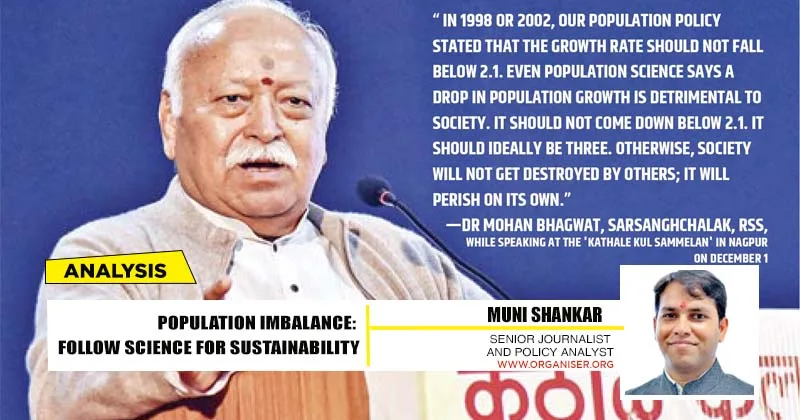
Population Imbalance: Follow science for sustainability
June 15, 2026
  • Read Ecopy
  • Circulation
  • Advertise
  • Careers
  • About Us
  • Contact Us
Android AppiPhone AppArattai
Organiser
  • ‌
  • Bharat
    • Assam
    • Bihar
    • Chhattisgarh
    • Jharkhand
    • Maharashtra
    • View All States
  • World
    • Asia
    • Europe
    • North America
    • South America
    • Africa
    • Australia
  • Editorial
  • International
  • Opinion
  • RSS @ 100
  • More
    • Op Sindoor
    • Analysis
    • Sports
    • Defence
    • Politics
    • Business
    • Economy
    • Culture
    • Special Report
    • Sci & Tech
    • Entertainment
    • G20
    • Azadi Ka Amrit Mahotsav
    • Vocal4Local
    • Web Stories
    • Education
    • Employment
    • Books
    • Interviews
    • Travel
    • Law
    • Health
    • Obituary
  • Subscribe
    • Subscribe Print Edition
    • Subscribe Ecopy
    • Read Ecopy
  • ‌
  • Bharat
    • Assam
    • Bihar
    • Chhattisgarh
    • Jharkhand
    • Maharashtra
    • View All States
  • World
    • Asia
    • Europe
    • North America
    • South America
    • Africa
    • Australia
  • Editorial
  • International
  • Opinion
  • RSS @ 100
  • More
    • Op Sindoor
    • Analysis
    • Sports
    • Defence
    • Politics
    • Business
    • Economy
    • Culture
    • Special Report
    • Sci & Tech
    • Entertainment
    • G20
    • Azadi Ka Amrit Mahotsav
    • Vocal4Local
    • Web Stories
    • Education
    • Employment
    • Books
    • Interviews
    • Travel
    • Law
    • Health
    • Obituary
  • Subscribe
    • Subscribe Print Edition
    • Subscribe Ecopy
    • Read Ecopy
Organiser
  • Home
  • Bharat
  • World
  • Operation Sindoor
  • Editorial
  • Analysis
  • Opinion
  • Culture
  • Defence
  • International Edition
  • RSS @ 100
  • Magazine
  • Read Ecopy
Home Bharat

Population Imbalance: Follow science for sustainability

While population increase can be advantageous, the negative side of the decline in Total Fertility Rate and the rise in the number of senior citizens is a worrisome demographic trend

Muni ShankarMuni Shankar
Dec 9, 2024, 09:30 pm IST
in Bharat, World, Analysis
Follow on Google News
FacebookTwitterWhatsAppTelegramEmail

Before diving into the complexities of declining fertility, imagine a village with 1,000 elderly residents and no youth. Would any company consider investing in such a place? Would it be feasible to plan for the next 50 years? The answer, unsurprisingly, is no. This scenario, though hypothetical, mirrors the realities faced by many countries grappling with sub-replacement fertility—a demographic trend that challenges economic growth and societal structures.

A wide discussion has once again started on the population of Bharat. It is worth noting that in 2023, India left China behind and become the most populous country. That is, India has become a country with more population than the combined population of America, Europe and Africa. While there is a section which sees population as a problem, the other section considers it as a resource for development. Let us try to know what are the scientific reasons behind the increasing population? What does the global experience say in this context?

According to the research report of the United Nations Population Fund (UNFPA), Bharat is going through a phase of demographic dividend. Twenty five per cent of India’s population is in the age group of 0-14 (years), 18 per cent between the age of 10 to 19, 26 per cent in the age group of 10 to 24, 68 per cent between the age group of 15 and 64 and seven per cent of the population is above 65 years of age. Statistics show that India’s population growth rate is on the decline yet due to the large base India’s population will grow for the next three decades to its highest level (in terms of numbers) of 165 crores, after which the phase of decline in Indian population will begin. In any case, it took 75 years for India’s population to double, while the global population took 76 years to increase from four billion to eight billion, that is, India’s population growth rate is close to the global average, which is witnessing a gradual decline.

What was the Objectives of National Population Policy 2000

  • The NPP’s primary goal is to handle unmet healthcare infrastructure, people, and contraception demands.
  • Additionally, it seeks to offer integrated services for primary reproductive and pediatric healthcare.
  • By adopting cross-sectoral working strategies, the medium-term goal is to raise the Total Fertility Rate (TFR) to replacement levels (TFR of 2.1) by 2010.
  • The long-term goal is to stabilise the population by 2045 at a level that satisfies the demands of societal development, environmental preservation, and sustainable economic growth.
  • In 2022, Bharat’s total fertility rate (TFR) was 2.01 children per woman, which is just below the replacement level of 2.1

It is worth noting that India has achieved the replacement level of Total Fertility Rate (TFR) (TFR of 2.0 in 2020). From the declining level of fertility, it can be inferred that women and girls of India are increasingly able to control their reproductive choices. At the same time, a total of 31 States and Union Territories of India (69.7 per cent of the country’s population) are below the replacement rate. The pace of decline in fertility is not the same in all the States of the country. The Southern States started declining TFR much earlier than other States. The global decline in fertility rates is reshaping economies and societies, presenting both unprecedented challenges and opportunities. Total Fertility Rate (TFR), the average number of children a woman is expected to have, is critical for population stability at 2.1. Yet, 55 nations now fall below this threshold, according to UNFPA. South Korea’s record-low of TFR is 0.78 and Italy’s 1.24 exemplify the looming cris of sub-replacement fertility.

55 countries of the world have policies for increasing the TFR , because they have reached at dangerous level of 2.1, which is accepted scientific norm. Bharat is among those countries whose replacement rate is at between 1.9-2.0. Hence, we need a rational, sane discussion on a uniform population policy for all.

Shrinking workforces are at the heart of this issue. OECD projections indicate South Korea’s labour force will shrink by 35 per cent by 2050, while Japan’s will contract by 23 per cent. These declines stifle innovation, reduce tax revenues and threaten global competitiveness. Simultaneously, ageing populations are straining resources, with governments redirecting funds toward pensions and healthcare, exacerbating fiscal imbalances.
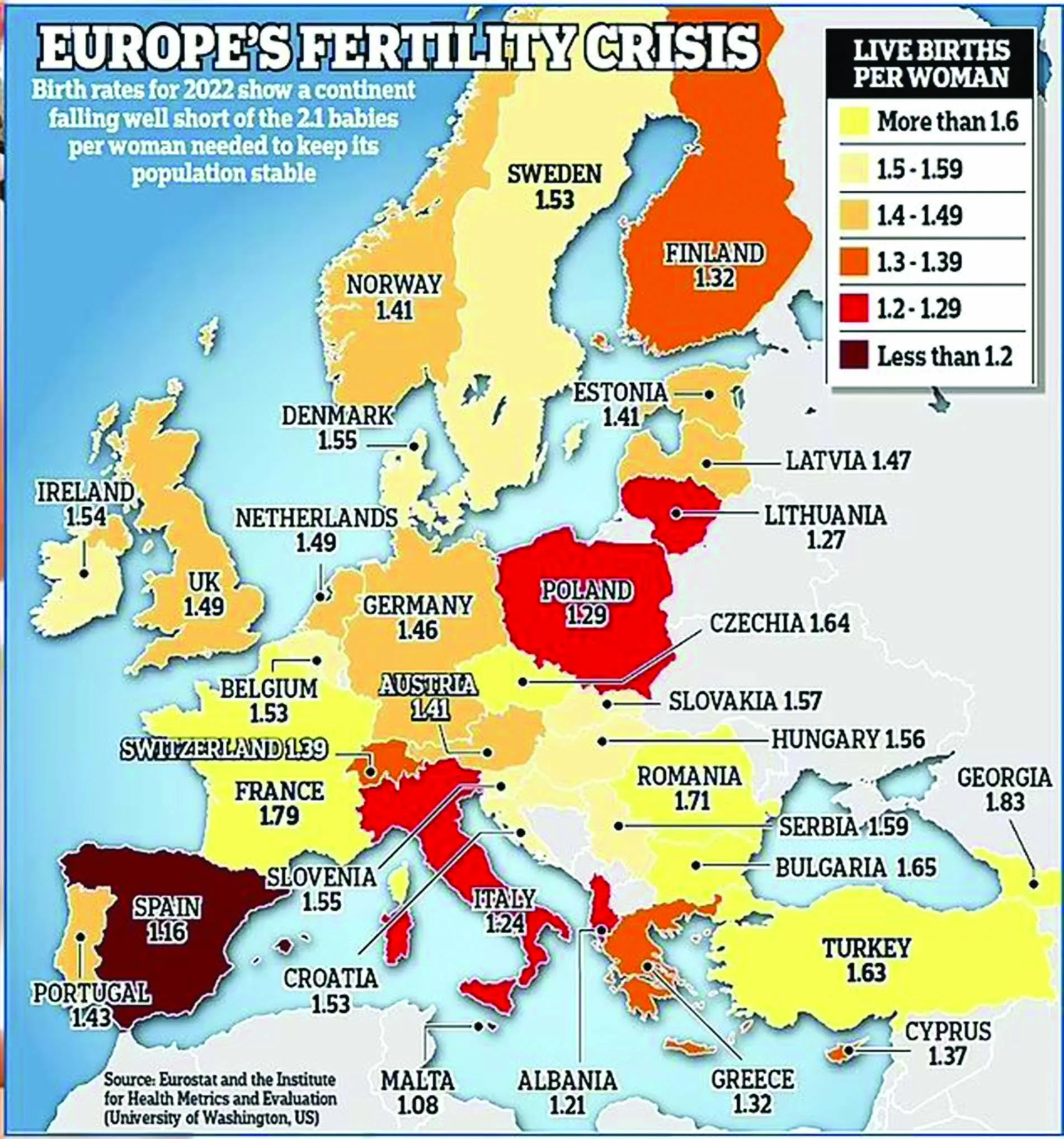
Economic activity also suffers as ageing populations shift consumption patterns, emphasising healthcare over discretionary spending. Savings depletion by the elderly further constraints investments, hampering growth. Countries like South Korea and Japan, despite pouring billions into pronatalist policies and technological interventions, struggle to reverse these trends. Meanwhile, Italy, Spain, and Germany face similar stagnation despite comprehensive childcare and parental benefits.

Managing Population

According to the National Family Health Survey (NFHS-5) of 2019-2021, India’s TFR ranged from 1.4 to 3.0. Interestingly, except for the three large States – Bihar, Jharkhand and Uttar Pradesh, all other States have achieved below replacement fertility levels. India is demographically diverse, so declining States can maintain continuity in economic activities by managing their population by attracting migrants from other States.

One of the major reasons for the concern of Indian policymakers is the religious imbalance of population growth. Another dark side of the Indian population is that due to increasing life expectancy and other reasons, the number of elderly people is increasing rapidly. According to the India Aging Report of the United Nations Population Fund in September 2023, in the next 27 years, the number of elderly people will increase rapidly.

Transcending Borders

The economic implications of sub-replacement fertility transcend borders. Whether it’s South Korea’s shrinking workforce, Japan’s ageing population, or Europe’s policy struggles, the message is clear: adapting to demographic changes is not optional—it’s imperative. By learning from successful models and fostering global cooperation, nations can navigate these challenges and build resilient, inclusive economies. For India, the time to act is now, leveraging its demographic dividend and maintaining the population momentum.


Topics: ChinaPopulation imbalanceUnited Nations Population FundEurope’s policy strugglesSouth Korea’s
ShareTweetSendShareSend
✮ Subscribe Organiser YouTube Channel. ✮
✮ Join Organiser's WhatsApp channel for Nationalist views beyond the news. ✮
Previous News

Converting to a religion solely to claim reservation benefit: Fraud on Constitution

Next News

World Hindu Economic Forum (WHEF) 2024 set to take place in Mumbai with an aim to drive growth across sectors

Related News

In China's strategic map of threats, geography continues to give India a significance that cannot be overlooked

The Rival China Cannot Ignore: Why India matters more than Beijing admits

As economic pressures mount, Beijing is tightening control over business, investment and society, placing security and stability above growth

Xi, the CCP and China’s New Reality: Why regime survival now matters more than economic growth

India Deploys 12 Nuclear Warheads: Heralds doctrinal shift to script strategic deterrence against multi-front threat

China’s anti-BLA offensive hits snag as UN members demand proof

UN Setback for China and Pakistan: US and allies stall move to ban Baloch Liberation Army

Chinese President Xi Jinping, Russian President Vladimir Putin and Prime Minister Narendra Modi

China’s New Tone Towards India: Tactical shift or strategic necessity? What Beijing’s push for RIC ties really signals

Chairman of the Rastriya Swatantra Party of Nepal Rabi Lamichhane meets PM Modi in New Delhi

From the China Card to Development Diplomacy: Nepal opens a new chapter in its political reset with India

Load More

Latest News

PoJK Protests: 2 JAAC activists killed, 8 injured in Rawalakot; Pakistani security forces crackdown on civilians

Singapen Special Task Force (SSTF) unit in Tamil Nadu

Singapen, all-women police unit, force launched by TVK, but crimes against women remain a growing concern in Tamil Nadu

The National Democratic Alliance (NDA) on June 10 passed a resolution marking 12 years of the Narendra Modi-led Government, describing it as a defining phase of "people-centric development, participative democracy and performance-oriented governance"

12 years of Modi government:  Restoration of self-belief

More than a cultural gathering, the event reflected a collective resolve to protect indigenous traditions, strengthen community bonds and celebrate Bharat's enduring unity in diversity.

Janajati Samagam 2026: The indigenous quest to protect culture, tradition and the soul of Bharat

12 years of Modi government: The scale of endurance

Representative Imaeg

The Fifty-Year Sabotage: How politicians are making delimitation meaningless

Video of CM Bhagwant Mann sprinkling alcohol on Sikh Guru portraits is authentic: Akal Takht Jathedar Gargaj to Sangat

Delhi CM Rekha Gupta take spart in cleanliness drive of River Yamuna

Delhi witnesses massive Yamuna cleanup drive: 14 Ghats, 71 tonnes of waste removed

Remembering Shaheed Bhai Mani Singh: They cut him joint by joint, he lives in every Sikh prayer

Cache of arms and explosives recovered by Odisha Police from Rayagadha forest

Odisha: Major Maoist dump unearthed in Rayagada Forest; Arms, explosives and Maoist literature seized

Load More
  • Privacy
  • Terms
  • Cookie Policy
  • Refund and Cancellation
  • Delivery and Shipping

© Bharat Prakashan (Delhi) Limited.
Tech-enabled by Ananthapuri Technologies

  • Home
  • Search Organiser
  • Bharat
    • Assam
    • Bihar
    • Chhattisgarh
    • Jharkhand
    • Maharashtra
    • View All States
  • World
    • Asia
    • Africa
    • North America
    • South America
    • Europe
    • Australia
  • Editorial
  • Operation Sindoor
  • Opinion
  • Analysis
  • Defence
  • Culture
  • Sports
  • Business
  • RSS @ 100
  • Entertainment
  • More ..
    • Sci & Tech
    • Vocal4Local
    • Special Report
    • Education
    • Employment
    • Books
    • Interviews
    • Travel
    • Health
    • Politics
    • Law
    • Economy
    • Obituary
  • Subscribe Magazine
  • Read Ecopy
  • Advertise
  • Circulation
  • Careers
  • About Us
  • Contact Us
  • Policies & Terms
    • Privacy Policy
    • Cookie Policy
    • Refund and Cancellation
    • Terms of Use

© Bharat Prakashan (Delhi) Limited.
Tech-enabled by Ananthapuri Technologies