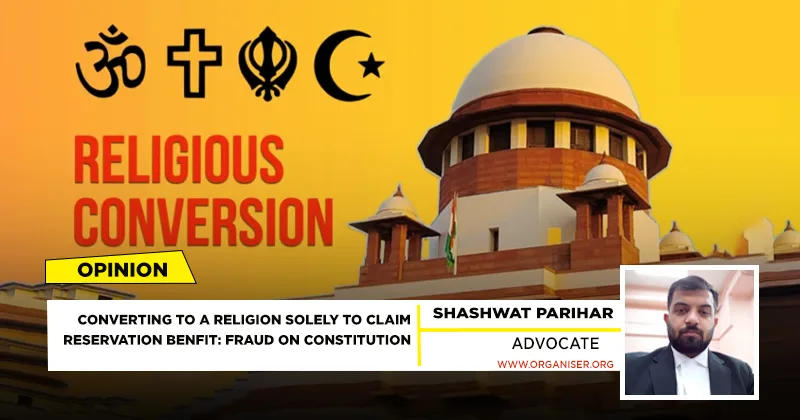
The Supreme Court of India recently delivered a judgment concerning the eligibility of a Dalit Christian for a Scheduled Caste community certificate. This case, C. Selvarani vs The Special Secretary-Cum-District Collector and Others; SLP(Civil) No. 6728 of 2023, revolves around the appellant’s claim to belong to the Valluvan caste, recognised as a Scheduled Caste under the Constitution (Pondicherry) Scheduled Castes Order, 1964. The Supreme Court said converting to a religion solely to claim reservation benefits without genuine belief in the adopted faith constitutes “fraud on the Constitution.”
The Appellant C. Selvarani claimed she was entitled to a Scheduled Caste community certificate as she professed Hinduism and belonged to the Valluvan caste. Her father was originally Hindu, converted to Christianity, and later reconverted to Hinduism. The appellant argued that her family had always maintained their identity within the Valluvan caste despite religious conversions.
The authorities rejected her application for a Scheduled Caste certificate, citing that she did not profess Hinduism, Buddhism, or Sikhism as required by the SCSC Order, 1964. They pointed out her baptism and her father’s conversion to Christianity as evidence against her claim.
The Court referred to Article 341 of the Indian Constitution which Specifies that only those professing Hinduism, Sikhism, or Buddhism can be recognised as Scheduled Castes. Further, it also noted the SC Order, 1964, which lists specific castes eligible for Scheduled Caste status in Pondicherry, including Valluvan.
Court’s Findings
- Religious Profession: The Court emphasised that under the SC Order, 1964, only individuals professing Hinduism, Sikhism, or Buddhism can be deemed members of a Scheduled Caste. Evidence showed that Selvarani was baptised and participated in Christian rituals, undermining her claim of professing Hinduism.
- Community Acceptance: The Court noted that for reconversion claims to be valid, there must be community acceptance and clear evidence of religious practice aligning with the claimed caste.
- Legal Precedents: The judgment referenced several precedents stipulating that caste identity is linked to birth and does not automatically revive upon conversion unless accepted by the community.
- Fraudulent Claims: The Court warned against fraudulent claims for benefits reserved for Scheduled Castes and emphasised the state’s responsibility to act against such frauds.
Dalit Christians and Muslims’ inclusion in the Scheduled Caste category will amount to Constitutional Fraud
The legal arguments against including Dalit Christians and Muslims in the Scheduled Caste (SC) category primarily revolve around constitutional provisions and the historical context of caste-based reservations in India.
The SC status was designed to address the historical injustices faced by certain castes within the framework of Hindu society. The inclusion of Sikhs and Buddhists was justified because these religions originated in India and share cultural and historical ties with Hinduism.
The classification of Hindus into castes and classes originates somewhere in the historical evolution of the society probably post-Magadh Empire. There is no scriptural sanctity to castes, nor is the classification of people as Dalits and untouchables mandated by the scriptures.
One of the pioneers of the movement to provide social dignity and justice to the so-called Dalits, Ambedkar mentioned this in many of his writings and speeches. “The outcaste is a by-product of the caste system. There will be outcastes as long as there are castes. Nothing can emancipate the outcastes except the destruction of the caste system. Nothing can help to save Hindus and ensure their survival in the coming struggle except the purging of the Hindu faith of this evil and vicious dogma.”
Article 341 of the Indian Constitution empowers the President to specify the castes, races, or tribes that shall be deemed Scheduled Castes about a state or union territory. It also allows Parliament to modify this list but maintains that only those professing certain religions are eligible for inclusion as SC. Article 341 requires a single ethnic group for inclusion in the SC list. It has been argued that Dalits who convert to Islam or Christianity belong to diverse ethnic groups, which complicates their inclusion under a single category like SCs.
The Constitution (Scheduled Castes) Order, 1950, specifies that only individuals who profess Hinduism, Sikhism, or Buddhism can be recognised as Scheduled Castes. This order was originally limited to Hindus, with Sikhs and Buddhists included in subsequent amendments. The rationale is that caste discrimination, which the SC status seeks to address, is traditionally linked to these religions.
Paragraph 3 of the Constitution (Scheduled Caste) Order, 1950 categorically says, “…no person who professes a religion different from Hinduism, Sikhism and Buddhism shall be deemed a member of a Scheduled Caste”. The obvious logic behind this was the fact that discrimination based on birth and caste was a peculiar social ill that afflicted Hinduism and its offshoots. Christianity and Islam proclaim that they are egalitarian and do not have castes. So, what explains “Dalit Christian”?
The political Reservation was to be made available for ten years, after which it was reviewed and discontinued. Reservation is a political representation based on caste and not religion. In the background of the tragic Partition, Ambedkar wanted the Constitution to guarantee equality of opportunity to the religious minorities but not Reservation on the lines of what he envisaged for the Dalits in Hindu society.
Extending SC status to Dalit Christians and Muslims could dilute the intended benefits of reservation policies. These religious groups do not face the same kind of caste-based discrimination as those within Hinduism, Sikhism, or Buddhism. Furthermore, conversion to Christianity or Islam leads to a change in social dynamics that does not align with the traditional caste system.
There are concerns about potential misuse of reservations if extended to converts. The Supreme Court has ruled that conversions solely for reservation benefits constitute “fraud on the Constitution,” emphasising that genuine belief in the adopted religion is necessary. This underscores fears that extending SCSC status could lead to strategic conversions for economic benefits rather than addressing genuine social inequities.
Further, religions like Christianity and Islam do not have roots in Indian ethos or culture in the same way as Hinduism, Sikhism, and Buddhism do. Therefore, these religions should not be included in provisions meant for communities historically marginalised within Indian-origin religious frameworks.
Implications of the Judgment
Fraudulent Conversions: The Court’s decision underscores the importance of genuine religious belief in claims for caste-based reservations. It highlighted that religious conversions driven by ulterior motives, such as accessing reservation benefits, dilute the social ethos and intended impact of reservation policies. This ruling sets a precedent for stricter scrutiny of such claims to preserve the integrity of constitutional safeguards.
The Supreme Court’s recent ruling reinforces the principle that reservation benefits should be reserved for those genuinely disadvantaged by caste discrimination within their religious communities.
Stricter Scrutiny of Conversion Claims: The ruling emphasises that conversions undertaken solely to access reservation benefits, without genuine belief or adherence to the religion’s practices, constitute a “fraud on the Constitution.” This sets a precedent for stricter scrutiny of claims where individuals convert or reconvert to a religion primarily to avail themselves of SC benefits. Authorities must implement more rigorous verification processes to ensure that only those genuinely disadvantaged by caste discrimination receive these benefits.
Preservation of Reservation Integrity: By reinforcing the need for authenticity in religious conversion claims, the judgment aims to preserve reservation policies’ integrity and intended impact. It ensures that reservation benefits are reserved for those who truly face socio-economic disadvantages due to caste-based discrimination within their religious communities. This decision discourages individuals from exploiting the system by making insincere conversions purely for personal gain.
For Dalit converts to Christianity, this judgment underscores their continued exclusion from SC reservations unless there is a genuine reconversion and acceptance by their original caste community. This has further reinforced that Reservation as affirmative action was intended to address past discrimination prevalent in the Hindu religion and create more inclusive societies. It further established that there is no caste-based system in Christianity or Islam, and hence, there is no question of extending Reservations to Christians or Muslims.
Further, the judgement reinforces the argument based on the doctrine of eclipse that once you convert, you leave behind all that you had in your other religion.
The judgment aligns with previous legal precedents that require clear evidence of genuine religious adherence and community acceptance for reconversion claims. This judgment reinforces the principle that reservation benefits should be accessed through legitimate means, ensuring they reach those most in need while maintaining constitutional integrity.
The judgement has further led to a stay on the debate that the Reservation benefit should be extended to the Hindu converts to Islam or Christianity. The judgement has further cleared the air and clarified that Reservation benefits as affirmative action were intended to address past discrimination and create more inclusive societies prevalent in Hindus and not in any other religion. The leaders of Schedule Caste and Schedule Tribes should spread awareness among the class that converting from Hindu to Christianity or Islam will take away the reservation benefit. The attempt by a section of Christianity and Islam to usurp the political, economic and employment privileges guaranteed, as affirmative action, to a section of the Hindu society had been thwarted as a dangerous and divisive move vide the judgement.