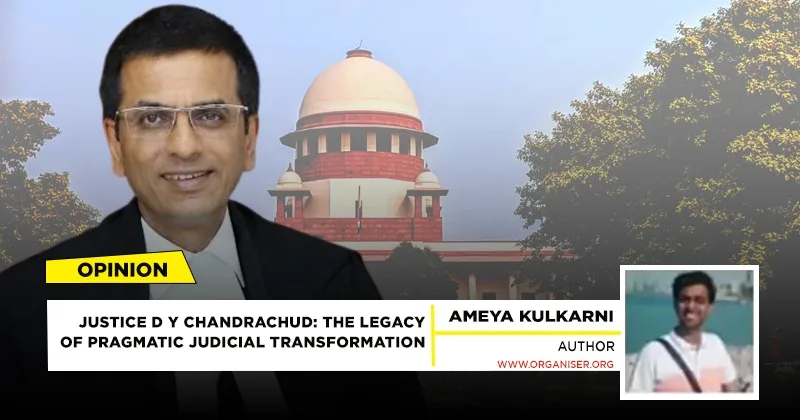
When Justice Dhananjaya Yeshwant Chandrachud assumed the position of chief justice of India in November 2022, he had high hopes for a transformative tenure. Known for his intellectual depth, progressive judgments and commitment to a “transformative Constitution”, he symbolised the judiciary’s aspirations to uphold constitutional values amid a shifting socio-political environment.
His two-year term unfolded during a critical juncture for India’s judiciary, marked by challenges ranging from diminishing public trust to intense political pressures. Throughout this period, Justice Chandrachud navigated these complexities with a focus on progressive ideals, judicial independence and the modernisation of the judiciary.
His normative labours in over eight years at the Supreme Court include, as of November 6, 612 judgments across 1,274 Benches, as per Supreme Court Observer (SCO). According to SCO data, the highest number of his judgments are in service (16 per cent), criminal (15 per cent) and constitutional and civil matters (10 per cent each). This is a proud record, brimming with new concepts and ideas. It is doubtful that all critics of his tenure have read this corpus. The CJI who publicly wondered about his legacy has left with a bouquet of brickbats from retired justices, senior lawyers, and both the print and social media.
Not only on the judicial side but even on the administrative side, CJI Chandrachud left his imprint as he led various reforms in the judiciary. He ordered an accessibility audit of the Supreme Court to make the courts accessible to the common man and disabled.
The list of judgements he penned is long and covers almost all aspects of law. They blend scholarship and jurisprudence and will likely inform future decisions and how the law is studied.
Besides delivering several landmark judgements like the Ayodhya land dispute, abrogation of Article 370 and the decriminalisation of consensual gay sex that shaped society and politics, he was part of 38 constitution benches during his eight years tenure as a judge in the Supreme Court.
He expanded the scope of the Medical Termination of Pregnancy Act and the corresponding rules to include unmarried women, even transgender, for abortion between 20-24 weeks of pregnancy.
He was also part of a nine-judge bench and a key author of the unanimous verdict that declared the right to privacy a fundamental right under Article 21 (life and personal liberty).
Most of the critique has been directed at his off-bench performances, with some ungenerously suggesting that these impacted his judicial decisions. Such criticism overlooks the constitutional conception of judicial independence, which is always, as I have previously described, “independence within dependence” — a relative, not an absolute, independence. The number of justices, the terms of service, their age of superannuation and pensions are determined by Parliament. The Supreme Court has conceded in the NJAC decision that a collegium system means “limited primacy of both the President and CJI”.
However, “robust consultation” may be creative only if boundaries to the bonhomie between the political executive and the judiciary are known to the people. We have the former CJI’s word that the dialogue is purely on the “administrative side” and never involves “the cases we decide”. We also have his appeal to “trust” judges. However, asserting the people’s right to know the grounds of deadlocks, justly affirmed in the electoral bonds case, would have helped!
We have also learned that the former CJI has always been “a person of faith”— this is unproblematic since the fundamental right to the freedom of conscience and religion is guaranteed by constitutional jurisprudence. Enough has been said about releasing a live recording of the puja where the Prime Minister joined the CJI in a public display of faith. However, I maintain that it is the judicial duty of all serving Supreme Court justices to follow the Bommai discourse which brilliantly distinguishes between constitutional and political secularism.
Additionally, a certain degree of judicial aloofness is expected in judicial conviviality with the executive. To quote me immodestly: “The distance between Tilak Marg (where the SCI sits) and Shastri Bhawan (where the law minister is located) is geographically very small but constitutionally very vast.”
However, constitutional judicial review will always meet with unworthy and ungenerous efforts at denigration and attributing a specific political and “careerist” motive to justices. This is flawed for at least three reasons. First, career aspirations are recognised everywhere as a good thing, provided they are based on the seniority-cum- merit principle. Second, judicial independence requires ulterior motives to be proved, which occurs only in rare cases. At the same time, the grapevine grows, rumours become news, and folklore about judicial venality and corruption grows. A high priority for adjudicative leadership is to revive the Judicial Standards and Accountability Bill of 2010. Third, unlike the high courts, there are no single-judge benches in the SC. Therefore, any imputation of the integrity of a CJI may also be implicitly extended to his companion justices.
Constitutional courts do have their politics of interpretation — a disinterested constitutional affair from which they have nothing to gain by way of personal benefit, in contrast to competitive party politics which must benefit from decisions (as shown in my book, The Indian Supreme Court and Politics, 1960).
A high priority of robust dialogue between the CJI and political executive should be to subject post-superannuation assignments to a two-year cooling-off period, as suggested by Arun Jaitley. No CJI has done this, but a legacy-seeking CJI ought to have done so with determination and datafication: We lack data on how many justices have declined such assignments and how many have been invited. Nor, in this context, is the specific form of judicial oath (‘Constitution at the centre’, IE, July 5) ever considered!
Just before I perforce conclude, I will mention two other matters. The CJI traditionally enjoys vast administrative powers as Master of the Roster. Even the so-called revolt of the four senior justices (on January 12, 2018) did not question this privilege of the CJI. However, the problem remains: How can we avoid “manifest arbitrariness” in exercising the CJI’s prerogatives?
Even if one may defer the hearing of “politically sensitive” matters, can this ever be done even when these matters directly affect the freedom of many incarcerated under mere suspicion? Are the added unusual powers — of “recalling” a decision duly rendered by a competent Bench and to “reconsider” a prior binding decision — always just and fair? Should such “judicial evasion” not be avoided when core human rights are at stake?
Tech-friendly initiatives
Under Chandrachud’s watch, the apex court Registry has evolved into a completely paperless one, and several courts are fully digital, where the exchange of paper files is a thing of the past. However, verification of petitions still requires a physical print-out scanned by the Registry, marking defects, if any.
The Court under CJI Chandrachud has launched the Electronic-Supreme Court Reports (e-SCR) project by which several of the top court’s judgments became available online for free; the Advocate Appearance Slip Portal to do away with manual filing of appearances by advocates-on-record thereby saving paper; the online Right to Information portal, Neutral Citations System; and more.
The digital revolution was not limited to the Supreme Court alone as it seeped down to the High Courts and district courts across the country, the credit for which goes to CJI Chandrachud.
Finally, there is the matter of distressing denunciation of prior precedents. The CJI made some harsh remarks against Justices Krishna Iyer and O Chinnappa Reddy on whether the state must acquire and distribute individual “private” property for the common good under Article 39 (b) of the Constitution. He stated that the two justices were not merely following a particular ideology but were “scuttling” the constitutional vision! Justices B V Nagarathna and Sudhanshu Dhulia called this and other remarks “harsh” and “unwarranted”.
The import of the word “socialist” in the preamble of the Constitution is at stake; to reduce past judicial decisions to mere regime-favouring is unworthy. Moreover, it is anachronistic to read the past as a prelude to ideologies of de-constitutionalisation, de-politicisation, de-democratisation and de-juridification of major governance and development issues. One hopes that sober reflections on the future of constitutionalism will flow now from the active pen of Dr Chandrachud.
And despite his pleasant demeanour in and outside court, the technological reforms he introduced, and some important judgments holding the executive to account and safeguarding civil liberties, it is difficult to pinpoint his legacy.
Perhaps we should ask history.