
Batenge toh Katenge: Beyond the Election Slogan
August 6, 2026
  • Read Ecopy
  • Circulation
  • Advertise
  • Careers
  • About Us
  • Contact Us
Android AppiPhone AppArattai
Organiser
  • ‌
  • Bharat
    • Assam
    • Bihar
    • Chhattisgarh
    • Jharkhand
    • Maharashtra
    • View All States
  • World
    • Asia
    • Europe
    • North America
    • South America
    • Africa
    • Australia
  • Editorial
  • International
  • Opinion
  • RSS @ 100
  • More
    • Op Sindoor
    • Analysis
    • Sports
    • Defence
    • Politics
    • Business
    • Economy
    • Culture
    • Special Report
    • Sci & Tech
    • Entertainment
    • G20
    • Azadi Ka Amrit Mahotsav
    • Vocal4Local
    • Web Stories
    • Education
    • Employment
    • Books
    • Interviews
    • Travel
    • Law
    • Health
    • Obituary
  • Subscribe
    • Subscribe Print Edition
    • Subscribe Ecopy
    • Read Ecopy
  • ‌
  • Bharat
    • Assam
    • Bihar
    • Chhattisgarh
    • Jharkhand
    • Maharashtra
    • View All States
  • World
    • Asia
    • Europe
    • North America
    • South America
    • Africa
    • Australia
  • Editorial
  • International
  • Opinion
  • RSS @ 100
  • More
    • Op Sindoor
    • Analysis
    • Sports
    • Defence
    • Politics
    • Business
    • Economy
    • Culture
    • Special Report
    • Sci & Tech
    • Entertainment
    • G20
    • Azadi Ka Amrit Mahotsav
    • Vocal4Local
    • Web Stories
    • Education
    • Employment
    • Books
    • Interviews
    • Travel
    • Law
    • Health
    • Obituary
  • Subscribe
    • Subscribe Print Edition
    • Subscribe Ecopy
    • Read Ecopy
Organiser
  • Home
  • Bharat
  • World
  • Operation Sindoor
  • Editorial
  • Analysis
  • Opinion
  • Culture
  • Defence
  • International Edition
  • RSS @ 100
  • Magazine
  • Read Ecopy
Home Bharat

Batenge toh Katenge: Beyond the Election Slogan

Prafulla KetkarPrafulla Ketkar
Nov 18, 2024, 01:00 pm IST
inBharat, Editorial
Follow on Google News
Facebook
Twitter
WhatsAppTelegramEmail

“I want to see you, Swami”, I began, “on this matter of receiving back into Hinduism those who have been perverted from it. Is it your opinion that they should be received?” “Certainly,” said the Swami, “they can and ought to be taken.”
He sat gravely for a moment, thinking, and then resumed. “Besides,” he said, “we shall otherwise decrease in numbers. When the Mohammedans first came, we are said — I think on the authority of Ferishta, the oldest Mohammedan historian — to have been six hundred millions of Hindus. Now we are about two hundred millions. And then every man going out of the Hindu pale is not only a man less, but an enemy the more.
“Again, the vast majority of Hindu perverts to Islam and Christianity are perverts by the sword, or the descendants of these. It would be obviously unfair to subject these to disabilities of any kind. As to the case of born aliens, did you say? Why, born aliens have been converted in the past by crowds, and the process is still going on.”
– Swami Vivekananda, On the Bounds of Hinduism, Prabuddha Bharata, April 1899

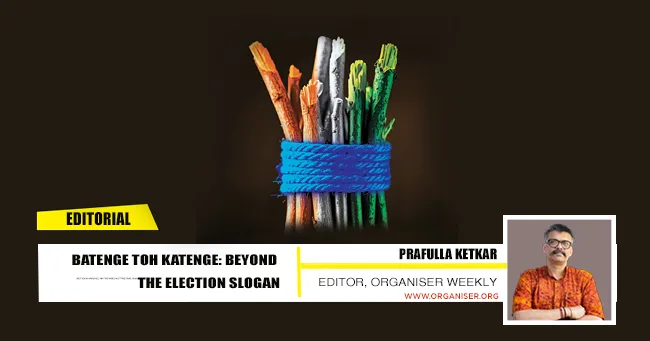
Remarkably, few slogans captured the popular imagination overnight, as the newly coined slogans by Prime Minister Narendra Modi and Uttar Pradesh Chief Minister Yogi Adityanath did. Ek Rahenge toh Safe Rahenge and Batenge toh Katenge are substantially not new slogans, but they have resonated with the masses in the present context. Instead of seeing them as election sloganeering, we need to derive the historical lessons, present connotation and future implications.

Bharat is a Hindu civilisation and Hindu Rashtra. Everyone knows this, whether they accept it or not. Being Hindu, Bharat can never be a theocratic state; hence, all ways of worship would be accepted and respected here, which is also a fact. Then why do these slogans, which apparently sound religious but are actually national, find widespread acceptance and should be supported? Bharat is the only civilisation that has survived the civilisational onslaughts right from the Greek invasion. Though most of the invaders were accommodated and assimilated in this great civilisation, the intolerant and brutal invasions by Islamists of Arab, Turk or Mongol variety starting from Mohammad Bin Kasim were unimaginable and Adhramic by the Bharatiya standards. Killing someone for not following your religion, forcefully converting people, sharing and disrobing women of the defeated society as a bounty, etc., were unheard-of practices. What Missionaries did through British administration by deceitful conversions and earmarking the forest and tribal areas for free-run of Missionaries further added fuel to this non-Bharatiya tendencies with intellectual narratives of alienation. The mass conversions, whether through sword or with the enforcement of state policies, resulted in a demographic transition in a few decades or centuries. In all these developments, we were divided. Therefore, a handful of invaders could cut the population from the roots and, later, land into pieces. From Afghanistan to Pakistan, Bangladesh or even in present-day Jammu-Kashmir, North-East and some parts of Kerala, the historical experience shows that the reduction of the Hindu population has resulted in growing divisive separatist activities.

The converts who were victims of the barbaric invasions soon became inheritors of the invaders’ legacy. The modern secular historians trained by the British or Marxist school of thought strengthened these impressions. Connecting with the pan-Islamic identity, insulting Hindu practices as infidels or kafirs, opposing any policy that strengthens the cultural identity of our nationhood, identifying with Gaznavis, Babars and Aurangzebs, bringing foreign money to facilitate conversions and illegal immigration to change the demography and influence the democratic process are the recent experiences that we cannot ignore. The plight of Hindus, Sikhs, Buddhists and Jains in the partitioned parts of Bharat is known to all. The recent developments in Bangladesh have indeed awakened the masses to the reality of demographic danger to democracy. The role of international actors in whitewashing these crimes against the global minority following Bharatiya faiths raises the tempers of ordinary Hindus. Simultaneously, to divide the larger Hindu population on linguistic, caste or regional identity is not just the continuation of the British policies but also creating new faultlines with rigorous intellectual efforts for political gains. The political and legal ploys used during the Shah Bano case and the Ram Janmabhoomi Movement exposed these divisive forces and their communal facade in the name of secularism. The Waqf Acts, legalising land-grabbing by religious boards, is another fraud that came to the people’s notice. The forest lands that are reserved for the tribals are also under invasion, both by Missionaries and Islamists. All these actions certainly create a threat perception for the indigenous faiths of Bharat.

From Chanakya to Shivaji, some unifiers emerged to create national consciousness among the common masses, which is why we have survived as a civilisation. Sages like Swami Vivekananda also cautioned against this while contextualising the Vedanta philosophy for the modern world. The historical experience and the contemporary trends of aggressive fanaticism demand the same kind of movement to build a shared understanding of Bharat as a Rashtra. Hindu unity of all Bharatiya faiths is the pre-condition for developing such consciousness. Therefore, ‘United we Stand, Divided we Fall’ cannot be just an election slogan. Our social actions and policy initiatives must be sharpened with the same zeal to combat, overcome and assimilate the divisive forces. Acceptance and respect, not just tolerance, are the fundamental cultural traits of Bharat on which the cultural nationalist paradigm rests. Any tendency that is derived from the binary of believers and non-believers or Mu’min and Kafir is non-Bharatiya and, therefore, should be considered a threat to our nationhood. All our policies and social actions should be based on this fundamental trait of unity. The slogans coined during the Haryana elections and got traction amidst the Maharashtra and Jharkhand Assembly elections should not be limited to our political behaviour but should shape our national behaviour and consciousness in the coming days.

 

Topics: Hindu Rashtrapan-Islamic identityBatenge toh KatengeIslamists of ArabChanakya to ShivajiNorth EastBangladesh
Prafulla Ketkar
Prafulla Ketkar
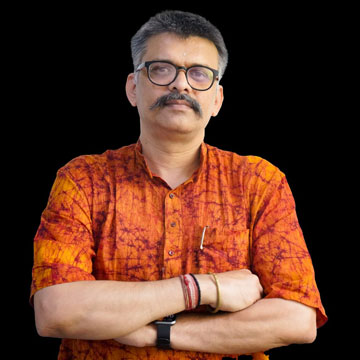
Prafulla Ketkar, is the Editor, Organiser (Weekly) since 2013. He has a experience of over 20 years in the fields of research, media and academics. He is also Advisory Committee School of Journalism, Delhi University. He has been writing on issues related to International politics and foreign policy, with special reference to China and Democracy, Hindutva, and Bharatiya Civilisation. He was also a member of the Editorial team of the recently published Complete Works of Pt Deendayal Ji in 15 Volumes. He has 2 books, 29 academic articles, 2 entries in Encyclopedia of India and numerous articles to his credit. [Read more]
Share
Tweet
SendShareSend
✮ Subscribe Organiser YouTube Channel. ✮
✮ Join Organiser's WhatsApp channel for Nationalist views beyond the news. ✮
Previous News

“Maharashtra’s legacy shapes my vision, Pawan Kalyan’s tour energises voters of Marathwada

Next News

Manipur Violence: RSS condemns brutal killing of women and children, calls for immediate resolution

Related News

Exiled Bangladeshi writer Taslima Nasrin speaks during a citizens felicitation programme titled 'Returning to a Free West Bengal After 19 Years'

‘One of the longest nights of my life’: Taslima Nasreen recalls forced exit from Kolkata after 2007 protests

Former Prime Minister of Bangladesh Sheikh Hasina

Sheikh Hasina’s first public appearance since leaving Bangladesh; Will she hint at return to Dhaka & political future?

Representative Image

India to set up 40 Intelligence Bureau units in Bangladesh border; Shield against infiltration & organised crimes

As per the reports, Russia is considering to settle payments with Bangladesh via Indian rupees

Russia Pushes Rupee trade with Bangladesh to bypass US sanctions; A leverage for Indian currency in cross-border trade

Hindu community in Bangladesh celebrates Rath Yatra

Bangladesh: Explosives found at Rath Yatra hint terror plot; Concerns raise over safety of minority Hindu community

Transnational drug kingpin arrested by NCB

India-Myanmar drug network busted: Crackdown on international syndicate by NCB; Prime kingpin Nengzatuan arrested

Load More

Latest News

The Indian Silambam team, which won 29 medals at the International Open Championship in Malaysia, arrives in Chennai

Silambam Glory on Global Stage: Team India Clinches 29 Medals Ancient Martial Art wins applause at Int’l championship

Tamil Nadu: Hindu Munnani slams TVK Budget over Quaide Milleth award and Jerusalem subsidy

Former Bangladesh PM Sheikh Hasina

Former Bangladesh PM Sheikh Hasina at FCC Delhi: ‘Whatever fate awaits me, will return to my people’ – Full Speech

Central Sanskrit University Signs MoU with Thailand's Silpakorn University to Promote Sanskrit and Indian Knowledge System

Central Sanskrit University signs MoU with Thailand’s Silpakorn University to expand Sanskrit studies globally

Zuckerberg Apologises Over PM Modi Video, Meta Faces Fresh Scrutiny

Meta under fire over content manipulation: Mark Zuckerberg apologises over PM Modi video row, CSAM & deepfake lapses

The Amritsar arrests expose a troubling new face of proxy warfare, low-cost, digitally recruited and built around vulnerable young recruits (AI generated image)

Amritsar Arrests Expose the New Face of Proxy War: Petrol bombs, online handlers & vulnerable teen recruits

CPM cadre convicted by Court

Keralam: CPM cadres get 16-year jail term for bid to murder RSS karyakartas in 2018 Panoor case

Tamil Nadu Finance Minister N. Marie Wilson presented the first Budget of the TVK government in Assembly on August 5, 2026

Tamil Nadu: TVK’s first Budget projects Rs 16,000 crore additional revenue, announces welfare push

India’s global crackdown on fugitives has intensified, with 274 offenders brought back from 36 countries since 2019 (AI generated image)

From Vijay Mallya to Tahawwur Rana: India’s global pursuit of fugitives brings 274 offenders back from 36 countries

SDPI National General Secretary Riyaz Parangipete

Karnataka Hate Speech Case: SDPI’s Riyaz Parangipete convicted in 11-year-old case, PFI links back in focus

Load More
  • Privacy
  • Terms
  • Cookie Policy
  • Refund and Cancellation
  • Delivery and Shipping

© Bharat Prakashan (Delhi) Limited.
Tech-enabled by Ananthapuri Technologies

  • Home
  • Search Organiser
  • Bharat
    • Assam
    • Bihar
    • Chhattisgarh
    • Jharkhand
    • Maharashtra
    • View All States
  • World
    • Asia
    • Africa
    • North America
    • South America
    • Europe
    • Australia
  • Editorial
  • Operation Sindoor
  • Opinion
  • Analysis
  • Defence
  • Culture
  • Sports
  • Business
  • RSS @ 100
  • Entertainment
  • More ..
    • Sci & Tech
    • Vocal4Local
    • Special Report
    • Education
    • Employment
    • Books
    • Interviews
    • Travel
    • Health
    • Politics
    • Law
    • Economy
    • Obituary
  • Subscribe Magazine
  • Read Ecopy
  • Advertise
  • Circulation
  • Careers
  • About Us
  • Contact Us
  • Policies & Terms
    • Privacy Policy
    • Cookie Policy
    • Refund and Cancellation
    • Terms of Use

© Bharat Prakashan (Delhi) Limited.
Tech-enabled by Ananthapuri Technologies