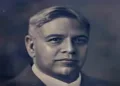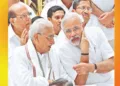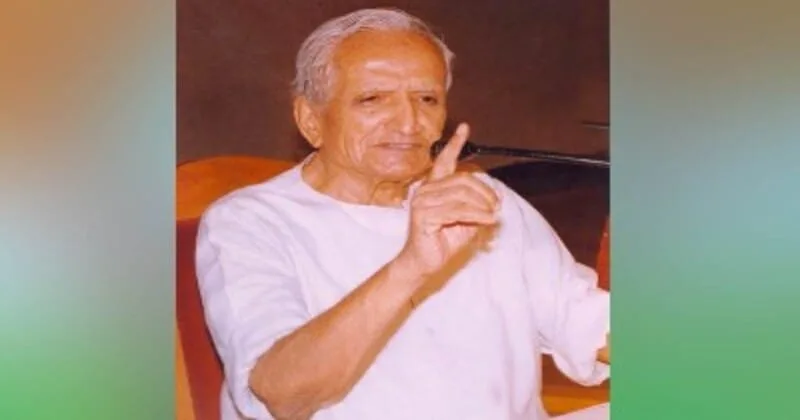
Dattatraya Bapurao alias Dattopant Thengadi, a towering intellectual, an organiser par excellence, Philosopher, a voracious reader, an original thinker, an excellent communicator and a living example of RSS vision, was born at Arvi in Wardha district of Maharashtra’s on Kartik Amavasya, Vikram Samvat 1977 i.e., November 10, 1920 as per Gregorian calendar. At the age of 15, he served as president of the ‘Vanar Sena’ as well as the Municipal High School student union at Arvi. He participated in Bharat’s Freedom Movement and was a member of the Hindustan Socialist Republican Association (HSRA) from 1936-38. He was profoundly influenced by Madhav Sadashiv Golwalkar, popularly known as Guru Ji, Pt. Deendayal Upadhyaya and Baba Saheb Ambedkar. Thengadi joined RSS as pracharak in 1942. He worked as RSS Pracharak in Kerala between 1942-44, Bengal in 1945-47 and Assam in 1948-49.
Thengadi founded, mentored and nurtured many well-known organisations of today like Bharatiya Mazdoor Sangh (1955), Bharatiya Kisan Sangh (1979), Swadeshi Jagran Manch (1991), Samajik Samarasata Manch, Sarva- panth Samadar Manch and Paryavaran Manch; also, a founder member of Akhil Bharatiya Vidyarthi Parishad, Akhil Bharatiya Adhivakta Parishad, Akhil Bharatiya Grahak Panchayat and Bharatiya Vichara Kendra.
He always believed in inclusiveness and refuted the idea of political untouchability. He was a member of the Rajya Sabha for two terms during 1964-76. He did not accept any post in the Government of Morarji Desai. He refused to accept the Padmavibhushan title later on.
Eloquent in speech and versatile with his writing, Thengadi has dozens of titles to his credit in Marathi, Hindi and English. Some of his popular books are “Karyakarta”, “Third Way”, “On Revolution” and “Prefaces in Hindu Economics” “Vichar Sutre’, ‘Sanketrekha’, `Ekatma Manav’, `Pragatipath par Kisan’, `Dr Ambedkar’, `Saptakram’ and `Lakshya Aur Karya’.
He was very keen to present Ambedkar in true light, from his own personal experience. “Dr Ambedkar” was his last book which he completed in July 2004 before passing away on October 14, 2004 due to Brain Hemorrhage.
What Thengadi ji said
1. Bharat, with Sanatana Dharma as its absolute reference, ‘All is One’ as its ultimate realisation and its continuously evolving socio-economic order in the light of the unchanging, eternal, universal principles, is eminently suited to play the role of Jagadguru.
2. The destination was visualised on the Vijayadashami day of 1925
– Our destination is the ‘Param Vaibhavam’, the pinnacle of glory, of the Hindu Rashtra.
– The starting-point of the journey is the commitment to certain Articles of Faith like One People (Jana), i.e. Hindu; One Culture (Sanskriti), i.e. Hindu; One Nation (Rashtra), i.e. Hindu; One Country (Desha), i.e. Akhanda Bharat; One Order (Vyavastha), i.e. Dharma-Rajya (not a theocratic state but based on values for social sustenance)
3. The integral approach is a must for durable and desirable progress and development; the compartmentalised thinking, giving rise to value-free economics, is self-defeating.
4. We should keep in mind that the fundamental thought process should be our basis. Once the hypothetical philosophical and academic order is established, the corresponding social reality can follow automatically –this is the Western thought process. Observing and understanding the phenomenon in social reality and the eventual development of conclusions and theories– is the Hindu thought process. For this collective thinking is also essential.
5. The Hindu nationalists know for sure that history without futurology would be fruitless, while futurology without history would be rootless. Our heritage enables us to be cautious without being conservative and dynamic without being adventurist.
6. Practical thinkers like Deendayal Upadhyay and Swatantryaveer Savark refused to present any utopia because, according to them, it was an exercise in futility. A blueprint may be evolved in the course of actual implementation in the light of the broad guiding principles of the basic ideology, and that too by a trial and error method
His Famous Quotes
• We don’t subscribe to the view that the Western paradigm is the universal model of progress and development. We don’t think that modernisation is Westernisation.
• Workers, Unite the world.
• Employment is our birthright
• Labourise the industry, industrialise the nation, nationalise the labour.
• The word Dravida does not appear anywhere in the ancient Tamil literature of the Sangam era. Hindu sage Agasthya of the Podhigai hills wrote the first Tamil grammar. The arrangement of alphabets in this Tamil grammar follows the Sanskrit order. The ancient social order pictured in Tholkappiam and Silappadigaram entirely mirrors the Hindu society. Hindu purusharthas are well arranged in the ancient Tamil scripture, Thirukkural. The annual Indira festival; worship of ancient Hindu deities, such as Shiva, Subramanya and Vishnu; the Hindu names of planets; the Hindu names of months…. all reveal the Hindu root of Tamil philosophy, deities, ways of worship, divisions of time and values of life
• Lal gulami chhod ker, bolo Vandematram. (Leave Red slavery, chant Vande Matram).
• The politician thinks of the next election, the statesman of the next generation and the nation-builder of many future generations. For a nation-builder, there is nothing called compulsion. He does not make compromises; deals are not struck at the altar of principles, and he chooses the difficult path.
• Knowledge and truth are universal in character; truth knows no class, caste or nation. We are in favour of assimilating knowledge from all peoples. But we must scrutinise it in the light of our past traditions and present requirements, and then decide how much of it is to be adopted, how much adopted, how much rejected.
• Blind imitation of the so-called advanced countries will be of no use. Guru Dev Tagore used to observe that God has given different question papers to different countries.
• Events have proved that the data upon which Marx worked was insufficient, his information inaccurate, his attitude unscientific, his conclusions incorrect, his predictions untrue, his theories untenable. Marxism is an intellectual parasite on Newtonian science, Darwinian evolutionism and Hegelian dialecticism. Those who try to compare Marxism with Hinduism betray their ignorance of both. If workers succeed, communists would fail; the prosperity of the former is the adversity of the latter; failures of the proletariat are the pillars of communist success.
• Fanatical Muslims assert that Islam does not permit any kind of nation-worship and that Muslims must fight against nationalism. But the nationalists in the so-called Muslim countries successfully combated this evil. The original tenets of Islam are quite compatible with the spirit of patriotism.
• The Hindu Law can embrace the entire mankind with the exception of those who deny themselves its magnificent benefits
Modi Government’s idea of providing universal healthcare, energy access to all, and poverty elevation plans (based on empowerment, not entitlements) all find their roots in Thengadi’s ideas.
His thoughts on different issues
Industry
-He founded Bharatiya Mazdoor Sangh with the motto ‘Industrialise the nation, Nationalise the Labour, Labourise the Industry’.
– Advocated for the use of appropriate technology and ensuring environmental protection
– The ownership of the industry should be decided on the basis of practical considerations
-The ownership can be with Government, cooperative, local government, private or joint ownership by Government and private as per requirement of industry and national interest.
-In order to curb the financial mal-administration, he suggested establishing Swayatta Vittiya Nigam (Autonomous Financial Corporation) way back in April 1971. Banks Board Bureau, an autonomous government organisation has now been established in February 2016 to improve the management of government-owned banks.
Labour Policy
He brought a paradigm shift in the realm of labour and trade union movement and process- a domain where communists used to have a monopoly. He defeated them in their own territory in a straight ideological war without indulging in guerrilla warfare. He shifted the communist’s set centre of loci of trade unionism from sectional and interested class conflict, forced annexation of industry, international labourism without national boundaries by care and cooperation for the national interest, a respectful primacy of labour in industrial process and swadeshi and nationalism. Thus, he carried nationalism to territories monopolised by class hatred and class war and rendered class ideas almost irrelevant. These ideas were reflected in his inaugural speech of BMS on July 23, 1955. The main points are here-
1. The interests of the country come first, followed by the interests of industry and labour in that order.
2. BMS will be a non-political labour organisation, an organisation of the workers, for the workers and by the workers that will be far away from party politics.
3. It will be based on the Bharatiya economic thought and culture
4. Structure of society that is free from exploitation and abuse and based on justice and harmony.
5. Honest work for the upliftment of Dalits, oppressed, neglected and downtrodden persons in society.
He did not limit his aim to issues directly concerning workers but contemplated the economic life of the entire country. Some examples
1. ‘Industrialise the nation, Nationalise the labour, Labourise the industry’ These slogans by Bharatiya Mazdoor Sangh gave an apt answer to the slogan ‘Nationalisation of all industries’ by the Communists. BMS’ idea of ‘Labourisation‘ of Industries promoted an idea where workers would collectively own and manage industrial units.
2. BMS’ slogan “We will work in the interest of the country and take full wage for the work done” (Desh ki hit me karenge kaam, kaam ke lenge poore daam ) was an answer to the slogan by Communists “chahe jo majburi ho, hamari mange poori ho” whatever may be the difficulties, our demands must be fulfilled.
3. Instead of a ‘capital-oriented economic structure’ he demanded a ‘labour-oriented economic structure’ to eradicate poverty and unemployment. This expression brings out major aspects of BMS goals.
4. Efficiency and productivity are important, but it is essential to take measures to retain employment.
5. Considering labour as capital and with a proper valuation of work of workers, workers should be given a share in profit, participation in management and some ownership.
6. The nation should have rights over the surplus value created in the production process. The owner and workers should not grab it exclusively for themselves.
Atmanirbharta & Swadeshi
Dattopant Thengadi defined Swadeshi as the practical manifestation of patriotism. This is a very appealing definition of Swadeshi, agreeable to all, and brings out the national spirit and the intent of the action. However, he explained that patriotism does not mean turning your back to other countries but, following the principle of Ekatma Manav Darshan (only one consciousness residing among all humanity. We are always ready for international cooperation based on equality and mutual respect. He wrote, “It is wrong to presume that ‘Swadeshi’ concerns itself only with the goods or services. That is more of an incidental aspect. Essentially, it concerns the spirit determined to achieve national self-reliance, preservation of national sovereignty and independence, and international co-operation on equal footing…. ‘Swadeshi’ was not merely an economic affair confined to material goods but a broad-based ideology embracing all departments of national life.
Third way
Thengdi ji visualised the withering away of Communism, and the probable collapse of Capitalism sooner than later, much ahead of Peter Drucker and Paul Samuelson, and other thinkers could foresee it.
Thengadi says, “We must conceive our own model of progress and development in the light of our culture, our past traditions, present requirements and aspirations for the future. The tradition of ever-changing socio-economic order in the light of the unchanging, eternal, Universal Laws of Dharma, is the foundation of the process envisaged by the Hindu vision of life. That is why the need to create integral national consciousness mentioned earlier to focus on traditional Hindu ethos. Any alternative to development that is not in keeping with the cultural core of society would not be beneficial to society.”
“Clamour of mankind for Third Way – After the pathetic failure of Western ideologies, the destiny is prompting Bharat to provide the new leadership to the world groping in darkness. Mankind is eager for the new order that is called ‘THIRD WAY’. The moral and god-entrusted responsibility to usher in this Third Way, which in fact is the only way, rests on Bharat. Only, the group of patriots dedicated to the goal of national reconstruction is eligible for this work. They will play a pivotal role in creating a new comprehensive world view (Weltanschauung)”.
Globalisation
Dattopant wrote, “Genuine ‘Globalisation’ is a part of Hindu heritage. In ancient times, we always considered ourselves as part and parcel of the entire humanity. We never cared to carve out a separate identity for ourselves. We identified ourselves with the entire mankind. ‘The whole earth is our family’ (Vasudhaiv Kutumbakam) – has been our motto. That is why the term ‘Hindu’ has no antiquity; it is not to be found in ancient literature… But now the roles are reversed. ‘Globalisation’ is being preached to us by those who are known to history for their imperialistic exploitation and even genocide. Satans are quoting the Bible. Hegemonism parading itself as globalisation!”
Thengadi ji emphasised that the thought of Swadeshi and mutual cooperation among the countries in the southern hemisphere would guide us to march ahead.