Supreme Court upholds Uttar Pradesh Board of Madarsa Education Act, 2004, reverses High Court’s ruling
October 3, 2026
  • Read Ecopy
  • Circulation
  • Advertise
  • Careers
  • About Us
  • Contact Us
Android AppiPhone AppArattai
Organiser
  • ‌
  • Bharat
    • Assam
    • Bihar
    • Chhattisgarh
    • Jharkhand
    • Maharashtra
    • View All States
  • World
    • Asia
    • Europe
    • North America
    • South America
    • Africa
    • Australia
  • Editorial
  • International
  • Opinion
  • RSS @ 100
  • More
    • World Hindu Congress 2026
    • Op Sindoor
    • Analysis
    • Sports
    • Defence
    • Politics
    • Business
    • Economy
    • Culture
    • Special Report
    • Sci & Tech
    • Entertainment
    • G20
    • Azadi Ka Amrit Mahotsav
    • Vocal4Local
    • Web Stories
    • Education
    • Employment
    • Books
    • Interviews
    • Travel
    • Law
    • Health
    • Obituary
  • Subscribe
    • Subscribe Print Edition
    • Subscribe Ecopy
    • Read Ecopy
  • ‌
  • Bharat
    • Assam
    • Bihar
    • Chhattisgarh
    • Jharkhand
    • Maharashtra
    • View All States
  • World
    • Asia
    • Europe
    • North America
    • South America
    • Africa
    • Australia
  • Editorial
  • International
  • Opinion
  • RSS @ 100
  • More
    • World Hindu Congress 2026
    • Op Sindoor
    • Analysis
    • Sports
    • Defence
    • Politics
    • Business
    • Economy
    • Culture
    • Special Report
    • Sci & Tech
    • Entertainment
    • G20
    • Azadi Ka Amrit Mahotsav
    • Vocal4Local
    • Web Stories
    • Education
    • Employment
    • Books
    • Interviews
    • Travel
    • Law
    • Health
    • Obituary
  • Subscribe
    • Subscribe Print Edition
    • Subscribe Ecopy
    • Read Ecopy
Organiser
  • Home
  • Bharat
  • World
  • Operation Sindoor
  • Editorial
  • Analysis
  • Opinion
  • Culture
  • Defence
  • International Edition
  • RSS @ 100
  • Magazine
  • Read Ecopy
Home Bharat

Supreme Court upholds Uttar Pradesh Board of Madarsa Education Act, 2004, reverses High Court’s ruling

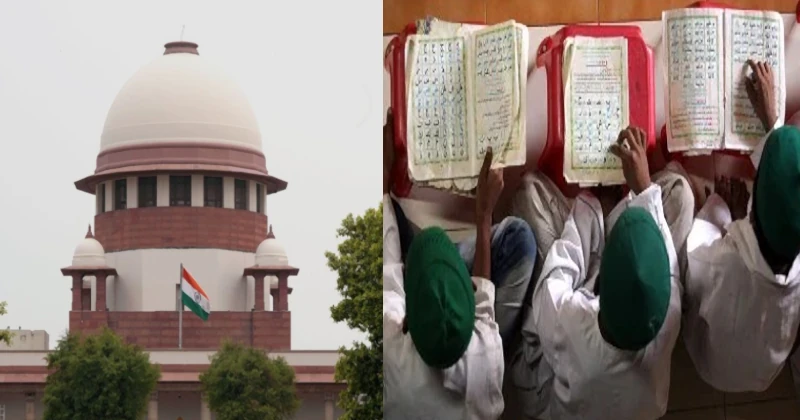
The Supreme Court of India upheld the constitutional validity of the Uttar Pradesh Board of Madarsa Education Act, 2004, emphasizing its role in regulating madarsa education while protecting minority rights. The ruling reverses an earlier judgment by the Allahabad High Court, which had deemed the Act unconstitutional for violating secular principles

WEBDESKWEBDESK
Nov 5, 2024, 01:30 pm IST
inBharat
Follow on Google News
Facebook
Twitter
WhatsAppTelegramEmail

The Supreme Court of India has upheld the constitutional validity of the Uttar Pradesh Board of Madarsa Education Act, 2004, in a significant ruling delivered on November 5. This decision reverses the Allahabad High Court’s earlier judgment, which had declared the Act unconstitutional on the grounds that it violated the principles of secularism.

The three-judge bench, led by Chief Justice of India (CJI) DY Chandrachud, stated that the Act serves a vital role in regulating madarsa education in Uttar Pradesh, where religious education is imparted alongside the curriculum of the National Council of Educational Research and Training (NCERT). This framework, the Court noted, is essential for ensuring educational standards while respecting the rights of minority communities.

The Uttar Pradesh Board of Madarsa Education Act was enacted in 2004 to establish a formal regulatory framework for madarsa education across the state. Madrasas are Islamic educational institutions that provide a blend of religious and secular education, and the Act aimed to standardise this education while ensuring adherence to the curriculum set by the National Council of Educational Research and Training (NCERT).

The Act led to the formation of the Uttar Pradesh Board of Madarsa Education, which is predominantly composed of members from the Muslim community. The board is tasked with developing curriculum materials, conducting examinations, and overseeing the quality of education provided at madrasas. It regulates various educational qualifications, ranging from ‘Maulvi’ (which is equivalent to Class 10) to ‘Fazil’ (equivalent to a Master’s degree).

The validity of the Madarsa Act came under scrutiny when the Allahabad High Court struck it down in March 2024. The court’s ruling was based on the argument that the Act violated the principle of secularism, a fundamental aspect of the Indian Constitution. The High Court asserted that establishing a board for religious education contradicted the secular nature of the state’s educational policies.

In its judgment, the Allahabad High Court stated that the state had the authority to regulate education but must ensure that such education is secular in nature. It highlighted that the Madarsa Act failed to provide universal and quality education, as mandated under Article 21A of the Constitution, which guarantees the right to free and compulsory education for children up to the age of 14. The court argued that the education imparted in madrasas was neither universal nor of the same quality as that provided by regular educational institutions, thus violating the fundamental rights of students.

Moreover, the High Court contended that the Act conferred powers on the Madarsa Board that encroached upon the Union Government’s legislative domain regarding higher education, further deeming the Act unconstitutional.

Following the High Court’s ruling, the Uttar Pradesh government sought redress from the Supreme Court, which issued a stay on the High Court’s verdict in April 2024, halting its enforcement while the apex court reviewed the matter. The government defended the Act by arguing that it was constitutional and that only specific provisions needed examination rather than the entire Act.

During the hearings, the Supreme Court justices examined the implications of the Madarsa Act and its alignment with constitutional provisions. Chief Justice Chandrachud emphasised that the state has a legitimate interest in regulating educational standards within religious institutions. He articulated that regulatory measures concerning educational quality do not inherently interfere with the administration of madrasas, noting that the Act aimed to enhance the educational experience for students rather than diminish religious instruction.

The Supreme Court’s Ruling

In its judgment, the Supreme Court clarified several critical points:

Constitutional Validity: The Court held that the Madarsa Act did not violate the basic structure of the Constitution, as the High Court had suggested. It clarified that a law could only be invalidated for violating fundamental rights as outlined in Part III of the Constitution or for issues related to legislative competence.

Balancing Secularism and Minority Rights: The judgment reinforced that the state has a positive obligation to protect minority rights while ensuring that educational standards are maintained. The Court noted, “The Madarsa Act does not interfere with the day-to-day working of the madrasas. It is to protect the rights of minorities in the State of Uttar Pradesh and is consistent with the positive obligation of the State, ensuring that students can pass out and earn a decent living.”

Legislative Competence: The Supreme Court affirmed that the Uttar Pradesh government had the legislative competence to enact the Madarsa Act, focusing on its role in standardizing the educational framework for madrasas without infringing upon the secular fabric of the educational system.

Conflict with the UGC Act: While upholding the majority of the Madarsa Act, the Court identified specific provisions that were unconstitutional. In particular, the provisions that allowed the Madarsa Board to confer degrees such as ‘Kamil’ and ‘Fazil’ were found to be in conflict with the University Grants Commission (UGC) Act of 1956. The Supreme Court ruled that only recognized universities have the authority to grant degrees, thus invalidating the relevant sections of the Madarsa Act.

Education Standards: The Court emphasised the need for religious and linguistic minority institutions to be allowed to impart education while adhering to national standards. It noted that the Act’s provisions must be interpreted in a way that aligns with Article 21A, which guarantees the right to education.


Topics: Supreme CourtNCERTDY ChandrachudMadarsa ActMadarsa Education ActMadarsa Education Act 2004
Share
Tweet
SendShareSend
✮ Subscribe Organiser YouTube Channel. ✮
✮ Join Organiser's WhatsApp channel for Nationalist views beyond the news. ✮
Previous News

Chhath Puja festivities begin: Thousands gather at Patliputra Ghat for ‘Nahaye Khaye’ rituals

Next News

Tamil Nadu: Teenage domestic worker dies under mysterious circumstances, employers Mohammed Nishad & wife arrested 

Related News

Supreme Court allows UPI Merchant Discount Rate framework to proceed; Urges govt to explain legal basis of the policy

AI-generated Image

Bar social media firms from adding minors, frame statutory rules: Supreme Court tells government

SC has overturned the Bombay High Court’s decision granting default bail to an accused in a PFI-linked UAPA case

PFI-linked UAPA case: Supreme Court overturns default bail, directs accused to surrender

Left: Danam Nagender as a winning BRS MLA; Centre: Rahul Gandhi and Revanth Reddy; Right: Danam Nagender.

BJP Telangana welcomes SC verdict on MLA Danam’s disqualification; calls Rahul Gandhi’s ‘Samvidhan Bachao’ a fake drama

SIR Spares None: Jaishankar, Judges & Elites Flagged — Delhi’s Voter Blitz Crushes ‘Targeting Poor & Muslims’ Narrative

SIR Spares None: Jaishankar, Judges & Elites Flagged — Delhi’s Voter Blitz Crushes ‘Targeting Poor & Muslims’ Narrative

Tamil Nadu: SC gives TVK government 3 months to identify land for Navodaya schools, asks reconsider position on Hindi

Load More

Latest News

Chinmaya Amrit Yatra meets Param Vir Chakra awardee Captain Bana Singh, highlighting his courage, simplicity and love for Bharat

Chinmaya Amrit Yatra: Captain Bana Singh recalls Siachen battle, his love for Jammu and message to youth

Hindu Mandir Vandalised in Ohio

US: Hindu mandir vandalised in Ohio; Community groups flag rising targeted attack, demand swift action from govt

Assam CM Himanta Biswa Sarma formally launched bamboo-made bicycles in Guwahati, marking a step towards sustainable transportation

Assam: CM Himanta Biswa Sarma launches bamboo-made bicycles, pushing sustainable transportation in the state

Hamam Al-Hammami’s extremist past and reported security concerns at Oman Air now under scrutiny after Flydubai cockpit attack

Omani-Syrian Hamam Al-Hammami identified as Flydubai co-pilot who attacked captain and tried to crash Tel Aviv flight

President Droupadi Murmu has given assent to the Gujarat UCC Bill, 2026, paving the way for its implementation in the state

Gujarat UCC Bill 2026 gets President Droupadi Murmu’s assent, legislation comes into effect across the state

SJTA plans dedicated darshan assistance for elderly and divyang devotees and restoration of 1.5 acres of temple land

Odisha: Shri Jagannath Mandir plans dedicated darshan assistance for elderly and divyang devotees

Representative image

Weekly Love Jihad Report: From fake names to fake social media accounts – Here’s how Islamists targeted Hindu women

Shivaji Park locals expressed anger against CJP protest

CJP’s Shivaji Park show fizzles in Mumbai: Low turnout, clueless crowd, angry residents and strong counter-protest

Former chief election commissioner Navin Chawla

From emergency indictment to election commission: The Navin Chawla record that Congress would rather not discuss

RSS All-India contact chief (Sampark Pramukh) Ramlal ji

Women farmers must be at forefront of policymaking: RSS Sampark Pramukh Ramlal ji

Load More
  • Privacy
  • Terms
  • Cookie Policy
  • Refund and Cancellation
  • Delivery and Shipping

© Bharat Prakashan (Delhi) Limited.
Tech-enabled by Ananthapuri Technologies

  • Home
  • Search Organiser
  • Bharat
    • Assam
    • Bihar
    • Chhattisgarh
    • Jharkhand
    • Maharashtra
    • View All States
  • World
    • Asia
    • Africa
    • North America
    • South America
    • Europe
    • Australia
  • Editorial
  • Operation Sindoor
  • Opinion
  • Analysis
  • Defence
  • Culture
  • Sports
  • Business
  • RSS @ 100
  • Entertainment
  • More ..
    • Sci & Tech
    • Vocal4Local
    • Special Report
    • Education
    • Employment
    • Books
    • Interviews
    • Travel
    • Health
    • Politics
    • Law
    • Economy
    • Obituary
  • Subscribe Magazine
  • Read Ecopy
  • Advertise
  • Circulation
  • Careers
  • About Us
  • Contact Us
  • Policies & Terms
    • Privacy Policy
    • Cookie Policy
    • Refund and Cancellation
    • Terms of Use

© Bharat Prakashan (Delhi) Limited.
Tech-enabled by Ananthapuri Technologies