There is a raging debate in the current international order that we may have returned to the age of sovereignty. While this may not be an entirely new debate in international history which surfaced quite a few times since the establishment of the Westphalian order in 1648, most recently in sovereignty’s contestation with globalisation towards the end of the last century, there is a reaffirming sense that sovereignty has reemerged to being one of the most fundamental tenets of statism. At various points in history, rising powers have stirred the sovereignty debate, in different ways. In the 19th century, as the American power grew, its sovereignty expansion was whitewashed as ‘Manifest Destiny’, even as it took 55 percent of Mexico’s territory including current-day states of California, Nevada, Utah, New Mexico, Arizona, Colorado, and parts of Oklahoma, Kansas, and Wyoming. In the 20th century, much of the sovereignty of the developing world was leased without interest to the West in the form of colonisation. At the end of the last century and since the beginning of the current one, globalisation ensured that, in many ways, sovereignty had become transnational. Some argued that sovereignty as we knew it had ended. Many countries allowed dual citizenship, migration from East to West increased, as did the people-to-people connect globally with the internet breaking down unimaginable barriers. Among others, India-Canada relations were a direct beneficiary of the ensuing cultural and ethnic transition in the inherent character of nation-states that characterised much of the 21st century. However, as transnational sovereign concerns became more entrenched with time, it revealed its darker side. Much of the problems currently playing out between Canada and India are a reflection of the latter phenomenon.
The harbouring of elements by Canada which threaten the sovereignty of India is a classic tale of the former’s domestic liberal overreach gone awry. Democratic freedom in Canada today is masquerading as political protection for transnational crimes. The 21st-century debates around state sovereignty focused on sovereignty passing on from the state to the individual but when this is viewed from the lens of transnational lens, states’ assertions of sovereignty are likely to override individualistic assertions of the same. The individual’s sovereign rights are a function of the state’s ability to defend and assert its sovereignty, both inside and outside. The fact that India and its Sikh population have turned the page on the Khalistan movement of yesteryear while it is simmering in Canada reflects the asymmetry between the two democracies. The dichotomy widens when the current circumstances are stacked against the politics of Canada’s liberal elite, primarily the functionaries of its Liberal Party.
The political fallout between India and Canada can also serve as a lesson in changing power dynamics and state response. The response of modern states, especially those like India that are aware of their growing global standing, reflects a shift towards a more assertive foreign policy that prioritises national integrity over traditional and expected diplomatic niceties.
Flipping the script
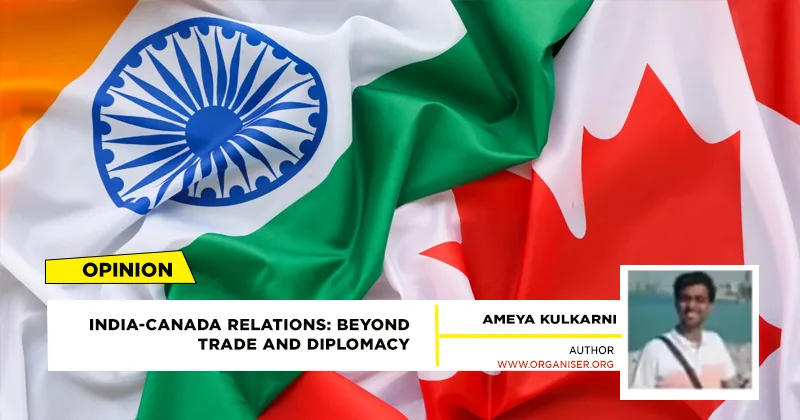
Today, India has flipped the script on Canada in most aspects. India’s economy ranks as the fifth -argest in the world, while Canada’s stands at ninth. India exported US$5.37 billion worth of goods to Canada in 2022, while Canada reciprocated with US$4.32 billion. India is the largest source of foreign students in Canada, with around 600,000 Indian students attending Canadian institutions. The presence of nearly 1.4 million Canadians identifying as Indian adds another layer of complexity to this relationship, creating a robust diaspora. Despite these favourable statistics, the current diplomatic crisis reveals an asymmetry that Canada seems unwilling to acknowledge. The paradigm governing India-Canada relations has shifted significantly; India’s growing power and influence challenge the previously dominant narratives of ‘developed-underdeveloped’ or an east-west.
In the current geopolitical landscape, India’s assertiveness is a calculated but necessary recalibration of its foreign policy, responding to latent threats as well as even those that extend beyond traditional rivalries. At the heart of this dispute is the issue of sovereignty, which is instrumental in the current churn in global geopolitics. The wars in Ukraine and the ongoing conflict between Hamas and Israel highlight how the concept of sovereignty is not only foundational but also a flashpoint for international conflicts which is likely to often supersede other tenets of statism in shaping a state’s assertiveness. An unchecked global coordination by Khalistanis, especially in Canada and the US has posed an increasing challenge to India’s sovereignty and territorial integrity through renewed calls for secessionism. India views Khalistani separatists as a direct challenge to its sovereignty, as they seek to promote a radical agenda from within Canadian borders. India’s demand for extradition and accountability for those promoting such agendas is not merely a matter of political posturing but a legitimate concern rooted in the preservation of its national integrity. This is a sentiment that Canada must recognise, especially given its own experiences with regional separatism, such as the situation in Quebec.
Canada often may have prided itself on its accommodation of internal dissent, yet it overlooks the distinction between managing internal challenges to sovereignty and addressing external challenges that threaten a state’s territorial integrity. While Canadians may find it admirable to accommodate internal demands for autonomy such as in the Quebec region, they must understand that India’s situation is complicated by external actors who are emboldened by the support of another nation.
Often, there is almost a direct correlation between state power and assertions of sovereignty. As the world re-enters an age of sovereignty, countries must be prepared to navigate a rapidly shifting landscape of threats and state responses. For Canada, recognising India’s genuine and legitimate concerns about sovereignty will be crucial in determining the future of their bilateral relationship. If Canada continues to disregard the shifts in the global power landscape, it risks further damaging its ties with India, which could have lasting repercussions not only for bilateral trade and diplomacy but also for its own role in Asia which it seeks through its Indo-Pacific strategy. The failure to recognise these shifts has the potential to undermine a historically strong relationship. As we navigate this age of sovereignty, state response from rising powers is likely to shift commensurately with the shape-shifting nature of threats, especially those that are transnational in character.