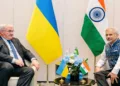
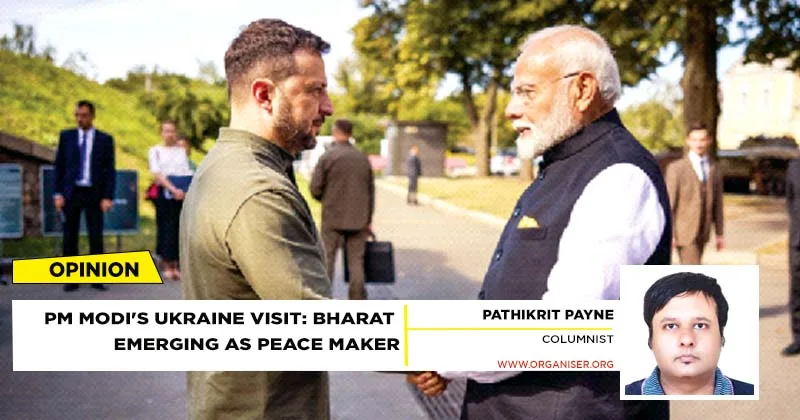
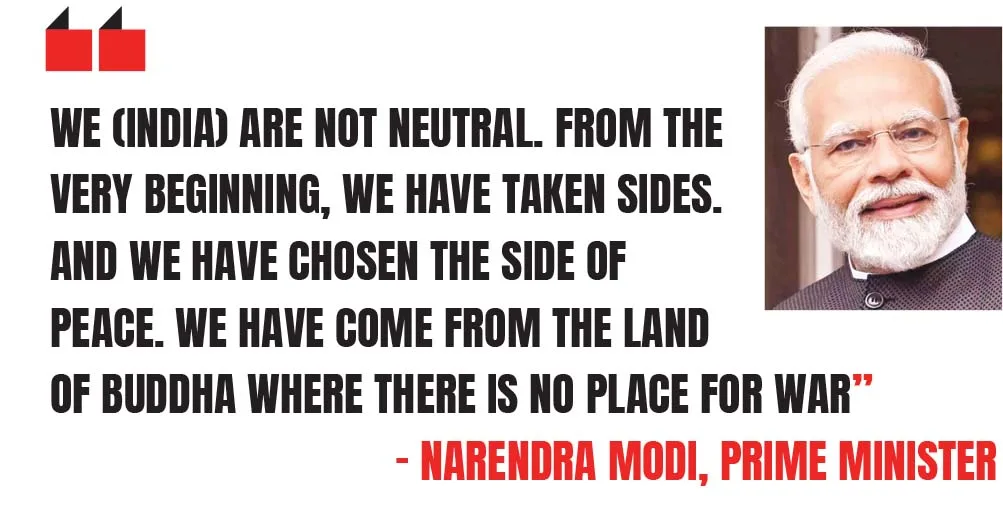
Nearly 45 days after his official visit to Russia in the first half of July, 2024, Prime Minister Modi visited Ukraine. In Kyiv, he placed flowers at the memorial of the children killed in the conflict and showed solidarity with Ukraine. PM Modi reiterated India’s undiluted stance for global peace, and respect for sovereignty and territorial integrity of all countries. Modi emphasised that India has not been ‘neutral’ or ‘indifferent bystander’ during the war between Ukraine and Russia, but has always been on the side of peace.
Decoding the Modi Template
While critics, naysayers and especially Western analysts have tried to project this visit of PM Modi in Ukraine as a ‘balancing act’ to ‘restore’ his image in the West, reality is far different from this narrative. In the first place, if not on equal terms, the conflict between Russia and Ukraine has been devastating for both the countries in terms of loss of lives. No doubt Russia is a far bigger economy with limitless resources and major global clout. But nevertheless, this war has not been easy for it either. Against this backdrop, when a conflict between Ukraine and Russia has impacted most countries of the world as a result of massive supply chain disruptions of critical commodities, what was most important for influential countries of the West, as especially UN, was to show solidarity with both countries, empathise with both of them, and then requesting both to come to the negotiating table for sorting out the differences. This is exactly what PM Modi has tried to do by standing in arms with leaders of both nations, trying to understand their concerns and issues, and then requesting them to end the war. Whether this would end the war or not is another issue, however, from the perspective of the approach of the Modi Government, this is a template that the West must emulate henceforth.
West’s Double Standard
Unfortunately, the Western approach towards the Ukraine-Russia conflict has been far from being impartial. By demonising Putin, imposing sanctions on Russia and by arming Ukraine to the hilt, the West, especially the US-led NATO countries have chosen their side. When Putin is termed as ‘War Criminal’ by the West, if Western powerhouses expect that Putin-led Russia would pay heed to Western calls for ceasefire, or come to the negotiating table, then it is no more than just a delusionary thinking.
Surprisingly, even as PM Modi was in Ukraine, where Zelensky appeared to project Ukraine as a victim of the conflict, his army was meanwhile in the Kursk region of Russia, having penetrated almost 30 km, and was now involved in severe clashes with Russian forces. As some analysts pointed out, in Kursk, Russian forces were literally fighting NATO logistics units, NATO communication units, NATO command units, and perhaps NATO personnel too. Major retaliations from Russia that may target Kyiv and beyond, was inevitable. If this war has to end then one must go to the genesis of the war and take corrective measures.
Siding with Peace More Important
India’s External Affairs Minister Dr S Jaishankar has often reiterated that the Ukraine-Russia conflict has a lot to do with the ‘post-Soviet politics’ and ‘expansion of NATO’. With the end of the Cold War and disintegration of the Soviet Union, much like the Warsaw Pact, NATO too should have seen the end of its shelf life. But instead, NATO continued its expansion in Eastern Europe, almost on the threshold of Russian borders. It essentially also can no more be termed as a defensive formation. Today Russia is literally fighting a Ukraine that is being armed by more than 30-odd NATO countries. In other words, Ukraine is being made to fight a war against Russia that most NATO members would shudder to fight themselves. And then it is expected that the rest of the world must stand in the cue and support West-backed NATO in this war. In essence, everyone must feel for the lives lost in Ukraine, in a war that was avoidable, had it not been for the expansion spree of NATO that fuels wars, triggers geopolitical crises and eventually helps Western military industrial complexes through massive contracts for weapon systems.
As Dr S Jainshankar stated at the 77th UN General Assembly (UNGA) on September 24, 2022, ‘As the Ukraine conflict continues to rage, we are often asked whose side are we on. And our answer, each time, is straight and honest. India is on the side of peace and will remain firmly there’. He then states, ‘We are on the side of those struggling to make ends meet, even as they stare at the escalating costs of food, of fuel and fertilizers’.
Standing for Global South
In fact, as the Voice of Global South, India has consistently sought to end the war primarily because both Ukraine and Russia collectively form critical parts of the food basket of the world. The conflict in the Black Sea belt therefore has ended up in creating massive disruptions in the global supply chain of not just foodgrains but also edible oil, crude oil, natural gas, coal, and fertilizers among many. For most of the small, emerging and least developing economies, the covid related disruptions were themselves a massive setback to their economies. Even before they could barely recover, and stand on their feet again, the Ukraine-Russia conflict devastated them due to unprecedented rise in prices of critical commodities, exacerbated by unilateral sanctions on Russia by the US and EU. Many countries were pushed to the brink of bankruptcy due to severe balance of payment crisis as a result of all these. The West Asia crisis is further adding to the woes.
Having herself been in such situations barely three decades back when India faced a similar balance of payment crisis, India knows what it takes to go through challenging times to emerge as the fifth largest economy of the world. Therefore, India genuinely wants this conflict to end, as its own economic growth hinges on stability of global prices of critical commodities and functioning of global supply chains without disruptions.
Bharat’s Growth Story
It is also to be understood that India’s own growth story, from the verge of bankruptcy to emerging as the fifth largest economy of the world, termed as ‘bright spot on the dark horizon’ by IMF, has happened in a difficult neighborhood. India had to fight multiple wars with Pakistan, and Pak-based terror continues its attempt to bleed India through ‘a thousand cuts’. Over the years, India has developed a robust counterterror machinery to deal with such menace, but at the same time, India did not allow its economic growth story to get hindered. Even as Pakistan’s economic downsides continue aided by widespread radicalism, sectarian violence and dysfunctional governments, India continues to be one of the fastest growing economies among the major economies of the world.
India, likewise, has serious disputes with China but has consistently worked to ensure that the disputes in borders do not cross the threshold and take the shape of major conflicts, which would be self-defeating for both. India’s diplomats work actively to manage the disputes with China. Even as military build-up in border areas, as well as overall military preparedness continues unabated, China also continues to be one India’s major trading partners. It may not guarantee peace forever but however, India has demonstrated a potential template for economic development that is possible even in a difficult neighborhood, while maintaining tranquility with difficult neighbours. Ukraine in the same manner, ideally could have stayed neutral. It could have developed good relations with both the EU and Russian Federation. It would have been a win-win situation for all. But that is not to be. It ended up being used as a proxy to fight someone else’s war and devastating itself.
Is there Pressure from the US?
There is no denial of the fact that the US has been trying to influence India to change its foreign policy stance. Somehow, it seems that some are not able to digest the fact that India’s foreign policy works for India now and not for anyone else. There are also certain quarters who believe that enough efforts were made by certain elements from the West to interfere in India’s Lok Sabha elections. Some believe that the West, for all its big claims on democracy, have always preferred ‘compromised’ leaders in developing economies, rather than those who work steadfastly for their own country’s growth with an uncompromising no-nonsense mindset.
Nevertheless, it is in mutual interest for both India and the US to have good relations with each other. It is however, for the US to decide what it wants, because from inordinate delays in delivery of GE F-404 engines for India’s Tejas fighter jet programme to allegations of involvement of many Western NGOs in triggering unrest in India, somehow, in spite of all the potentials, it seems somewhere that the Indo-US relation is not at its best right now. And a lot has to do with the US being unhappy with India’s foreign policy. But this entire approach to browbeat a nation to fall in line may have worked in the past with many, may even work now on many, but when it comes to India, applying it and expecting quick outcomes, may not be that easy anymore.
The West must therefore overcome this approach of triggering conflicts every few years and expecting countries like India to support such wars. Ultimately it boils down to what PM Modi has stated for long, that ‘this is not an era of war’. The whole concept of conflict induced economic growth where military industrial complexes make money at the cost of global peace, must be put to rest. The West is equally responsible for the Ukraine-Russia conflict, if Russia is to be blamed for it.
Modi’s Task Has Not Been Easy
In an extremely difficult geopolitical environment with major conflicts going in in critical geographical areas, with potential of conflicts spilling over into uncontrollable regional wars gaining momentum, with economies still reeling under severe supply chain challenges, Modi Government has worked relentlessly to maintain good relation with all countries, and has strived to do what is good for India and the world. Through the Ukraine visit Modi Government has demonstrated its commitment towards peace. However, the Ukraine visit does not mean that India has given up on its strategic autonomy or would be giving up on friendship with Russia. This friendship permeates down to people and their collective memories in India, and not just a mere Government to Government connection. India remains the only country as a bridge between Western bloc and Russia. Most of the rest have burnt their bridges. Therefore, the West must celebrate it instead of being upset with India. It may in future be the only hope to negotiate peace in the region, if at all there is any possibility left before the raging fires of the war spreads to the rest of Europe.