Bangladesh Government toppled amid Islamist-led protests, escalating regional instability for India
July 17, 2026
  • Read Ecopy
  • Circulation
  • Advertise
  • Careers
  • About Us
  • Contact Us
Android AppiPhone AppArattai
Organiser
  • ‌
  • Bharat
    • Assam
    • Bihar
    • Chhattisgarh
    • Jharkhand
    • Maharashtra
    • View All States
  • World
    • Asia
    • Europe
    • North America
    • South America
    • Africa
    • Australia
  • Editorial
  • International
  • Opinion
  • RSS @ 100
  • More
    • Op Sindoor
    • Analysis
    • Sports
    • Defence
    • Politics
    • Business
    • Economy
    • Culture
    • Special Report
    • Sci & Tech
    • Entertainment
    • G20
    • Azadi Ka Amrit Mahotsav
    • Vocal4Local
    • Web Stories
    • Education
    • Employment
    • Books
    • Interviews
    • Travel
    • Law
    • Health
    • Obituary
  • Subscribe
    • Subscribe Print Edition
    • Subscribe Ecopy
    • Read Ecopy
  • ‌
  • Bharat
    • Assam
    • Bihar
    • Chhattisgarh
    • Jharkhand
    • Maharashtra
    • View All States
  • World
    • Asia
    • Europe
    • North America
    • South America
    • Africa
    • Australia
  • Editorial
  • International
  • Opinion
  • RSS @ 100
  • More
    • Op Sindoor
    • Analysis
    • Sports
    • Defence
    • Politics
    • Business
    • Economy
    • Culture
    • Special Report
    • Sci & Tech
    • Entertainment
    • G20
    • Azadi Ka Amrit Mahotsav
    • Vocal4Local
    • Web Stories
    • Education
    • Employment
    • Books
    • Interviews
    • Travel
    • Law
    • Health
    • Obituary
  • Subscribe
    • Subscribe Print Edition
    • Subscribe Ecopy
    • Read Ecopy
Organiser
  • Home
  • Bharat
  • World
  • Operation Sindoor
  • Editorial
  • Analysis
  • Opinion
  • Culture
  • Defence
  • International Edition
  • RSS @ 100
  • Magazine
  • Read Ecopy
Home World

Bangladesh Government toppled amid Islamist-led protests, escalating regional instability for India

Bangladesh is facing severe political turmoil with the ousting of PM Sheikh Hasina's government amid violent student-led, Islamist-backed protests. This instability, alongside regional conflicts in Myanmar and Pakistan, presents significant challenges for India's efforts to maintain regional stability and foster democratic governance in South Asia

Ameya KulkarniAmeya Kulkarni
Aug 25, 2024, 04:00 pm IST
in World, Opinion
Follow on Google News
FacebookTwitterWhatsAppTelegramEmail

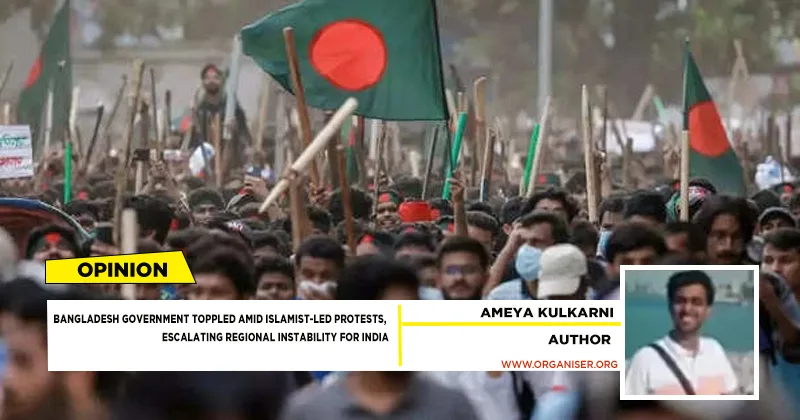
Violent student-led, Islamist-backed protests in Bangladesh have toppled Prime Minister Sheikh Hasina’s government, and mob attacks targeting those viewed as supporters of her secular Awami League party – in particular, the country’s dwindling Hindu minority – are increasing. At a time when neighbouring Myanmar is engulfed in violence, and the Pakistan-Afghanistan belt remains fertile ground for cross-border terrorism, political upheaval in Bangladesh, two years after the overthrow of Sri Lanka’s government, is the last thing India, the regional power, needs.

Achieving lasting political stability in South Asia would require entrenching democracy. But this is no easy feat. India notwithstanding, the region remains in thrall to longstanding autocratic traditions and centralisation of power. Hasina, for example, had become autocratic during her more than 15 years in office. In this context, popular demands for democracy are far more likely to lead to violence and political chaos than to smooth political transitions.

As Hasina has shown, autocratic leaders do not necessarily survive popular challenges to their rule. Consider the chaos that engulfed Sri Lanka in 2022, when a severe economic crisis triggered mass protests against the Rajapaksa brothers’ dynastic, un-democratic regime. President Gotabaya Rajapaksa, like Hasina, initially unleashed a violent crackdown, but his opponents proved too powerful. Like Hasina, he gave up and fled the country without formally resigning. Sri Lankan protesters then occupied the presidential palace, much as Bangladeshi mobs have ransacked Hasina’s sprawling official residence.

But when an autocrat is toppled, it is often the military – not a democratic government – that takes over, even if behind a civilian facade. Bangladesh is no exception. The military has attempted at least two dozen coups since the country’s violent birth in 1971 and ruled for several extended periods since its 1975 assassination of Bangladesh’s charismatic founding leader, Sheikh Mujibur Rahman.

Hasina, who is Rahman’s daughter, stood out for her success at keeping the military (and Islamists) in check, at least until last week, when the army chief refused to continue supporting her crackdown on rampaging protesters. The military then facilitated her escape to India and established an interim government of civilian “advisers” with little experience with national issues.

To be sure, some South Asian countries have made some progress toward democracy. In particular, Bhutan’s democratic transition is proceeding apace, thanks to a benevolent king who has supported the transition from a traditional monarchy to a parliamentary system. Earlier this year, the country’s fourth national election brought an opposition party to power.

But elections alone – even if competitive – do not guarantee popular empowerment or adherence to constitutional rules, especially when the military holds decisive power. Consider Pakistan, which held elections earlier this year. The military’s preferred candidate, Shehbaz Sharif, returned as prime minister, but his government will survive only at the pleasure of the country’s effective ruler, the army chief. Until the rule of law is firmly entrenched and those wielding extra-constitutional power are unequivocally reined in, democratic progress will remain limited and reversible.

Myanmar learned this the hard way. Though the military had called the shots in the country since independence in 1948, it began ceding power to a nascent civilian government in 2015, filling the country with hope for a democratic future. But in February 2021 – barely six years later – it staged a coup. This time, however, resistance has proved intense, and heavily armed insurgent groups – some receiving “non-lethal aid” from the United States – are managing to expand their territorial control. In response, the military junta has stepped up punitive air strikes and artillery barrages.

The violence and deepening humanitarian crisis are fueling instability beyond Myanmar’s borders. Already, more than 32,000 ethnic Chin have sought refuge in India’s Mizoram state, and thousands more have fled to the state of Manipur, where their arrival has stoked violent ethnic conflict. And it is not just the Chin: India is also home to millions of illegal immigrants from Bangladesh, whose ranks are set to grow as desperate Hindus flee Islamist attacks against them.

When it comes to security risks, immigration is just the beginning. Political turbulence in the Maldives – which began in 2012, when Islamist radicals forced the country’s democratically elected president to resign at gunpoint – has enabled China to gain a foothold in India’s maritime backyard. This year, China signed a military pact with the Maldives and docked a giant marine research ship in a Maldivian port. Meanwhile, Islamist radicals are expanding their grassroots base, establishing ISIS and al-Qaeda cells on the archipelago.

Mounting economic pressures compound the security risks. Pakistan has repeatedly sought International Monetary Fund bailouts in recent years. And Hasina’s overthrow could usher in challenging times for the once-booming Bangladeshi economy, as the country’s foreign reserves dwindle rapidly. None of this is conducive to regional prosperity. As long as South Asian countries remain plagued by political instability, strong and sustainable economic growth will remain elusive.

The difficulty of maintaining political stability and advancing democratisation can also be seen in Nepal – a country with which India has close cultural and historical ties. Last month, the country swore in its 14th government in just 16 years, led by four-time prime minister K.P. Sharma Oli of the pro-China Marxist-Leninist Party. Oli, who spent years in jail in the 1970s and 1980s for waging war against the state, is Nepal’s fifth head of government in five years, replacing another former communist guerrilla, Pushpa Kamal Dahal.

This puts India, the world’s largest democracy and South Asia’s geographical hub, in a difficult situation. It must minimise the spillover effects of political and economic instability in its neighbourhood, even as it seeks economic and strategic partnerships far beyond its troubled region.


Topics: IslamistsSheikh HasinaHindu minorityBangladesh GovernmentPM Sheikh Hasina
Share1TweetSendShareSend
✮ Subscribe Organiser YouTube Channel. ✮
✮ Join Organiser's WhatsApp channel for Nationalist views beyond the news. ✮
Previous News

PM Modi’s Kyiv Visit: A diplomatic push to end Russia-Ukraine war and promote global peace

Next News

Bangladesh Violence: Silent march, loud voice

Related News

An investigation into the demographic, cultural and security transformations unfolding across Europe's cities

Europe’s No-Go Zones and Parallel Societies: How political Islam and immigration are reshaping the continent?

Representative Image

Radical Islamist drivers weaponise public transit to target and exploit Hindu women

Former Prime Minister of Bangladesh Sheikh Hasina

Bangladesh: Sheikh Hasina vows return despite death sentence; Aims for restoration of democracy & rule of law in Dhaka

Saleem and Jaleel arrested in forced religious conversion case

Karnataka Conversion Case: Forced conversion of Hindu woman and minor son sparks outrage; Saleem and Jaleel arrested

FIR filed against the Islamists in the Love Jihad case in Bhopal

Love Jihad again in Bhopal: Minor Hindu girl forced to drink beer, trapped and pressured to convert by Islamists

Dr Surendra Jain, Joint General secretary, VHP

Cow slaughter & insult to Sanatan is unbearable; Hindus ready to go to any extent for cow protection: Dr Surendra Jain

Load More

Latest News

NEET 2026 Re-Exam Result announced

Re NEET 2026 Result announced by NTA: 11.21 lakh candidates qualify; Download scorecard here & know the state toppers

Karnataka: Counterfeit Rs 500 note manufacturing unit busted in Beltangady; Ibrahim-led gang arrested

ED raids 16 locations in Tamil Nadu, two in Keralam and one in Srinagar in Roshan Fiaz crypto cyber fraud probe

Representative Image

Balochistan: Pakistani authorities cut food, medicine supply to the province along with erosion indigenous culture

Iran-themed event at Shantiniketan High School in Hyderabad.
Image courtesy: Tathvam-asi (@Tathvam_asi on X

LRPF moves NHRC over display of Iran flags, Ayatollah Ali Khamenei poster at Hyderabad’s Shantiniketan school assembly

Parakkal Mohammed (File Photo)

Keralam: Parakkal Mohammed, who defied opposition to join the RSS, dies after prolonged illness in Wayanad

India's Ayush exports doubled to USD 2.16 billion in a decade, with NITI Aayog charting Ayurveda's global expansion

Ayurveda Export Decade: How India doubled Ayush exports to USD 2.16 billion and reached 150 countries

Rajouri's Bhairav Yatra

Rajouri’s Bhairav Yatra recognised as India’s intangible cultural heritage

Telangana: ABVP seeks Success School recognition cancellation; MoS calls Kalma homework threat to religious freedom

Tribute to Shri Nand Kishore Goenka

Shri Nand Kishore Goenka: A yugpurush of service, values, dedication and national spirit

Load More
  • Privacy
  • Terms
  • Cookie Policy
  • Refund and Cancellation
  • Delivery and Shipping

© Bharat Prakashan (Delhi) Limited.
Tech-enabled by Ananthapuri Technologies

  • Home
  • Search Organiser
  • Bharat
    • Assam
    • Bihar
    • Chhattisgarh
    • Jharkhand
    • Maharashtra
    • View All States
  • World
    • Asia
    • Africa
    • North America
    • South America
    • Europe
    • Australia
  • Editorial
  • Operation Sindoor
  • Opinion
  • Analysis
  • Defence
  • Culture
  • Sports
  • Business
  • RSS @ 100
  • Entertainment
  • More ..
    • Sci & Tech
    • Vocal4Local
    • Special Report
    • Education
    • Employment
    • Books
    • Interviews
    • Travel
    • Health
    • Politics
    • Law
    • Economy
    • Obituary
  • Subscribe Magazine
  • Read Ecopy
  • Advertise
  • Circulation
  • Careers
  • About Us
  • Contact Us
  • Policies & Terms
    • Privacy Policy
    • Cookie Policy
    • Refund and Cancellation
    • Terms of Use

© Bharat Prakashan (Delhi) Limited.
Tech-enabled by Ananthapuri Technologies