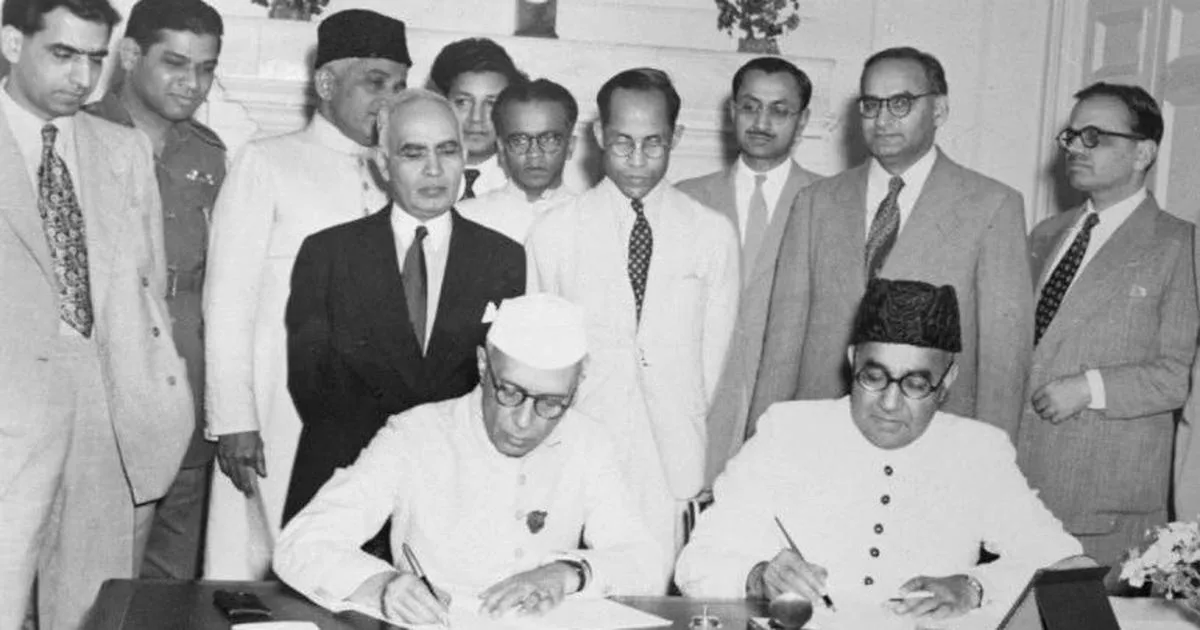
With rising concerns about the treatment of minorities in countries neighbouring India, it is important to revisit a significant moment in history—the Nehru-Liaquat Pact, also known as the Delhi Agreement. Signed on April 8, 1950, by India’s Prime Minister Jawaharlal Nehru and Pakistan’s Prime Minister Liaquat Ali Khan, this pact was a commitment to protect religious minorities in both countries. But the current situation in the neighbouring countries says otherwise.
In the aftermath of the 1947 partition, which created India and Pakistan along religious lines, the region was engulfed in communal violence and one of the largest forced migrations in history. By 1950, the situation was dire, particularly in East Pakistan (now Bangladesh) and West Bengal, with widespread violence against minorities. The Nehru-Liaquat Pact aimed to address this by ensuring the protection of life, property, and religious freedom for minorities in both nations. The situation mirrored present-day Bangladesh and the tensions there.
The pact’s provisions included the protection of minorities, freedom of movement, restoration of abducted women and looted property, non-discrimination in employment, and the establishment of Minority Commissions to oversee its implementation. Although the pact was a crucial step towards stabilising the situation, its uneven implementation meant that communal tensions persisted.
Did the pact change anything?
The division of East and West Pakistan, which led to the creation of Bangladesh in 1971, was a monumental event in South Asian history. Yet, recent events suggest that the challenges of the past have not been fully resolved. Bangladesh is currently experiencing severe unrest, with troubling reports of targeted violence against Hindu minorities. This includes looting, attacks, and sexual violence, indicating that the issues contributing to the country’s division are still at play.
Minorities in Bangladesh
The unrest in Bangladesh has deep roots in the partition of British India in 1947, which created Pakistan and divided it into West Pakistan (now Pakistan) and East Pakistan (now Bangladesh). The significant linguistic and cultural differences between the Bengali-speaking East and the Urdu and Punjabi-speaking West fueled discord and protests.
Economic disparities further heightened tensions. Despite East Pakistan’s large population and its crucial role as a major jute producer, it received inadequate resources and funding compared to West Pakistan. The political power was concentrated in the West, leaving East Pakistan’s aspirations largely ignored, and Sheikh Mujibur Rahman’s push for greater autonomy was rejected.
The situation escalated in the 1970 elections when the Awami League, led by Rahman, won a decisive victory in East Pakistan. West Pakistani leaders’ refusal to transfer power led to a severe crackdown by the military in March 1971, resulting in mass violence and displacement. Rahman declared Bangladesh’s independence, igniting a war with the Pakistani military, which ended with the country’s victory and independence in December 1971.
Today, ongoing violence against minorities in Bangladesh highlights the enduring challenges and the complex legacy of the 1971 conflict.
Minorities in Pakistan
The persecution of Hindus in Pakistan is a significant and ongoing issue that has resulted in a dramatic decline in their population since the country’s independence in 1947. Hindus, who once constituted a substantial portion of the population in what is now Pakistan, have faced systemic discrimination, violence, forced conversions, and social marginalisation, leading to their dwindling numbers and deteriorating status.
At the time of partition, Hindus represented approximately 15-20 per cent of the population in West Pakistan (now Pakistan) and about 30 per cent in East Pakistan (now Bangladesh). Over the decades, the Hindu population in Pakistan has sharply declined. This significant drop can be attributed to factors such as migration, forced conversions, and ongoing religious persecution.
A recent report by the Economic Advisory Council to the Prime Minister (EAC-PM) highlights different trends in India. Unlike in neighbouring South Asian countries where the majority religious denomination has increased and minority populations have diminished, India has witnessed a decrease in the share of its majority Hindu population and an increase in religious diversity. The paper also notes that Muslim-majority countries, with the exception of the Maldives, have seen an increase in the share of the majority religious group. Specifically, Bangladesh has experienced an 18 per cent increase in the share of its majority religious group, while Pakistan has seen a 3.75 per cent increase in the share of Muslims.
This cross-country analysis of minority status over 65 years highlights the stark contrast in religious demographics and the evolving landscape of minority rights and representation globally.
Minorities in India
The conditions for minorities in India present a striking contrast to those in neighbouring countries. A recent report by the Economic Advisory Council to the Prime Minister indicates that minorities in India are not only being protected but are also thriving. According to the report, the share of the majority Hindu population has declined significantly from 84.7 per cent in 1950 to 78.1 per cent in 2015.
The EAC-PM report notes that the share of Hindus in India’s population decreased by 7.82 per cent between 1950 and 2015, while the Muslim population increased by 43.15 per cent over the same period. The paper also observed a 5.38 per cent increase in the Christian population and a slight decrease in the share of Jains. This indicates a relatively diverse environment in India, with a trend towards increased minority representation despite the overall reduction in the majority Hindu population.
The paper, authored by Shamika Ravi, Abraham Jose, and Apurv Kumar Mishra, reveals that the proportion of Muslims in India increased by over 43 per cent, rising from 9.8 per cent in 1950 to 14.1 per cent in 2015. Meanwhile, the share of Jains decreased slightly from 0.4 per cent to 0.3 per cent, and the share of Christians grew modestly from 2.2 per cent to 2.4 per cent, representing a 5.4 per cent increase. Sikhs saw an increase from 1.2 per cent to 1.9 per cent, a rise of 6.6 per cent, whereas the proportion of Parsis fell sharply by 85 per cent, from 0.03 per cent in 1950 to 0.004 per cent in 2015.
The report highlights that these shifts in population demographics suggest a conducive environment for fostering diversity. It emphasises that effective policy, political decisions, and societal processes have contributed to an environment that supports increasing diversity.
Who stood by the Pact?
Today, the issues addressed by the Nehru-Liaqat pact persist. Bangladesh, which emerged from the 1971 split of Pakistan, faces severe unrest with reports of targeted violence against Hindus. In contrast reports reveals that while India’s Hindu majority has decreased from 84.7 per cent in 1950 to 78.1 per cent in 2015, the Muslim population has grown by over 43 per cent. Additionally, the populations of Christians and Sikhs have also seen increases, highlighting a supportive environment for minority communities. This trend underscores India’s commitment to fostering an inclusive society where diverse groups are not only protected but are also thriving.
Certainly, India appears to be the only country that has upheld the promises outlined in the Nehru-Liaquat Pact, in stark contrast to its counterparts. Unlike these nations, which have subjected minorities to exploitation, forced conversions, and violence, India has made substantial efforts to protect and support its minority communities. For those who did not witness the events of 1947 or the 1970s, the current situation in Bangladesh—where Hindus are facing severe persecution—serves as a stark reminder of the ongoing challenges faced by minorities in countries that identify themselves as ‘Islamic’ nations.