Book Review: 'A Decade for Mandirs' by Sandeep Singh explores reviving mandirs as socio-economic centers
June 26, 2026
  • Read Ecopy
  • Circulation
  • Advertise
  • Careers
  • About Us
  • Contact Us
Android AppiPhone AppArattai
Organiser
  • ‌
  • Bharat
    • Assam
    • Bihar
    • Chhattisgarh
    • Jharkhand
    • Maharashtra
    • View All States
  • World
    • Asia
    • Europe
    • North America
    • South America
    • Africa
    • Australia
  • Editorial
  • International
  • Opinion
  • RSS @ 100
  • More
    • Op Sindoor
    • Analysis
    • Sports
    • Defence
    • Politics
    • Business
    • Economy
    • Culture
    • Special Report
    • Sci & Tech
    • Entertainment
    • G20
    • Azadi Ka Amrit Mahotsav
    • Vocal4Local
    • Web Stories
    • Education
    • Employment
    • Books
    • Interviews
    • Travel
    • Law
    • Health
    • Obituary
  • Subscribe
    • Subscribe Print Edition
    • Subscribe Ecopy
    • Read Ecopy
  • ‌
  • Bharat
    • Assam
    • Bihar
    • Chhattisgarh
    • Jharkhand
    • Maharashtra
    • View All States
  • World
    • Asia
    • Europe
    • North America
    • South America
    • Africa
    • Australia
  • Editorial
  • International
  • Opinion
  • RSS @ 100
  • More
    • Op Sindoor
    • Analysis
    • Sports
    • Defence
    • Politics
    • Business
    • Economy
    • Culture
    • Special Report
    • Sci & Tech
    • Entertainment
    • G20
    • Azadi Ka Amrit Mahotsav
    • Vocal4Local
    • Web Stories
    • Education
    • Employment
    • Books
    • Interviews
    • Travel
    • Law
    • Health
    • Obituary
  • Subscribe
    • Subscribe Print Edition
    • Subscribe Ecopy
    • Read Ecopy
Organiser
  • Home
  • Bharat
  • World
  • Operation Sindoor
  • Editorial
  • Analysis
  • Opinion
  • Culture
  • Defence
  • International Edition
  • RSS @ 100
  • Magazine
  • Read Ecopy
Home Bharat

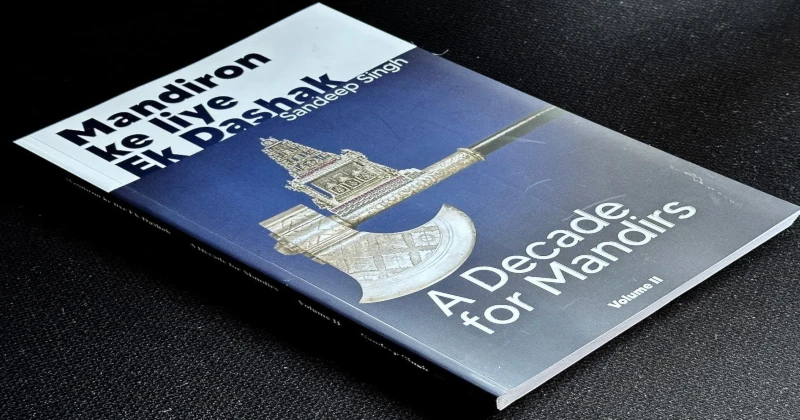
Book Review: ‘A Decade for Mandirs’ by Sandeep Singh explores reviving mandirs as socio-economic centers

In "A decade for Mandirs Volume II," Sandeep Singh addresses the anti-mandir bias in Bharat, proposing actionable solutions for reclaiming and restoring Hindu temples, including reclaiming deity rights, respecting pujaris, and reviving mandirs as socio-economic centers

Janhavi NaikJanhavi Naik
Jul 28, 2024, 06:00 pm IST
in Bharat, Book Review
Follow on Google News
Representative Image

Representative Image

FacebookTwitterWhatsAppTelegramEmail

This book is a continuation of Temple Economics Volume I by Sandeep Singh.

Although he explained in detail how Bharat is losing Mandirs in Volume I itself, talking solely is not the solution to fighting the obstacles to reclaiming the mandirs, particularly in this secular era. Hence, the author addresses actionable solutions for the same cause.

So, to have durable, pragmatic, and practical solutions, the author starts this book boldly addressing the deep-seated ‘anti-mandir bias’ in the entire ecosystem and also pays attention to this blazing issue of ‘how Bharat is losing Mandirs’ again when we are completely ‘free’. ( Are we?)

The author started with the instance of Kalighat Mandir and described how it suffered from imperial—colonial forces. A ‘tarksheel’ (logical) Hindu will agree with the author when he emphasises that bringing the internal affairs of the mandir to the court is a huge blunder for the future of the Mandirs of Bharat.

Describing the preconceived notion of people about the authority of the mandir, the author points out –  “The practice of modernising mandirs through reducing the authority in them and thereby, wealth of Brahmins has been going on since the late eighteenth century. The default assumption in Bharat today is that unless a mandir is inside a person’s home or there is evidence that it was founded as a private endowment, The public — either through state bodies or as individual citizens — have the right and even the responsibility to determine what goes on at Hindu mandirs.”

While analysing the bias and colonial mindset of the Indian Judiciary, Singh says –

“Once the pujaris went to the court, the judges and the Sarkari Hindus became the new pujaris. They started dictating the functioning of mandirs, not only those that went to them with their dispute but also of all the mandirs. Their interest was more in the money in the mandir than on pending cases in the courts.”

The author wants us to realise the fact that the government’s control over Hindu temples must be a point of apprehension and anguish for many Hindus. However, it is there; it has not reached a critical mass to spark widespread awareness and drive meaningful reform.

As we have that colonial mentality of accepting our appreciation from white faces to appeal to Laymen, the author cleverly decides to present the whole issue in the next unit through the lens of a foreigner; the author presents the perspective of a non-Hindu—Deonnie Moodie—to get a better understanding of this entire matter.

Even history students go through many books where a foreigner understands and appreciates Bharat better than a Hindu. From this perception, this book proves more useful to the students of social sciences.

Singh, in the next unit, breaks the wrong constructs formulated by either ‘colonial masters’ or the lack of adhyayan by Hindus. For instance, in the context of desh, we have misunderstood ‘In’ia’ as a name for Bharat. Further he breaks the wrong construct around panchatantra’s much talked shlok at every Hindu seminar i.e. ‘Vasudhaiva Kutumbakam’. The author explains that we’ve accepted the wrong vision of the entire statement.

Moreover, the author delves into the ramifications of these detrimental constructs of Hindu society by emphasising the verity that not reading our scriptures is the biggest fault line of present Hindu Society. The author points out that although there is much comprehension regarding identifying the enemies within,  not identifying enemies and their tactics properly will eventually harm our Hindu society. In Part III, Singh identifies various enemies, encompassing political Hindus, governmental Hindus, intentional enemies, and unintentional enemies. Like the previous volume, he presents these ideas through recent case studies.

In the present ideological warfare, Hindus need to be proactive rather than defensive on several issues, and the author in part IV suggests certain ways to do this. But first, Hindus should demand the reclaiming of temples along with the restoration of the murtis and arrange legal support for this cause.

The author gives several solutions for restoring mandirs to their glory, such as deity’s rights, respecting the pujaris, reviving utsav fairs, cleaning Mandirs, reclaiming literature, reestablishing Mandirs as a centre of socio-economic activities and building new Mandirs.

The insights provided by Sandeep Singh in this volume of Temple Economics are not just a wake-up call but a roadmap for action for all Hindus. The author is currently working on the third volume. After delving into these eye-opening first two volumes, which address the critical issue of Hindu Mandirs, readers will surely wait for the next instalment.

Topics: HindusHindu TemplesA decade for Mandirs
Share1TweetSendShareSend
✮ Subscribe Organiser YouTube Channel. ✮
✮ Join Organiser's WhatsApp channel for Nationalist views beyond the news. ✮
Previous News

Modi 3.0: National Security Priorities

Next News

1947 Letter: How Congress Govt turned to RSS to rescue Hindu and Sikh women from Pakistan

Related News

Amazon in dock for mocking Hindu Gods

Amazon File: From Ganesha to Aryabhatta – Has Amazon India become a platform for Anti-Hindu narratives?

Bangladesh Hindus protest against Bhagwan Ram photo desecration; Chant Jai Sri Ram against radical islamist atrocities

RSS Sarsanghchalak Dr Mohan Bhagwat addressing the gathering in Keralam on the occasion of lecture series on 100 years of RSS

Journey of RSS in 100 Years | Hindu means cultural heritage of Bharat; none is outsider to Sangh: Dr Bhagwat in Keralam

Keralam: Audit finds gold and silver ornaments missing from nearly 20 temples under Neyyattinkara Devaswom sub group

RSS functionaries on the stage on the occasion of samapan samaroh of Rashtriya Swayamsevak Sangh’s Karyakarta Vikas Varg–Pratham of Purvi Uttar Pradesh Kshetra on June 10

RSS has awakened self-realisation in Hindu society: Ramdatt Chakradhar

New York anti-Hindu Bill fails to advance: How the bill fueled bias & espoused caste discrimination

Load More

Latest News

Y.D. Manjunath, Additional Excise Commissioner and brother-in-law of Karnataka PWD Minister Satish Jarkiholi

ED raids Karnataka Excise Dept officials: Rs 13.3 Cr seized, Minister Satish Jarkiholi’s brother-in-law under scanner

Former -DMK Minister EV Velu (File Photo)

Tamil Nadu: Anti-graft agency raids 13 locations linked to ex-DMK Minister EV Velu over alleged contract irregularities

Government introduces AIR SUVIDHA portal following WHO Ebola emergency for international travellers

The Emergency: India’s darkest chapter, the struggle for democracy and the ban on the RSS

Exposing Western Media’s Climate Hypocrisy: When Europe burns it’s just weather, When India heats up it’s a crisis

Rahul Gandhi’s 2018 Panama Papers Remark: Congress leader apologetic in MP High Court, but political fallout continues

UP Govt orders audit of various coaching centres that are illegally constructed

Lucknow Coaching Fire: UP CM Yogi Adityanath orders statewide fire safety audit, forms special teams across districts

India’s education debate needs clarity, not noise

Scuffle at the Tiruvananthapuram Municipal Corporation on June 25

Keralam: Nine BJP councillors injured as CPM protest demanding Mayor’s resignation turns violent at Thiruvananthapuram

India's textile ambitions are being woven through local manufacturing strengths, innovation, sustainability and an expanding global trade footprint

National Textile Export Roadmap 2030: India’s strategic push for a $100 billion global textile presence

Load More
  • Privacy
  • Terms
  • Cookie Policy
  • Refund and Cancellation
  • Delivery and Shipping

© Bharat Prakashan (Delhi) Limited.
Tech-enabled by Ananthapuri Technologies

  • Home
  • Search Organiser
  • Bharat
    • Assam
    • Bihar
    • Chhattisgarh
    • Jharkhand
    • Maharashtra
    • View All States
  • World
    • Asia
    • Africa
    • North America
    • South America
    • Europe
    • Australia
  • Editorial
  • Operation Sindoor
  • Opinion
  • Analysis
  • Defence
  • Culture
  • Sports
  • Business
  • RSS @ 100
  • Entertainment
  • More ..
    • Sci & Tech
    • Vocal4Local
    • Special Report
    • Education
    • Employment
    • Books
    • Interviews
    • Travel
    • Health
    • Politics
    • Law
    • Economy
    • Obituary
  • Subscribe Magazine
  • Read Ecopy
  • Advertise
  • Circulation
  • Careers
  • About Us
  • Contact Us
  • Policies & Terms
    • Privacy Policy
    • Cookie Policy
    • Refund and Cancellation
    • Terms of Use

© Bharat Prakashan (Delhi) Limited.
Tech-enabled by Ananthapuri Technologies