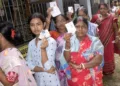
The tepid voter participation observed in the initial two phases of the 2024 Lok Sabha elections has reignited the discourse surrounding the proposition of ‘compulsory voting’. Nonetheless, the anxieties stemming from this have been somewhat assuaged by the release of the final voter turnout statistics for these phases by the Election Commission, as well as the subsequent phases. Presently, there exists no notable deviation in the voter turnout metrics between the ongoing elections and the Lok Sabha elections of 2019 and 2014. The concerted endeavours undertaken by the Election Commission of India to bolster voter engagement post-initial phases, the reiterated calls to voting by Prime Minister Modi, and the multifaceted initiatives spearheaded by both governmental and non-governmental entities such as the National Service Scheme, the National Cadet Corps, alongside various student organisations and aware segments of society, have all played pivotal roles in fostering heightened civic awareness.
Nevertheless, achieving a mere 65 percent voter turnout falls short of any remarkable milestone. Aiming for a turnout of 90-95 percent is indispensable for upholding the vitality, robustness, and vibrancy of democracy. India must diligently strive towards this ambitious objective. The active and assured engagement of the widest spectrum of the populace forms the bedrock for realising democracy’s overarching objectives. Such participation fortifies the very foundations of democracy, expanding its horizons and depth. We are cognizant of the precarious state of democracy in neighbouring nations like China, Pakistan, Bangladesh, Afghanistan, and Nepal. The erosion of democracy therein stems from its inadequacies, limitations, and the disillusionment of the populace towards it. Fortunately, India has thus far managed to avert such pitfalls. However, to fortify its democratic fabric, augmenting the voter turnout from approx 65 percent to 90-95 percent is imperative.
Drawing inspiration from certain Western ‘think tanks,’ the suggestion to mandate voting for achieving this objective is often put forth. However, the proposition of compulsory voting, as advocated by them, runs counter to the foundational principles of democracy. It would encroach the fundamental rights of freedom enshrined in India’s constitution. Instead, it could be introduced as a fundamental civic duty of citizens.
Instead of resorting to mandating voting to achieve the objective of boosting voter turnout, it is more pragmatic to identify the underlying causes of low voter turnout and devise practical solutions to address them.
Among the myriad factors impacting voter turnout, one prominent cause is the migration of voters domestically or internationally. This migration encompasses a substantial number of individuals across diverse regions of the country and is spurred by opportunities in government and non-government jobs, education, and employment prospects. Post-liberalisation, this trend has seen a significant surge. In India, there has been a significant influx of individuals temporarily residing in distant cities in search of employment opportunities, a trend which we saw during the COVID-19 era reverse migration. Similarly, millions of students pursuing education in Europe and America, along with a substantial contingent of expatriate workers in Gulf countries and Western nations, encounter logistical challenges in returning to their hometowns to cast their votes. Their absence inevitably impacts voter turnout. To address this issue, provisions akin to those extended to military and paramilitary personnel for ‘on duty voting’ should be instituted for these migrant voters. Such provision would greatly benefit the millions of Indian workers stationed at their respective workplaces, who are unable to undertake the arduous journey back to their villages for voting, which entails days of travel and financial expenditure.
A sizable segment of the populace in India remains oblivious to the significance of voting, harbouring the misconception that their ballot holds no sway. Additionally, a growing faction has adopted a cynical or indifferent stance towards the political apparatus.They perceive all political parties and leaders as either corrupt or cut from the same cloth, leading them to dismiss the possibility of any meaningful change through electoral outcomes. This disillusionment has bred disinterest in voting among them. Such a mindset is detrimental, for not all political entities can be painted with the same brush. However, it behooves all political parties and leaders to introspect through this prism. Presently, democracy grapples with the specter of criminal influence, corruption, and the hegemony of monetary power. Parties prioritise candidates’ ‘winnability’ over their qualifications, conduct, character, and socio-political commitment, fostering a culture of turncoats. The pervasive trend of party-switching during elections has engendered disillusionment among discerning voters. Moreover, there has been a discernible decline in the decorum and substance of political discourse and electoral campaigns. Personal accusations, counter accusations, and vacuous promises have left voters disenchanted with the electoral process. While such theatrics may be entertaining, they run counter to democratic decorum. All political parties should convene and establish boundaries for constructive dialogue and electoral discourse, serving as a testament to the maturity of democracy and ensure the preservation of its values.
In addressing the concerns of such constituents, the provision of ‘NOTA’ (None of the Above) has been instituted. However, its efficacy remains lacking. It warrants enhancement whereby, if ‘NOTA’ garners the majority of votes, all candidates vying for office within the respective electoral constituency should be disqualified from contesting elections for the ensuing five years. Moreover, affiliated political parties should be precluded from fielding candidates from said constituency for the same duration.
Weather conditions also exert a palpable influence on voter turnout, as evidenced by the tepid participation witnessed during the scorching heat of May and June. Given India’s terrain and climatic diversity, identifying a universally conducive season proves challenging. Nonetheless, the period surrounding Diwali holds promise, as it witnesses a mass exodus of migrants returning to their native abodes. Scheduling a significant tranche of voting immediately before and after Diwali could potentially augment voter participation.
Furthermore, it is imperative for governments, non-governmental organisations, businesses, industrial units, corporations, and other entities to extend various benefits, discounts, and facilities to encourage conscientious citizens to vote. Undoubtedly, such initiatives will serve to galvanise and inspire citizens to participate in the electoral process. Mandating leave for government employees on voting days constitutes a commendable step, one that should be replicated across non-governmental institutions and organisations. Likewise, offering percentage discounts at malls, shopping centres, hotels, restaurants, cinemas, etc., on voting days could serve as a further enticement for voter engagement.
Celebrities wielding substantial social influence, social media influencers, voluntary organisations, and educational institutions should also be enlisted to inspire citizens to vote, underscoring the significance of electoral participation. To ensure their active involvement and collaboration, the Election Commission should craft comprehensive strategies involving all these stakeholders.
Recently, the central government has embarked on a pivotal initiative aimed at electoral reform. The government has undertaken significant measures, including linking the voter identification card with the Aadhaar card and consolidating the voter lists for local body elections as well as legislative assembly and parliamentary elections.
Integrating voter rolls with Aadhaar cards has streamlined the process of identifying and eliminating fraudulent voters. Across India, numerous individuals unwittingly find themselves listed as voters in multiple locales. This not only contravenes the constitutional principle of “one person, one vote” but also subverts the authenticity of electoral outcomes. When an individual’s name recurs in multiple voter rolls, it dilutes the voter turnout percentage. By aligning the voter identification process with Aadhaar cards, the detection and removal of spurious voters can be effectively facilitated.
To thwart the replication of voter names and voter lists, steps akin to those deployed to counteract electoral duplicity should be taken to hinder redundancy in the electoral procedure. “One nation, one election” emerges as a viable remedy for this duplication. Synchronising Lok Sabha and Vidhan Sabha elections can yield substantial savings in labour, time, and resources. Conducting elections once every five years, as opposed to frequent electoral cycles, can serve as a catalyst for heightened voter engagement.
Prioritizing endeavours geared towards amplifying voter participation is indispensable. Voting stands as the bedrock of democratic mechanisms, epitomizing citizens’ resolute conviction and steadfast allegiance to the democratic ethos. Without this fervent sentiment, democracy remains vulnerable and fails to attain its pinnacle of maturity and advancement. Essentially, democracy strives to ensure the widest representation of its citizenry, a goal actualized through electoral triumphs. Lacklustre voter turnout casts doubt upon this quintessential democratic ideal.