China's forced relocations in Tibet: HRW report exposes 140,000 residents shifted against their will, violating rights
August 14, 2026
  • Read Ecopy
  • Circulation
  • Advertise
  • Careers
  • About Us
  • Contact Us
Android AppiPhone AppArattai
Organiser
  • ‌
  • Bharat
    • Assam
    • Bihar
    • Chhattisgarh
    • Jharkhand
    • Maharashtra
    • View All States
  • World
    • Asia
    • Europe
    • North America
    • South America
    • Africa
    • Australia
  • Editorial
  • International
  • Opinion
  • RSS @ 100
  • More
    • Op Sindoor
    • Analysis
    • Sports
    • Defence
    • Politics
    • Business
    • Economy
    • Culture
    • Special Report
    • Sci & Tech
    • Entertainment
    • G20
    • Azadi Ka Amrit Mahotsav
    • Vocal4Local
    • Web Stories
    • Education
    • Employment
    • Books
    • Interviews
    • Travel
    • Law
    • Health
    • Obituary
  • Subscribe
    • Subscribe Print Edition
    • Subscribe Ecopy
    • Read Ecopy
  • ‌
  • Bharat
    • Assam
    • Bihar
    • Chhattisgarh
    • Jharkhand
    • Maharashtra
    • View All States
  • World
    • Asia
    • Europe
    • North America
    • South America
    • Africa
    • Australia
  • Editorial
  • International
  • Opinion
  • RSS @ 100
  • More
    • Op Sindoor
    • Analysis
    • Sports
    • Defence
    • Politics
    • Business
    • Economy
    • Culture
    • Special Report
    • Sci & Tech
    • Entertainment
    • G20
    • Azadi Ka Amrit Mahotsav
    • Vocal4Local
    • Web Stories
    • Education
    • Employment
    • Books
    • Interviews
    • Travel
    • Law
    • Health
    • Obituary
  • Subscribe
    • Subscribe Print Edition
    • Subscribe Ecopy
    • Read Ecopy
Organiser
  • Home
  • Bharat
  • World
  • Operation Sindoor
  • Editorial
  • Analysis
  • Opinion
  • Culture
  • Defence
  • International Edition
  • RSS @ 100
  • Magazine
  • Read Ecopy
Home World Asia East Asia

China’s forced relocations in Tibet: HRW report exposes 140,000 residents shifted against their will, violating rights

A recent report by Human Rights Watch (HRW) unveils that Chinese authorities are employing significant coercion to compel rural Tibetans to undergo mass relocation from their villages. The report, titled ‘Educate the Masses to Change Their Minds’: China’s Coercive Relocation of Rural Tibetans, highlights these findings wherein a total of 140,000 residents have been relocated

WEBDESKWEBDESK
May 22, 2024, 06:15 pm IST
inEast Asia, World, Asia
Follow on Google News
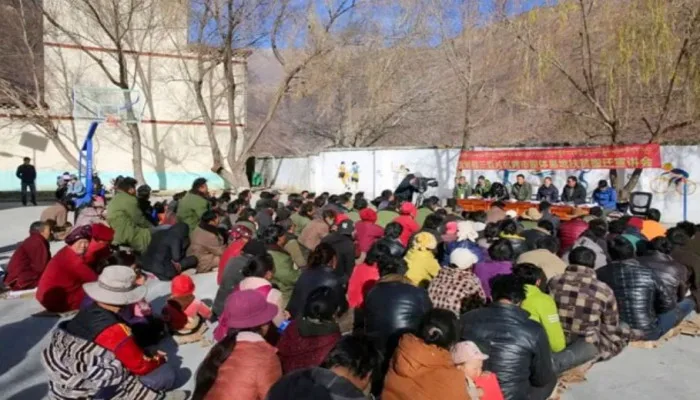
China implying extreme pressure to relocate people in Tibet (Image Source: Myind)

China implying extreme pressure to relocate people in Tibet (Image Source: Myind)

Facebook
Twitter
WhatsAppTelegramEmail

In a comprehensive report released on May 21, Human Rights Watch (HRW) exposed the extensive use of coercive tactics by Chinese authorities in relocating rural communities within the Tibet Autonomous Region. Since 2016, approximately 500 villages with over 140,000 residents have been forcibly relocated, constituting a grave violation of international law.

HRW’s findings are based on official statistics derived from over 1,000 reports in China’s state-run media, indicating that Chinese authorities plan to relocate more than 930,000 rural Tibetans between 2000 and 2025. Notably, the majority of these relocations, accounting for 76 per cent, have occurred since 2016.

The 70-page report, titled “Educate the Masses to Change Their Minds: China’s coercive relocation of rural Tibetans,” unveils the deceptive tactics employed by Chinese officials, who falsely claim that relocation will result in improved employment opportunities and ecological protection.

Furthermore, Chinese law mandates the demolition of former homes in both whole-village and individual-household relocations to deter residents from returning.

Of the 709,000 individuals relocated, 140,000 were part of whole-village relocation drives, while 567,000 were relocated individually. Entire villages have been uprooted and moved to locations hundreds of kilometres away, with the pace of relocation dramatically accelerating since 2016.

These coercive measures by Chinese authorities have drawn condemnation from human rights groups and the Central Tibetan Administration, based in Dharamsala. Allegations include forcible separation of children from parents, enrollment in boarding schools, pervasive surveillance, and harassment of Tibetan activists on an international scale.

HRW has strongly asserted that the “whole-village relocation” initiatives implemented in Tibet constitute forced evictions, flagrantly violating international law. The Chinese government mandates the demolition of homes within a year of relocation, effectively preventing relocated individuals from returning to their original residences.

Additionally, between 2000 and 2025, a staggering 3.36 million rural Tibetans have been impacted by various programs, compelling them to rebuild homes and transition to a sedentary lifestyle, even without being relocated physically.

Maya Wang, acting China director at HRW, underscored the contradiction between the Chinese government’s claims of voluntary relocation and the reality depicted in official media reports. These reports illustrate the coercive nature of village relocations, leaving residents with no viable option but to comply under threat of severe repercussions.

The report analysed over 1,000 articles from China’s state-run media published between 2016 and 2023. Despite adhering to strict propaganda guidelines, these reports shed light on the objectives and methods employed by local officials overseeing relocation programs.

HRW’s recommendations are clear and urgent: the Chinese government must halt all relocation efforts in Tibet until an independent, expert review can assess their compliance with domestic and international laws regarding forced evictions. Authorities must ensure that relocations adhere to international human rights standards, including exploring alternative solutions, providing compensation, and offering legal recourse to affected individuals.

Moreover, HRW emphasises the need to cease all forms of coercion and pressure tactics employed to secure consent for relocation. The government’s policy mandating household consent for relocation is contradicted by numerous instances of initial reluctance among Tibetan residents. In some cases, villagers face intrusive home visits and threats of service cuts if they resist relocation, further underscoring the coercive nature of these initiatives.

In conjunction with broader Chinese initiatives aimed at assimilating Tibetan culture into the broader Chinese identity, the relocation of rural communities poses a significant threat to Tibetan cultural heritage and traditional ways of life. HRW warns that these policies erode Tibetan culture and exacerbate the already precarious state of Tibetan communities.

The methods employed by Chinese officials to coerce Tibetan residents into “consenting” to relocation are coming under scrutiny, revealing a pattern of intense propaganda and persistent pressure tactics during home visits.

One notable instance involves a village in Nagchu Municipality, where initially, 200 out of 262 households resisted relocation but eventually relented, purportedly “voluntarily.” However, the report highlights that such compliance often follows repeated visits and threats of service cuts by Chinese officials.

Maya Wang, Acting China Director at Human Rights Watch, emphasised the disparity between the Chinese government’s claims of voluntary relocation and the stark reality depicted in official media reports. Despite assertions of voluntariness, these reports reveal the impossibility for residents to refuse relocation without facing severe repercussions, thereby undermining the notion of genuine consent.

HRW’s investigation also unveiled a disturbing trend of targeting poor families for relocation, often accompanied by threats of administrative and criminal penalties against dissenters. This strategy extends to “individual household relocation,” where poorer families are coerced into moving to areas purportedly offering better income opportunities.

Between 2016 and 2020, an estimated 567,000 individuals were relocated under these programs. However, many face challenges in securing employment, particularly as they are relocated to peri-urban areas where their traditional farming or herding skills are rendered obsolete.

HRW warns that these coercive relocation efforts are part of China’s broader agenda to erode Tibetan culture, posing a significant threat to Tibetan communities. Forced to abandon their traditional livelihoods, many Tibetans are compelled to seek employment in unfamiliar industries, further exacerbating the erosion of their cultural heritage.


Topics: ChinaTibetHuman Rights WatchChines forced expansion in TibetRelocation in Tibet
Share1
Tweet
SendShareSend
✮ Subscribe Organiser YouTube Channel. ✮
✮ Join Organiser's WhatsApp channel for Nationalist views beyond the news. ✮
Previous News

Nepal Minister Rabi Lamicchane exacts vengeance on KMG chief through arrest warrant, fake citizenship charge

Next News

Jharkhand: Special PMLA court extends ED’s remand of Alamgir Alam for five days

Related News

Prime Minister Narendra Modi and Chinese President Xi Jinping(File Photo)

India-China Boundary Talks: New Delhi pushes for peace across the LAC; Seeks transparency over upstream hydro projects

27 Arunachal Landmarks Added to India’s Official Maps Amid China Row

India strikes back at China’s ‘Map Politics’: 27 Arunachal landmarks officially recorded on national maps

Sarsanghchalak Dr Mohan Bhagwat addresses Gen Z students

Sarsanghchalak Dr Mohan Bhagwat on Pak, China ties: Conflict may halt relations, but permanent hatred isn’t a solution

India-China border trade resumes after 6 years; Himalayan routes of Nathu La, Shipki La & Lipulekh signal reset in ties

India's Ambassador to China Vikram Doreswami interacted with the Indian diaspora during the Open House event(File Photo)

Indian diaspora in China flags anti-India hate & abuse on social media; Embassy reaffirms to counter misinformation

POTUS Trump (left) and Chinese President Xi (right); file photo shows Uyghur detainees during a political education session at a detention camp in Xinjiang, China, April 2017.

US blacklists 43 Chinese companies over abuses against Uyghur Muslims in latest trade war escalation

Load More

Latest News

Partition Horrors Remembrance Day

Partition Horrors Remembrance Day: Know why it is important to remember those who became victims of mindless violence

Ram Temple CEO Candidates Faced No Questions on Religion or Personal Lifestyle

Ram Mandir Trust’s CEO Interview: Professional governance takes precedence over personal life in selection process

Representative Image

Why Bharat needs to pursue independence from big tech

India corner opens at Kenya school library; Echoes nation’s freedom struggle, civilisational heritage & growth story

Keralam: NIA seizes massive 89,600 explosive sticks in Malappuram, reports suggest Kerala Kumbh Mela was target

August 14 is observed as Partition Horrors Remembrance Day

From Crushing 1857 Jihad to Muslim Appeasement: British and Gandhi’s policies that helped partition India

Ousted President of Syria Bashar al-Assad sentenced to death

Syria: Ousted President Assad sentenced to death for crimes against humanity; Will verdict aid extradition from Russia?

Bar Council of India defers enrolment of NALSAR’s 2026 law graduates, seeks report over campaign targeting CJI

1947 Partition and Bengal: The unvarnished truth

Bastar Dussehra Begins in Jagdalpur:

Bastar Dussehra Begins in Jagdalpur: A 75-day celebration of tribal faith, tradition and cultural heritage

Load More
  • Privacy
  • Terms
  • Cookie Policy
  • Refund and Cancellation
  • Delivery and Shipping

© Bharat Prakashan (Delhi) Limited.
Tech-enabled by Ananthapuri Technologies

  • Home
  • Search Organiser
  • Bharat
    • Assam
    • Bihar
    • Chhattisgarh
    • Jharkhand
    • Maharashtra
    • View All States
  • World
    • Asia
    • Africa
    • North America
    • South America
    • Europe
    • Australia
  • Editorial
  • Operation Sindoor
  • Opinion
  • Analysis
  • Defence
  • Culture
  • Sports
  • Business
  • RSS @ 100
  • Entertainment
  • More ..
    • Sci & Tech
    • Vocal4Local
    • Special Report
    • Education
    • Employment
    • Books
    • Interviews
    • Travel
    • Health
    • Politics
    • Law
    • Economy
    • Obituary
  • Subscribe Magazine
  • Read Ecopy
  • Advertise
  • Circulation
  • Careers
  • About Us
  • Contact Us
  • Policies & Terms
    • Privacy Policy
    • Cookie Policy
    • Refund and Cancellation
    • Terms of Use

© Bharat Prakashan (Delhi) Limited.
Tech-enabled by Ananthapuri Technologies