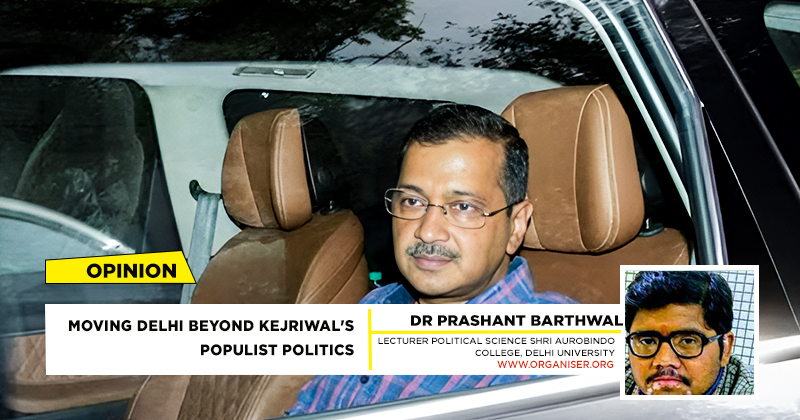
In a dramatic development, Arvind Kejriwal, the Chief Minister of Delhi and the national convenor of the Aam Aadmi Party (AAP), was arrested on charges of corruption and misuse of government funds. His arrest has sparked widespread protests from AAP supporters who view it as a political witch-hunt. At the same time, his critics have long accused him of employing divisive populist tactics and making empty promises. Regardless of where one stands on Kejriwal’s politics, his arrest presents Delhi with an opportunity to move beyond the perpetual cycle of confrontational populism that has gripped the city’s politics in recent years.
The Rise of Kejriwal’s Populism
Arvind Kejriwal burst onto the national political scene in 2011 as an activist leading the anti-corruption movement alongside Anna Hazare. Projecting himself as an outsider fighting against the entrenched corruption of the mainstream parties, Kejriwal formed the AAP in 2012 on an anti-corruption plank. In the 2013 Delhi Assembly elections, the fledgling AAP won a surprising 28 seats, enough to form a minority government with outside support from the Congress party. However, Kejriwal’s first stint as chief minister lasted 49 days as he resigned over his failure to pass the Jan Lokpal bill to create an ombudsman. The real breakthrough for Kejriwal and the AAP came in the 2015 Delhi Assembly elections when the party won 67 out of 70 seats. Running an overtly populist campaign railing against the elite and projecting himself as a crusader for the “Aam Aadmi”, Kejriwal promised a slew of freebies and subsidies – 200 units of free electricity, free water supply, free Wi-Fi hotspots, and more. He also played the ethnic card, portraying himself as a Delhi son of the soil being victimized by the opposition. His trump card was relentlessly attacking Prime Minister Narendra Modi and the BJP, accusing them of pursuing anti-people policies and trying to subvert democracy.
When in power, Kejriwal delivered on some popular freebie promises, like free lifeline water and subsidized electricity. He also initiated reforms in education and healthcare. However, his populist impulses often overrode sound policymaking. The AAP government continued to buy media ads glorifying Kejriwal and advertising achievements in creative ways. There were regular run-ins with the Lieutenant Governor and the Centre over the division of powers. Kejriwal also frequently indulged in whataboutery, dubious accusations, and perpetual protests against the BJP despite having a thumping majority in the state.
The Winter of Discontent
Heading into the 2020 Delhi elections, Kejriwal appeared to change tack and moderated his populist rhetoric while touting his government’s health, education, and infrastructure achievements. However, the recently unearthed evidence of corruption and misuse of funds suggests the shift may have been more optics than reality. There are credible charges that the AAP Government misused funds for self-promotion and doled out favours to party workers. There are also accusations that Kejriwal encouraged deliberate delays and protests to whip up a victimhood narrative.
The evidence suggests that Kejriwal’s arrest may be legally justified. However, the manner and timing of his arrest so close to elections in other states have raised suspicions of political motivations, playing into the AAP’s hands and allowing Kejriwal to portray himself as a victim once again. Regardless of the merits, the spectacle of Kejriwal’s dramatic arrest and the protests it has provoked risk trapping Delhi in a never-ending cycle of confrontational politics, populist rhetoric, and policy paralysis.
Moving Delhi Beyond Populism
To break this cycle, Delhi will need a new political leadership and public dialogue shorn of populist machinations. A good start would be for all political parties to take the high road and focus on substantive issues, policies, and governance reforms rather than resorting to drama, divisive rhetoric, or competitive populism. Political discourse must move away from the ‘us vs them’ binary perpetuated by populists and towards a more inclusive and nuanced discussion of Delhi’s challenges and potential solutions.
On the economic front, Delhi needs a shift from perpetual giveaways towards policies that expand economic opportunities and the productive capacity of the city. Populist parties have relied on perpetual freebies and subsidies as their main voter outreach. While some subsidy is necessary for the poorest sections, there should be a greater focus on promoting job creation, improving economic infrastructure like power, water, and transport to boost productivity, incentives for investment and entrepreneurship, and upskilling the workforce. Fiscal prudence is also key to preventing budget deficits that lead to the deterioration of public services and investments in the long run.
On the political front, the aggressive style often practised by populists has hampered effective administration and policy implementation. Delhi has witnessed repeated run-ins between the state government and the Lieutenant Governor over the distribution of powers. The turf wars have resulted in policy paralysis and blame games rather than effective governance. What Delhi needs is constitutional clarity on the powers of respective stakeholders, adherence to established governance norms, and a spirit of cooperation between different tiers of government for the betterment of citizens. The social fabric of Delhi has also been strained by populists resorting to divisive rhetoric and ethnic nationalism and perpetuating an artificial divide between the “elite” and the “common person” for political gain. Delhi has a cosmopolitan culture with people from all over India and the world. The political discourse must move away from divisive “us vs them” narratives and promote inclusive policies that provide opportunities for all residents regardless of background. There is also a need to depoliticize governance and ensure that public services and welfare schemes do not become vehicles for political patronage.
Educating and Empowering the Voter
Lastly, the road to moving beyond populism will require the voters in Delhi to become more discerning and empowered. Populists have often relied on making grandiose promises, perpetuating divisive “us vs them” narratives, or donning the victim’s cloak to win over voters. Delhi’s voters must become more literate about political tactics and look beyond the optics and rhetoric to evaluate parties based on substantive policies and governance track records.
Educational initiatives could improve civic literacy about constitutional norms, division of powers, democratic processes, and distinguishing between populism and true empowerment. The media is also key in promoting issue-based political coverage and holding leaders accountable for their actions rather than simply amplifying divisive rhetoric or controversies.
Ultimately, Delhi’s voters must reward parties focusing on sound policies, inclusive governance, adherence to norms, and productive growth rather than falling for short-term giveaways or divisive rhetoric. Only an aware and empowered electorate can disincentivize populist demagoguery and compel political parties to offer a positive agenda for progress.
The Road Ahead
The arrest of Kejriwal has opened a window of opportunity for Delhi to break free from the perpetual cycle of confrontational populism, divisive politics, and policy paralysis. To capitalize on this opportunity, all stakeholders – political parties, civil society, media, and voters – must promote issue-based discourse, adherence to constitutional norms, and shared prosperity through productive policies rather than indulging in divisive rhetoric or competitive populism.
For Delhi’s politics to truly transform, voters must become more discerning and empower parties that focus on substantive policies and inclusive governance. Political parties must shed populist machinations, focus on an agenda for productive growth, uphold constitutional proprieties, and adhere to cooperative federalism. Only such a comprehensive reform effort can help Delhi move beyond the politics of perpetual protests and confrontations towards a new era of progressive, inclusive, and sustainable development for all its citizens.