China’s Economic Decline: Opportunity for India
June 23, 2026
  • Read Ecopy
  • Circulation
  • Advertise
  • Careers
  • About Us
  • Contact Us
Android AppiPhone AppArattai
Organiser
  • ‌
  • Bharat
    • Assam
    • Bihar
    • Chhattisgarh
    • Jharkhand
    • Maharashtra
    • View All States
  • World
    • Asia
    • Europe
    • North America
    • South America
    • Africa
    • Australia
  • Editorial
  • International
  • Opinion
  • RSS @ 100
  • More
    • Op Sindoor
    • Analysis
    • Sports
    • Defence
    • Politics
    • Business
    • Economy
    • Culture
    • Special Report
    • Sci & Tech
    • Entertainment
    • G20
    • Azadi Ka Amrit Mahotsav
    • Vocal4Local
    • Web Stories
    • Education
    • Employment
    • Books
    • Interviews
    • Travel
    • Law
    • Health
    • Obituary
  • Subscribe
    • Subscribe Print Edition
    • Subscribe Ecopy
    • Read Ecopy
  • ‌
  • Bharat
    • Assam
    • Bihar
    • Chhattisgarh
    • Jharkhand
    • Maharashtra
    • View All States
  • World
    • Asia
    • Europe
    • North America
    • South America
    • Africa
    • Australia
  • Editorial
  • International
  • Opinion
  • RSS @ 100
  • More
    • Op Sindoor
    • Analysis
    • Sports
    • Defence
    • Politics
    • Business
    • Economy
    • Culture
    • Special Report
    • Sci & Tech
    • Entertainment
    • G20
    • Azadi Ka Amrit Mahotsav
    • Vocal4Local
    • Web Stories
    • Education
    • Employment
    • Books
    • Interviews
    • Travel
    • Law
    • Health
    • Obituary
  • Subscribe
    • Subscribe Print Edition
    • Subscribe Ecopy
    • Read Ecopy
Organiser
  • Home
  • Bharat
  • World
  • Operation Sindoor
  • Editorial
  • Analysis
  • Opinion
  • Culture
  • Defence
  • International Edition
  • RSS @ 100
  • Magazine
  • Read Ecopy
Home Bharat

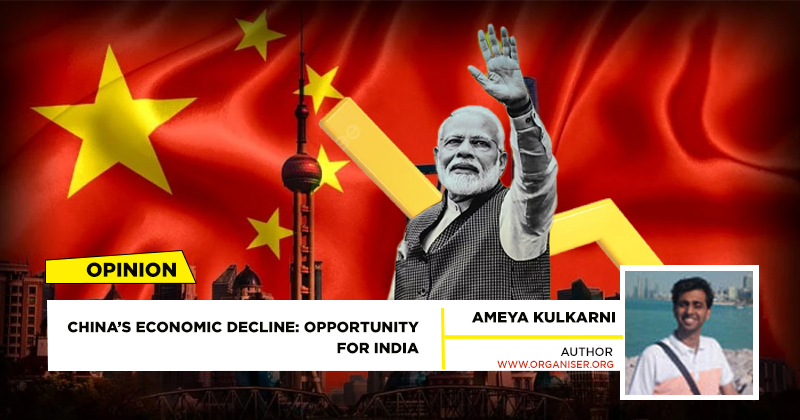
China’s Economic Decline: Opportunity for India

The article explores changing global power dynamics, focusing on China's economic trajectory and its impact on India and geopolitics. It examines factors behind China's declining influence, the emergence of multipolarity in Asia, and strategic considerations for India. The piece also considers prospects for reforms in China and evolving dynamics in U.S.-China relations

Ameya KulkarniAmeya Kulkarni
Feb 17, 2024, 07:00 pm IST
in Bharat, World, Opinion
Follow on Google News
FacebookTwitterWhatsAppTelegramEmail

Writing in the Financial Times a few weeks ago, well-known investor and fund manager Ruchir Sharma highlighted the irreversible decline of China’s share of the global GDP. Sharma represents a growing body of opinion that believes China has peaked economically. Many Chinese hands don’t agree with the notion that we are in a “post-China world”. They point to the enduring strengths of the Chinese economy, its growing technological prowess and expanding military power.

Is China’s continuing rise inevitable, or is its incipient decline irreversible?

If the world has struggled to come to terms with the dramatic expansion of China’s power in the early 21st century, what might be the consequences of China’s slowdown in the coming decades? How should India, which has been feeling the heat of China’s rise on its Himalayan frontier, in the regional politics of the Subcontinent, and the waters of the Indian Ocean adapt to the unfolding shift in China’s trajectory?

As Sharma points out, China’s share in the world’s GDP rose from about two per cent in 1990 (after a decade of economic reform and opening up) to about 18.4 per cent in 2021. It is now down to 17 per cent. Sharma estimates that China’s share will continue to decline because of several factors, including demographic decline. China’s share of the world’s working-age population has been falling for a decade and is about 19 per cent. It will likely come down to 10 per cent in the next three decades.

Chinese leader Xi Jinping’s anti-market interventions, high levels of debt and declining worker productivity are seen as other reasons for China’s relative decline.

Who is gaining if China’s share of the global GDP is falling? According to Sharma, several emerging markets like India, Indonesia, Mexico, Brazil, and Poland contributed to nearly half of the expansion of the global economy last year. The US has grown at an impressive rate and made up most of the other half. Last year, the US added $1.6 trillion to its GDP, about the size of the South Korean economy (the 13th largest in the world).

Two important immediate implications for the world order stand out. One is the growing gap between the comprehensive national power of the US and China. Until recently, it was conventional wisdom that China would soon overtake the US GDP. It now looks unlikely to occur in the near term; some would say it is unlikely to ever happen.

The latest numbers on the world economy put the US economy in 2023 at $28 trillion and the Chinese at 18 trillion. In 2020, the Chinese economy was inching towards 80 per cent of America’s. It is now drifting down towards 60 per cent. If the present trends continue, China’s relative weight vis-a-vis the US will likely decrease further.

The changing economic fortunes of China and the US mean we are unlikely to be a bipolar or the G2 world that never stops animating India. The notion of parity or symmetry between the US and China was always unrealistic, given the wide coalition of Western partners that the US leads. America’s European and Asian allies weigh far heavier than China’s friends, including Russia.

What about Asia? Until recently, the notion of a China-centred Asia seemed inevitable. While many Asian countries have had impressive economic performances in the last few decades, China’s rise has been faster than most of its neighbours. That seemed to suggest that Asia must simply learn to live with China’s weight and accept a regional order dominated by it.

China’s relative decline now suggests that Asia has other alternatives. The faster economic growth in India, Indonesia, Vietnam, and the Philippines suggests a “multipolar Asia” can be a real possibility.

Although China will remain the most important economy in Asia and the second largest in the world for the foreseeable future, its large Asian neighbours have the potential to increase their standing in China.

Meanwhile, China’s muscular approaches to its neighbours on territorial issues opened space for the US to revitalise its alliances and build new Asian partnerships in the last few years. An America that is regaining economic ground and is politically more confident could indeed queer the pitch for China and open up more strategic options for Beijing’s neighbours.

India, for example, is unlikely to overtake the Chinese economy soon. But China’s slower growth and India’s economic acceleration will mean Delhi can steadily reduce the economic gap with Beijing. Indian pessimists had in the past presumed that the gap between the two will never narrow.

Even as it grows faster than Beijing and reduces the economic gap, Delhi can’t take a complacent attitude on the boundary or in its competition for influence with China in the Subcontinent and the extended neighbourhood. It can, however, cope with the Chinese power more confidently if it continues to build on its national capabilities and strengthens the Quad and other regional coalitions.

But is China doomed to decline, or does it have the political flexibility to rework its policies? Some analysts like Ruchir Sharma think that whatever Xi Jinping does, he is not in a position to reverse China’s relative economic decline. Others would bet China can initiate structural reforms in the Chinese economy to reclaim a faster growth rate. Some might bet on internal political change in China that could lead to more accommodative external policies and reduce some of the internal pushback against Beijing.

It is still being determined if Xi is willing or capable of reversing the policies he has initiated over the last decade. It is possible that Xi could offer a political olive branch to the United States to gain geopolitical breathing room. At a time when the US is coping with multiple wars, limiting conflict with China and seeking cooperation with China is already on top of the Biden agenda. But the domestic political mood in the US has hardened against China, and if the Republicans win the White House again, Washington’s pressures on China could only mount.

Put simply, the time has come to rethink many of the assumptions in India about the global distribution of power and its consequences. For one, the US is not about declining and fading away, notwithstanding its multiple challenges today. Second, although China’s rise has been impressive, the limits to its power are coming into view. Third, the growth of China’s Asian neighbours has enhanced possibilities for a more internally balanced region. Finally, if it can stay calm, build on its strengths, and avoid the kind of nationalist hubris that has undermined China’s fortunes, India could thrive amid the unfolding power shift.


Topics: GDPEconomic DeclineChina's economic declineUS economyChinaXi Jinping
Share1TweetSendShareSend
✮ Subscribe Organiser YouTube Channel. ✮
✮ Join Organiser's WhatsApp channel for Nationalist views beyond the news. ✮
Previous News

BJP State Chief Sukanta Majumdar recovers from injuries, discharged from hospital after Sandeshkhali protest

Next News

Jharkhand: Maoist camp busted in Chaibasa, IEDs unearthed and destroyed

Related News

Chinese President Xi Jinping

China Back to Mao Era? Xi unveils new doctrine of party supremacy over state and people

Yoga Day celebrations in Shanghai, China

International Yoga Day: Global celebrations echo the message of health, well-being and timeless ancient Indian wisdom

UK retailers demand tougher curbs on Chinese online giants amid deepening EU–Beijing trade rift

Prestige Denim Mills' $20 million project marks India's industrial entry into one of Africa's fastest-growing textile hubs

India enters Egypt’s textile battlefield, challenging Chinese, Turkish and Pakistani dominance in Africa

In China's strategic map of threats, geography continues to give India a significance that cannot be overlooked

The Rival China Cannot Ignore: Why India matters more than Beijing admits

As economic pressures mount, Beijing is tightening control over business, investment and society, placing security and stability above growth

Xi, the CCP and China’s New Reality: Why regime survival now matters more than economic growth

Load More

Latest News

Keralam’s former Industries Secretary, Mohammed Haneesh IAS (Right Side)

Keralam Cashew scam: Former Industries Secretary apologises before High Court after contempt proceedings

Tamil Nadu: Assembly Speaker directs all bureaucrats to strictly follow warrant of precedence after Mayor-MLA row

Kamakhya Mandir

Kamakhya Mandir’s Ambubachi Mela: The ancient tradition that honours the menstruation of mother Earth

Amazon in dock for mocking Hindu Gods

Amazon File: From Ganesha to Aryabhata-Has Amazon India become a platform for Anti-Hindu narratives?

The West Bengal Budget 2026–27 aims to drive growth through infrastructure, industry, innovation and welfare

Reimagining Bengal: How the West Bengal Budget 2026–27 seeks to balance growth, welfare & economic transformation

Pratiraksha is Gujarat Police's Aadhaar-based verification platform designed to identify illegal workers and prevent identity fraud in industrial sectors

Pratiraksha: How Gujarat police uses Aadhaar verification to secure industrial workforce against identity fraud

Israel-Iran crisis has highlighted not only shifting dynamics of West Asia but also growing confidence of India's foreign policy

India, Israel and the rise of strategic autonomy in an era of global geopolitical realignment

Saleem and Jaleel arrested in forced religious conversion case

Karnataka Conversion Case: Forced conversion of Hindu woman and minor son sparks outrage; Saleem and Jaleel arrested

Bareilly Cantonment Emerges as Model for Sustainable Urban Development in India (Image Source X)

Uttar Pradesh: Bareilly Cantonment becomes India’s first carbon-negative cantonment

CM Yogi Adityanath making industry, investment and the connectivity revolution in Eastern Uttar Pradesh

The Purvanchal Growth Story: How industry, infrastructure, tourism & exports are fueling development in eastern UP

Load More
  • Privacy
  • Terms
  • Cookie Policy
  • Refund and Cancellation
  • Delivery and Shipping

© Bharat Prakashan (Delhi) Limited.
Tech-enabled by Ananthapuri Technologies

  • Home
  • Search Organiser
  • Bharat
    • Assam
    • Bihar
    • Chhattisgarh
    • Jharkhand
    • Maharashtra
    • View All States
  • World
    • Asia
    • Africa
    • North America
    • South America
    • Europe
    • Australia
  • Editorial
  • Operation Sindoor
  • Opinion
  • Analysis
  • Defence
  • Culture
  • Sports
  • Business
  • RSS @ 100
  • Entertainment
  • More ..
    • Sci & Tech
    • Vocal4Local
    • Special Report
    • Education
    • Employment
    • Books
    • Interviews
    • Travel
    • Health
    • Politics
    • Law
    • Economy
    • Obituary
  • Subscribe Magazine
  • Read Ecopy
  • Advertise
  • Circulation
  • Careers
  • About Us
  • Contact Us
  • Policies & Terms
    • Privacy Policy
    • Cookie Policy
    • Refund and Cancellation
    • Terms of Use

© Bharat Prakashan (Delhi) Limited.
Tech-enabled by Ananthapuri Technologies