There are 4 judgments that have been passed in the Supreme Court in this case WP (civil) 728/2015 and related matters. The last judgment, which is in force now, was passed on 23.10.2018. To understand this 2018 judgment, it is important to first understand the previous three judgments and especially the interesting turn that the case took, after the second judgment was passed, in September 2017.
As an immediate response to the extreme levels of pollution seen in Delhi in 2016, the Court, on 11.11.2016, suspended licenses of all shops selling fireworks in NCR (National Capital Region). Thus, fireworks could no longer be sold in NCR.
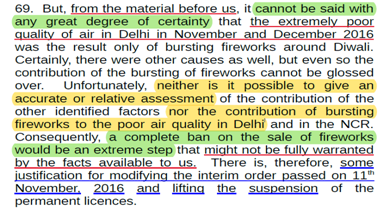
Then, around 10 months after this, on September 12 2017, after hearing detailed arguments of both sides, the Court passed a judgment with two critical observations:
- That, there is no clear proof of crackers causing pollution in Delhi; and
- That, in light of the above, a complete ban on fireworks was “too radical” and not advisable.
Thus saying, the Hon’ble Supreme Court, lifted the order of suspension on sale of fireworks that was imposed in November 2016. (See screenshots of the extracts from the judgment)
After this judgment, the events took a very interesting turn.
If any judgment goes against us, we ordinary mortals, generally, accept the same as fate and move on or, at best, appeal against the judgment. But the set of petitioners in this case, obviously, are no ordinary mortals. The power and influence wielded by them can be gauged from the fact that when the judgment of the bench was not to their liking, they presented a flimsy document and got the bench that was hearing the case itself changed!
This is not an allegation being levelled by the author but the recorded finding of the Hon’ble Supreme Court itself. See extract from the judgment delivered in Oct 2017:

Even more interesting than the constitution of the new bench, at the behest of petitioners, was the change in views of the new bench. While the earlier bench had said that there was no clear proof of crackers causing pollution in Delhi, the new bench took the view that:
- There is “direct evidence” to show that the “direct and immediate cause” of pollution in Delhi in 2016 was the “burning of crackers during Deepawali!” (para 10 of Oct 2017 judgment).
- And that – “…there is virtually a consensus in the society that the crackers should not be burnt during Deepawali…” (para 10 of Oct 2017 judgment).
Hence, the new bench in October 2017, less than a month after September 2017 judgment, and just a week before Deepawali, rolled back the earlier orders which allowed people to sell fireworks in NCR. The way in which the bench did this was also unique.
It (bench) said that it was not sitting in “review of the September judgment” and was not overturning the judgment. But it (the court) was just changing the date from which the September judgment would become effective – which is from 01.11.2017 – around 12 days after Deepawali (celebrated on 19.10.2017). Thus, it reimposed the ban on sales of fireworks in NCR before Deepawali – a step which the earlier bench had called “too radical and unwarranted,”- and lifted the ban again, just after Diwali!
Thus, was achieved a review of a judgment without a formal review and a ban imposed, without actually imposing a ban! The justification given by the bench was that the suspension of fireworks was a step to “…test..and find out if there would be positive effect of this suspension on pollution, during the Deepawali period.” (Para 14 of October 2017 judgment).
The fireworks were, therefore, banned in NCR – this time, not to stop Pollution but to “test and see” if it stopped pollution!
Weird though it may seem, the case then hinged on the results of this experiment or “test” conducted on Deepawali. The results were soon submitted in form of two reports. The content of these reports and the Court’s interpretations of them, are given hereunder:
- CPCB report on level of pollution in Delhi during Deepawali 2017 (details covered in part 2)
The report stated that while, NO2 and SO2 levels remained within limits, the PM 2.5 and PM 10 levels showed an increase of up to 2 to 3 times at some places. This, though, dissipated within 2-3 days – leaving no scope for any long term impact.
While what is said in this report is important, what is not said or missed is even more important. Note that:
- This report said that Pollution levels increased during Deepawali but what it did not state was that on other non-Diwali days, the Pollution levels were even higher or rather, much higher than those seen during Deepawali (see graphs in part 2).
- If pollution, on days which are months away from Deepawali – 12 Jun 2018, for instance, with PM 10 levels of 933 – is more than double of the level seen during Deepawali (PM 10 level of 365 on 20.10.17) – then surely it’s a sign that there are other factors at play – which are perhaps even more important, in increasing Delhi’s pollution. But no effort was made by CPCB to bring the above facts to the notice of the Court.
- Much worse, CPCB did not deem it fit to even record basic factors like wind speed and humidity which have a direct bearing on quality of air. Expecting it to factor in the impact of crop burning on air pollution was hence, a far cry.
- No effort was made to check the chemical composition of the Particulate Matter either – to enable accurate identification and quantification of the source of pollution. The study done by IIT Kanpur, as shown earlier in Part 2, had done a full chemical analysis of the Particulate Matter and it did not identify fireworks as a source of pollution (see relevant portions of Part 2).
Hence, the claim that crackers caused the pollution in Delhi during Deepawali, would not stand the test of science.
- Report of committee appointed by the Supreme Court to assess impact on health of citizens
This committee stated that “..adverse impact of firecracker bursting.. was not significant statistically.”
As stated in Point # 4 in Part 2, what the committee means by the above is that they could not find any adverse impact of bursting crackers on the health of citizens in Delhi! With this definitive a conclusion by the Supreme Court appointed Committee, the case against the fireworks should have ended then and there – after all, “grave harm” and “irreversible damage” to health of citizens were touted as the main reasons for filing the case.
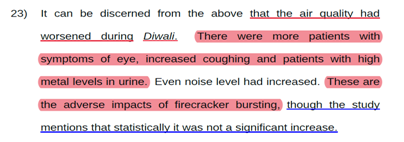
The Court, nonetheless, interpreted the report differently. See extract:
From the above extract, it looks like the Court was, rather surprisingly – not apprised of the true meaning of the statistical concept of “Statistical significance.” And was therefore, misled into deriving a meaning which is the exact opposite of what was said in the report! (Refer to Point #4 in Part #2 for a better understanding).
The above misinterpretation notwithstanding, the Hon’ble Court was led into committing another grave error – that of relying on anecdotal and unverifiable claims made by individual petitioners instead of relying on the scientific, evidence based and verifiable reports submitted by NGT, IIT and the Supreme Court appointed committee itself! See extract of the judgment
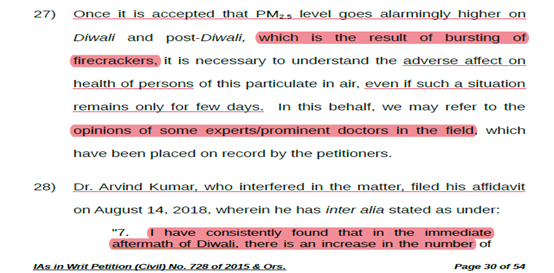
Thus, to summarise the above rulings for a better understanding:
- The Supreme Court, in an emergency response to the severe pollution in Delhi, banned sales of all fireworks (in Delhi) from 11.11.2016.
- After a detailed hearing and study of various reports, the Court said that there is no clear proof of crackers causing pollution and therefore, lifted the ban on 12.09.2017.
- The petitioners, unhappy with the ruling got themselves a new bench to hear the case and the new bench now ruled that there is direct evidence of crackers causing pollution in Delhi!
- Therefore, it re-imposed the ban on 9.10.2017 and lifted the ban back again from 1.11.2017 after Deepawali.
- The reason for banning sales of fireworks during Deepawali was – also to enable the Court to “test” and see the effect it had on pollution!
- The committee constitute by the Court to monitor this ‘experiment,’ concluded that the increased pollution during Deepawali did not have an adverse impact on health of people.
- The Court, however, was misled into believing that the Committee had found that there is an adverse impact on the health of people!
- Hence, the Court, finally on 23.10.2018 banned production and sale of all fireworks other than “Green Crackers” across India.