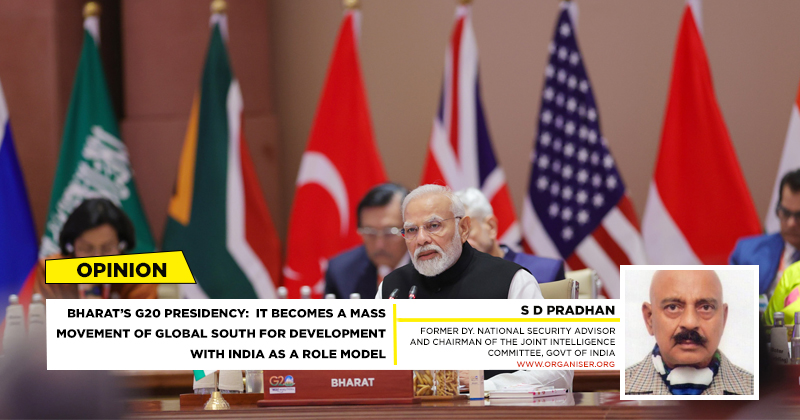
India has brought developed and developing countries together on a single platform to find solutions to global problems, particularly those that affect the latter. Since the inception of the G20 until India took over, the major economies coordinated responses to global economic crises. The Global South was neither represented in the forum nor had any role in the decision-making process, even indirectly. Their aspirations and needs did not find room in the forum.
Overall concept
Realising this, PM Modi defined the priorities of the G20 presidency while unveiling the logo and theme. He decided to champion the cause of the neglected Global South. His vision of Vasudaiva Kutumbakam (world is one family) not only reflected inclusiveness but also called for coordinated action for the global common good.
Establishing links between the G20 and the Global South.
PM Modi took four important steps to involve the Global South in G20 events. First, India organised the “Voice of the Global South Summit” in New Delhi (January 12-13, 2023). With the theme “Unity of Voice, Unity of Purpose,” the virtual summit brought together 125 countries of the Global South, including 29 from Latin America and the Caribbean, 47 African nations, 7 countries from Europe, 31 Asian countries, and 11 countries from Oceania, to share their perspectives and priorities on a common platform across a whole range of issues.
The summit presented a good opportunity for India to consult a sizable number of developing countries not represented in the G20 and to learn about their expectations from India’s presidency. In his inaugural speech, PM Modi underlined that people in the Global South should no longer be excluded from the fruits of development and suggested that global political and financial governance should be redesigned for this objective. He called for a global agenda of ‘Respond, Recognize, Respect and Reform’:
- Respond to the priorities of the Global South by framing an inclusive and balanced international agenda.
- Recognize that the principle of ‘Common but Differentiated Responsibilities’ applies to all global challenges.
- Respect sovereignty of all nations, the rule of law and the peaceful resolution of differences and disputes;
- Reform international institutions, including the United Nations, to make them more relevant.
Significantly. at the end of this summit, ‘the participating leaders appreciated the leadership of PM Modi for hosting the summit at a crucial juncture and expressed hope that it would serve as a catalyst for building a prosperous and inclusive future for the world that takes into account the needs of the Global South.’
Second, it invited six guest countries from the Global South to the G20 summit: Bangladesh, Egypt, Mauritius, Nigeria, Oman, and the United Arab Emirates. These countries are important representative nations from the Global South.
Third, PM Modi invited the African Union to become a permanent member of the G20 in pursuance of India’s vision of inclusiveness, thereby, providing a platform for the voice of Africans (an important group of nations in the Global South) to reach the world.
Fourth, India organised a meeting on international taxation at the National Academy of Direct Taxes (NADT), Nagpur, in collaboration with South Centre, a Geneva-based intergovernmental policy research think-tank of 55 developing countries, including India. This was aimed at hearing the views of the Global South on important international issues. There was also a workshop on tax treaty negotiations. This helped the Indian tax officials understand the complexities of international taxation from a Global South perspective.
Important facets of Indian model of development
PM Modi’s recent interview brings out some salient aspects of India’s role in the forum. He rightly pointed out that India’s words and vision serve as a road map for the future, particularly for the Global South. A gist of the important facets of the Indian model of development and growth is given in the subsequent paragraphs.
First, India’s human-centric model of development, with an unwavering focus on delivering tangible benefits to its citizens, has been lauded globally. This approach proved its mettle during the pandemic, with India successfully executing the world’s largest vaccination campaign and providing vaccines and medicines to 150 countries. India has created a resilient, responsive, sustainable, universal, and quality health system that serves as a model for other countries.
Second, India’s economic growth presents an alluring model. Despite challenges emanating from the pandemic, the Ukraine crisis, the border standoff, and cross-border terrorism, India’s economic growth remained high. In 2022-2023 the economic growth was 7.2%, and the current indicators suggest that the economic momentum continues. With improved infrastructure and ease of doing business, India has emerged as an increasingly attractive location across a wide range of industries. While most advanced economies are facing an economic slowdown, chronic shortages, high inflation, and ageing populations, the Indian economy is acknowledged to be the fastest-growing large economy with the largest youth population. India has already become the fifth-largest economy jumping from the tenth position in less than a decade, which itself indicates strong fundamentals. Indi has been working to create trustworthy and reliable supply chains- an important factor for the growth of trade.
The Goldman Sachs report concludes that India is poised to become the world’s second-largest economy by 2075, leapfrogging not just Japan and Germany but the U.S., too. PM Modi has rightly stated that all this is the result of a clear, action-oriented roadmap of ‘Reform, Perform, Transform’. He further stated that India identified districts that were labelled backward and neglected, and development in them was launched under the aspirational district programme. Villages and households without electricity and drinking water were provided with them. Significantly, since 2015, about 140 million people have been pulled out of poverty. The global Multidimensional Poverty Index (MPI), released by the United Nations Development Programme (UNDP) and the Oxford Poverty and Human Development Initiative (OPHI), shows that the incidence of poverty in India fell from 55.1 percent in 2005-06 to 16.4 percent in 2019-21.
Third, India’s pioneering role in Digital Public Infrastructure (DPI), characterised by secure, interoperable digital systems built on open standards, has garnered global recognition. DPI principles, endorsed by several countries, underscore India’s leadership in this critical domain. Cumulatively, so far, Rs 31,53,045 Crore have been transferred to beneficiaries. It covers 313 schemes, and 53 ministries are involved. The Direct Benefit Transfer (DBT) programme aims at bringing transparency and terminating pilferage from distribution of funds sponsored by the Government of India. The PM Jan Dhan Yojana account was introduced by the Government of India to provide easy access to financial services such as Remittance, Credit, Insurance, Pension, Savings and Deposit Accounts to the poor and needy sections of our society. This is crucial for poverty reduction. India’s Unified Payments Interface (UPI) has powered India to become a world leader in digital transactions.
Fourth, India’s impressive strides in women’s empowerment, including the substantial representation of women in local governance, serve as a noteworthy example of gender equity worldwide. Today, out of three lakh sarpanches in the country, 50% are women. This surpasses the quota for women, which is 33%. This constitutes the feeder-line for state and national elections. PM Modi has succinctly stated: “From space to sports, economy to entrepreneurship, Indian women have taken the lead in various sectors. They have shifted the narrative from the development of women to women-led development.” He further stated that India is assiduously working “on bridging the gender divide, reducing the labour force participation gaps, and enabling a larger role for women in leadership and decision-making.”
Fifth, education and skill development have been given adequate focus. This has resulted in producing one billion aspirational minds and two billion skilled hands. Research and development in science and technology, as well as in medicine, have yielded the desired results. India is becoming a prominent global educational hub. The education sector in India is expected to reach $225 bn by FY25. The online education sector in India is growing rapidly, with growth of $2.28 bn expected during 2021-2025.
Sixth, India gives priority to employment generation and improving employability. India has taken various steps to generate employment. India launched the Aatmanirbhar Bharat package to provide stimulus to businesses and mitigate the adverse impact of COVID-19. Under this package, the government is providing fiscal stimulus of more than Rs. 27 lakh crores. The Aatmanirbhar Bharat RojgarYojana (ABRY) was launched with effect from 1st October, 2020 as part of the Atmanirbhar Bharat package 3.0 to incentivise employers for the creation of new employment along with social security benefits and the restoration of lost employment during the pandemic. Pradhan Mantri Mudra Yojana (PMMY) is being implemented by the government to facilitate self-employment. Under PMMY, collateral-free loans (up to Rs. 10 lakh), are extended to micro/small business enterprises and to individuals to enable them to setup or expand their business activities. Besides, India launched the Garib Kalyan Rojgar Abhiyaan (GKRA) of 125 days in June, 2020 to boost employment and livelihood opportunities for returnee migrant workers and similarly affected persons including youth in rural areas, in 116 selected districts across 6 States of Bihar, Jharkhand, Madhya Pradesh, Odisha, Rajasthan and Uttar Pradesh.
Seventh, India is paying attention to dealing with cybercrime. According to the World Bank, cyber-attacks could have caused losses of around $5.2 trillion to the world during 2019-2023. However, their impact goes beyond financial losses. Cyber space is also used to radicalise youth to push them to terrorism or drug smuggling. Deep fakes are used to affect the cognitive capabilities of individuals. The influence operations can change the results of elections or weaponise public opinion by our adversaries. These are worrisome dimensions. Global cooperation is essential to deal with such crimes. India is taking steps in this direction by entering into agreements with other countries. Besides India has made efforts to improve its cyber resilience with the aim of making cyber space secured for various operations. Its experience can be vital importance to other countries.
Eighth India’s success in controlling emissions is remarkable. India achieved the climate targets nine years ahead of the scheduled date. Despite having 17% population, India’s share of cumulative emissions has been less than 5%. Initiatives like the International Solar Mission (ISA), the Hydrogen Mission, and the Global Biofuel Alliance are increasingly being supported by other nations. India’s use of renewable energy has significantly increased. In the last few years, India ramped up its solar energy capacity twenty times. India is among the top four countries in the world in terms of wind energy. India’s Mission LiFE focuses on Lifestyle for Environment. PM Modi has aptly stated that ‘Mission LiFE as a global mass movement will nudge individual and collective action to protect and preserve the environment.’ India has also launched “Mission Amrit Sarovar”, which is a unique water conservation initiative. These provide options to other nations for achieving climate targets.
India is also pushing for “transformative” and “holistic” reforms of the multilateral development banks- a need for the Global South. Climate financing is important to fund the transition of countries, mostly in the Global South, to low-emission economies. Reforms of the multilateral development banks are central to dealing with international debt crises. This effort is receiving support from the US and some other developed countries.
Future of G20
In essence, India’s presidency of the G20, in the words of PM Modi is the “people’s presidency.” This has indeed emphasised inclusivity and showcased India’s strengths and values on the global stage. The meetings organised by India in all the States and Union Territories were aimed at involving more people and showcasing India’s demography, democracy, diversity, and development to inspire the visiting delegates to adopt India’s practices to achieve sustainable development goals. Jaishankar mentioned in his article that in the G20 meetings, over 1,00,00 participants were involved, Civil 20 touched 45 lakh people worldwide, and social media became a pivotal tool in galvanising citizens, resulting in over 14 trillion social media impressions. The Jan Bhagidari events collectively drew 23.3 crore participants. This data itself speaks of the G20 becoming a mass movement.
India’s role as a bridge between developed and developing nations in the G20 is crucial. It reflects the country’s capacity to understand the challenges faced by both sides and work towards balanced solutions that benefit all parties. India’s active role in shaping the agenda and priorities of the group has garnered support from developed countries. They are now paying greater attention to the priorities indicated by India and are far more supportive to India’s multilateral leadership than in the earlier period.
India’s contributions to global governance and cooperation are increasingly recognised. India has created a movement for the Global South and with the increased cooperation between the developed and the developing countries, the progress of economic growth for all nations would be accelerated and that will be for global good. India has acted as a catalyst in the progress towards a more equitable international order. This momentum is likely to continue despite hurdles in arriving at a consensus in the final G20 summit.