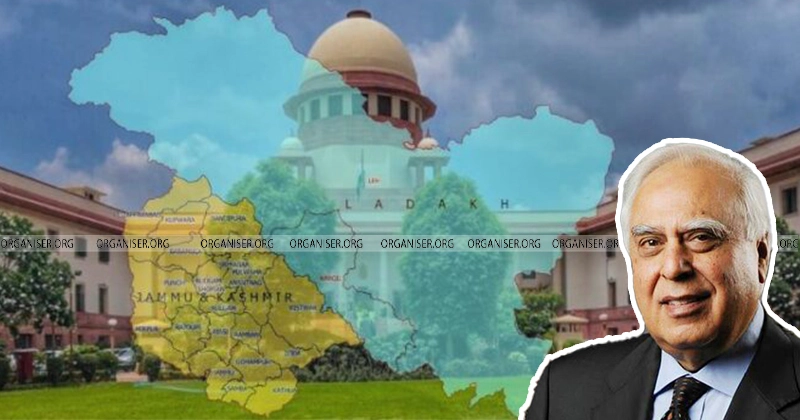
On August 8, the Supreme Court of India rejected Senior Advocate Kapil Sibal’s arguments in favour of a Brexit-like referendum in a plea challenging the amendment of Article 370, which abrogated the special status of Jammu & Kashmir.
“Ultimately, this was a political decision taken in the context of the situation prevailing. Right? And the complete abrogation must also be a political decision. Your lordships must remember Brexit. What happened? There was no constitutional provision seeking a referendum. But when you want to severe a relationship, you must seek the opinion of the people. Because people are central to the decision,” Kapil Sibal argued in favour of a Brexit-like referendum in J&K.
“In a constitutional democracy, seeking the opinion of people has to be through established institutions. So long as democracy exists, any recourse of will of people has to be expressed by established constitution. So you cannot envisage a Brexit-type referendum. That’s a political decision which was taken by the then government. But within a constitution like ours, there is no question of a referendum,” Chief Justice of India DY Chandrachud said.
The court’s Constitution Bench, comprising CJI DY Chandrachud, Justice SK Kaul, Justice Sanjiv Khanna, Justice BR Gavai and Justice Surya Kant, are hearing the batch of petitions challenging the amendment of Article 370.
National Conference MP Mohammad Akbar Lone’s counsel, Kapil Sibal, commenced his arguments referring to J&K Constituent Assembly’s speeches. He resorted to Sheikh Abdullah, Mir Kasim and MA Beg’s speeches to underline the historical context for J&K’s accession with India. Kapil Sibal further argued that a ‘unilateral executive act’ could not change the terms of the relationship with J&K, which was constitutionally embedded under Article 370.
When Justice SK Kaul enquired if Sibal was arguing that the amendment of Article 370 was an executive act, he replied in affirmative and submitted that the invocation of Article 356 (President’s Rule) and the amendment of Article 367 (Interpretation) were executive acts done through Presidential Orders.
“Parliament accorded approval to executive acts which unilaterally changed the constitution as it was applicable to J&K. Could the Union of India have done it?,” he argued, questioning the Government of India’s decision to take away the special status of J&K.
Kapil Sibal Insults Accession of Junagadh/Hyderabad
Notably, on August 2, Kapil Sibal argued that Article 370 had achieved permanence and thus could not be abrogated. He argued that under Article 370(3), the recommendation of the Constituent Assembly of the State was necessary for the President of India to abrogate the special status. He further submitted that as the Constituent Assembly of the State ceased to exist after its tenure from 1951 to 1957, the provision could not be revoked.
However, the Chief Justice of India asked about the non-obstante clause in Article 370(3), which seemed to override the complete Article, including its special provisions. He said that no constituent assembly could have an indefinite life, asking what happens after it lapses. He noted that as per Article 370(3), the President could abrogate the article on recommendations of the Constituent Assembly of the State.
“What happens when Constituent Assembly ceases to exist? If the proviso ceases to operate, by virtue of the fact that the tenure of Constituent Assembly has ceased to exist, surely the substantive part of (3) still continues?” the CJI asked Kapil Sibal.
Sibal responded that the non-obstante clause was valid during the Constituent Assembly’s term and argued that the provision’s ‘temporary’ nature was tied to its existence.
“Acceptance of sovereignty of the dominion of India was complete. They accepted the sovereignty for all intents and purposes. That acceptance was complete, but they reserved some rights over certain legislative subjects. So the accession was complete. Consistent with that, they said that in clause (3), the President would have the right to abrogate 370,” the Chief Justice of India, unconvinced with Sibal’s arguments, said.
However, Sibal continued to assert that the recommendation of the Constituent Assembly of J&K was necessary to abrogate the special status, which had ceased to exist in 1957.
When Justice Surya Kant asked Sibal, would it not mean Article 370 could never be abrogated, the counsel replied in affirmative. “Yes! That’s the whole point. That’s our case. That is why I said that formation of Constituent Assembly is a political exercise,” he said.
The former Congress leader, Kapil Sibal, equated the Government of India’s decision to abrogate J&K’s special status with the “act of crown” and “annexation of Junagadh or Hyderabad,” calling the government’s action jettisoning the people of J&K. Notably, the first Dy Prime Minister of India, Sardar Vallabhbhai Patel, played a crucial role in the accession of Junagadh and Hyderabad with India.
“You cannot jettison the people of J&K and decide. Then what is the difference between this and the act of crown or annexation of Junagadh or Hyderabad? If you have agreed to a process which two sovereign authorities have accepted, then you must follow it,” Kapil Sibal contended.
Background
On August 5, 2019, the Government of India amended Article 370, scrapping J&K’s special status. The government further notified the J&K Reorganisation Act, 2019, which divided the erstwhile state into two Union Territories – J&K and Ladakh. The erstwhile J&K state was infamous for observing shutdowns, witnessing stone pelting and separatists delivering anti-national sermons.
The hearings against the amendment of Article 370 had commenced before the Constitution Bench in December 2019, four months after the Government of India’s notification. One of the issues before the court concerned whether the matter should be referred to a seven-judge bench in light of the alleged divergence of opinion by two coordinate benches of the court.
However, on March 2, 2020, Constitution Bench held that there was no need to refer the matter to a larger bench. Of the last bench which heard the case, Justices NV Ramana and Subhash Reddy have retired. Chief Justice DY Chandrachud and Justice Sanjiv Khanna are the new members of the Constitution Bench.
Several petitions have been moved before the Supreme Court, including those of private individuals, lawyers, activists and politicians and political parties challenging the J&K Reorganisation Act, 2019, which splits J&K into two Union Territories – J&K, and Ladakh.
Notably, one of the petitioners, IAS officer Shah Faesal, has said that the matter now is a “thing of the past.” The bureaucrat said he had withdrawn his petition challenging the Presidential Order to scrap Article 370 a long time back. “I have withdrawn the petition in the Supreme Court challenging the Presidential Order to scrap Article 370 long ago,” IAS officer Shah Faesal said. The court would also hear whether Faesal’s petition can be withdrawn.
“370, for many Kashmiris like me, is a thing of the past. Jhelum and Ganga have merged in the great Indian Ocean for good. There is no going back. There is only marching forward,” Shah Faesal said in his tweet. The 2010 batch IAS officer, Shah Faesal, resigned from service in January 2019, floating his party – Jammu Kashmir People’s Movement – with Shehla Rashid. However, he resigned from his political outfit in August 2020, after which the Government of India reinstated him in service.