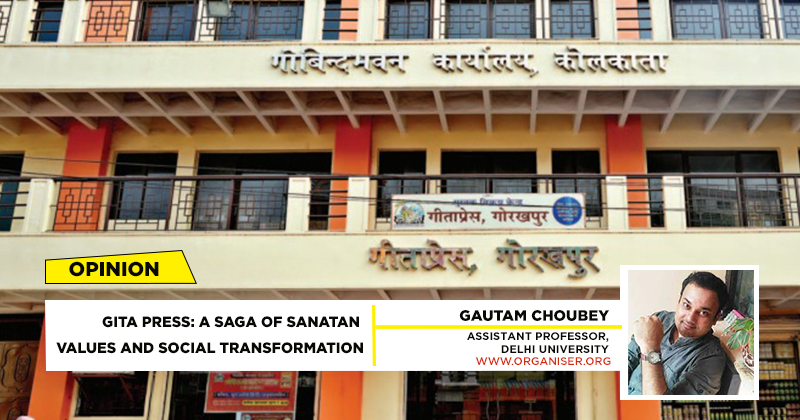
The decision to confer Gandhi Peace Prize on Gita Press is a matter of great satisfaction. The recognition, although long delayed, acknowledges the contributions of a truly committed print venture that has quietly and diligently pursued the cause of moral regeneration of Bharat. Our country has been a breeding ground for spiritual leaders, texts, and movements that have shaped its cultural and social fabric for centuries. Bharat is home to numerous religious and semi-religious organisations, all inspired by our Sanatan values, that have played a significant role in promoting spirituality, morality and spiritual literature. Gita Press of Gorakhpur stands out as an emblematic institution that has impacted millions of lives. In the history of modern India, and perhaps modern world too, no other organisation has been as successful in embracing print technology to promote a socio- spiritual.
Founded in 1923 Gita Press Gorakhpur is a leading publishing house dedicated to the distribution of Hindu religious literature. Hanuman Prasad Poddar—a devout follower of Lord Hanuman, and one who dedicated his life to cow, Gita and Ganga—envisioned Gita Press as a platform for spreading the teachings of the Bhagavad Gita and other sacred texts to the masses. Under Poddar’s guidance, the publishing house began producing low-cost editions of Hindu scriptures written in various regional languages, making them accessible to people from all walks of life. When majority of the texts produced by Gita Press reflect on religious scriptures and episodes from our Puranas, all such reflections are mediated through the impact of scriptural wisdom in contemporary times and their relevance to Bharati society. In other words, Gita Press has championed the cause of Sanatan wisdom, simplifying it for the masses, and emphasising its relevance in today’s globalised world.
Bharatiya logic of Print
Gita Press is a veritable epitome of a truly Bharatiya print venture. Unlike in the West, where the project of publishing and distributing books is seen largely as a commercial enterprise—hence the term print capitalism—the business of writing, editing and publishing books in India, right from the early days of print, was seen as largely social ventures. This is so because the history of printing in India is nearly coterminous with the history of nationalist movement and socio-cultural renaissance. All the editors, writers and in most cases, the publishers too, were inspired by our struggle for independence. To them, print was meant to further the cause of independence and the business of print was to be carried out in a spirit of national service. Whether it was Madan Mohan Malviya’s Abhyudaya, Ganesh Shankar Vidyarthi’s Pratap or Premchand’s Hans, every print venture threw its lot behind the nationalist struggle, often risking imprisonment, impounding of press and other penal hardships inflicted by the colonial government.
It was with this spirit of sacrifice for the cause of nation and Hindu society that in 1922, Jaydayal Goyandka, the founder of Gita Press, rented Govinda Bhawan on Banstalla Street (Kolkata), risking the health and future of his own flourishing business interests. It is a classic case of an entrepreneur turning philanthropic with a missionary zeal. The founders of Gita press and its flagship monthly Kalyan embraced the same spirit of service towards the nation as was exhibited by the likes of eminent journalist like Mahatma Gandhi, Ramananda Chatterjee, Banarsidas Chaturvedi, Lakshmi Narayan Garde, Bal Mukund Gupta, to name a few.
It is heartening to see even after a century of its inception, that the original design of Gita Press is intact and its spirit untarnished. While the press embraced the recognition—a fact which testifies to its close identification with Gandhi and Gandhian practices—it refused the the princely sum of one crore rupee as prize money. Which other print venture or author/editor, in this day and age, liberal or conservative, would have the moral courage to refuse a prize money this big?
A key aspect of Gandhi’s journalistic ethics—a feature noted with much scepticism by scholars of journalism—was non-inclusion of advertisements in periodicals and newspapers. The coupling of print mission which business interests would have surrendered the idealism of address to the demands of commerce. Since Gandhi did not want to make the discourse of nationalist movement dependent on the market, he scrupulously avoided publishing advertisements in his weeklies. Kalyan is possibly be the only print venture in Bharat has not only embraced this practice of during its initial days, but has kept up with the practice long after the euphoria over freedom struggle subsided. Both Kalyan and Kalyan Kalpatur , the two hugely popular monthlies Published by Gita Press, never run an advertisement.
Socially-responsible Press
It is hard to imagine a Hindu household in Bharat and elsewhere that does not possess a few copies of a Gita press book. The writer of this essay grew up reading Gita press Ramcharitmanas and Ramayana that were passed down to him through his grandfather. While books and print houses move in and out of circulation, Gita Press has sustained spiritual discourse in India through generations.
Gita Press became popular for its affordable pricing and high-quality publications. People from diverse backgrounds started purchasing books, pamphlets, and magazines published by Gita Press to gain spiritual knowledge and guidance. This initiative played a crucial role in empowering the masses with the profound wisdom encapsulated in the sacred texts. The practice was also in sync with Gandhi’s emphasis on spiritual education—a fact that has been ignored and deliberately obscured in recent times. The first generation of nationalists in India—Aurobindo, Gokhle, Tilak, Bankim Chandra Chatterjee—were inspired by Indian Scriptures and used scriptural wisdom to exhort masses. As the inheritor of the legacy of Gokhale and Tilak, Gandhi was conscious of the the profound power of religious education and our Sanatan values. He knew that in India, no social revolution is possible without the intervention of Sanatan values or a sagacious public figure who champions it with aplomb. This could the reason he wanted every child to acquire basic understanding of scriptures. This was carefully inducted in his Ashram routine and the blueprint of Nai Taleem. Unfortunately, in the modern drive to secularise Bharat, these aspects were overlooked and even deliberately neglected. In this sense, Gita Press has shouldered a crucial responsibility and is truly deserving of the recognition.
However, Gita Press’s impact extended beyond religious and spiritual realms. Poddar and his team recognised the significance of social and cultural transformation to uplift society. They used the medium of literature to address pertinent issues of the time, such as religious harmony, women empowerment, and the eradication of social evils like untouchability and caste discrimination. One of the noteworthy contributions of Hanuman Prasad Poddar was the creation of the monthly magazine “Kalyan.” The magazine served as a platform for spreading social awareness and promoting virtuous ideals. Through articles, stories, and poems, it addressed societal concerns, advocated for positive social change, and emphasized the importance of moral values and ethical conduct. In 1914, When Madan Mohan Malaviya was raising funds to establish Banaras Hindu University, Poddar’s role in raising funds was instrumental.
Gita Press also played a crucial role in the Indian freedom struggle. It published materials highlighting the nationalistic spirit and motivating people to stand up against colonial rule. Poddar’s vision of Gita Press was to make it a center for not only spiritual nourishment but also social and national awakening. The impact of Gita Press and Hanuman Prasad Poddar’s efforts can be seen in the millions of individuals whose lives were transformed by the knowledge and teachings disseminated by the institution. The teachings of the Bhagavad Gita, Ramayana, and other Hindu scriptures have inspired countless individuals to lead virtuous lives, promote harmony, and contribute to society.
Furthermore, Poddar’s legacy continued to inspire generations even after his passing. The publishing house, under the stewardship of his successors, continued to evolve and adapt to the changing times. Gita Press embraced modern technology and expanded its reach through digital platforms, further extending the power and influence of its publications. Gita Press Gorakhpur and Hanuman Prasad Poddar’s contributions are a testament to the transformative potential of spirituality and literature. The institution’s profound impact on society is a reminder of the enduring power of spiritual literature in shaping individuals and societies for the better.