Way ahead for Syrian Kurds
June 25, 2026
  • Read Ecopy
  • Circulation
  • Advertise
  • Careers
  • About Us
  • Contact Us
Android AppiPhone AppArattai
Organiser
  • ‌
  • Bharat
    • Assam
    • Bihar
    • Chhattisgarh
    • Jharkhand
    • Maharashtra
    • View All States
  • World
    • Asia
    • Europe
    • North America
    • South America
    • Africa
    • Australia
  • Editorial
  • International
  • Opinion
  • RSS @ 100
  • More
    • Op Sindoor
    • Analysis
    • Sports
    • Defence
    • Politics
    • Business
    • Economy
    • Culture
    • Special Report
    • Sci & Tech
    • Entertainment
    • G20
    • Azadi Ka Amrit Mahotsav
    • Vocal4Local
    • Web Stories
    • Education
    • Employment
    • Books
    • Interviews
    • Travel
    • Law
    • Health
    • Obituary
  • Subscribe
    • Subscribe Print Edition
    • Subscribe Ecopy
    • Read Ecopy
  • ‌
  • Bharat
    • Assam
    • Bihar
    • Chhattisgarh
    • Jharkhand
    • Maharashtra
    • View All States
  • World
    • Asia
    • Europe
    • North America
    • South America
    • Africa
    • Australia
  • Editorial
  • International
  • Opinion
  • RSS @ 100
  • More
    • Op Sindoor
    • Analysis
    • Sports
    • Defence
    • Politics
    • Business
    • Economy
    • Culture
    • Special Report
    • Sci & Tech
    • Entertainment
    • G20
    • Azadi Ka Amrit Mahotsav
    • Vocal4Local
    • Web Stories
    • Education
    • Employment
    • Books
    • Interviews
    • Travel
    • Law
    • Health
    • Obituary
  • Subscribe
    • Subscribe Print Edition
    • Subscribe Ecopy
    • Read Ecopy
Organiser
  • Home
  • Bharat
  • World
  • Operation Sindoor
  • Editorial
  • Analysis
  • Opinion
  • Culture
  • Defence
  • International Edition
  • RSS @ 100
  • Magazine
  • Read Ecopy
Home World

Way ahead for Syrian Kurds

The Kurdish experiment of self-rule inside Syria, long facilitated by the US military presence, is looking precarious now

Manish RaiManish Rai
Jun 27, 2023, 08:30 pm IST
in World, Opinion
Follow on Google News
FacebookTwitterWhatsAppTelegramEmail

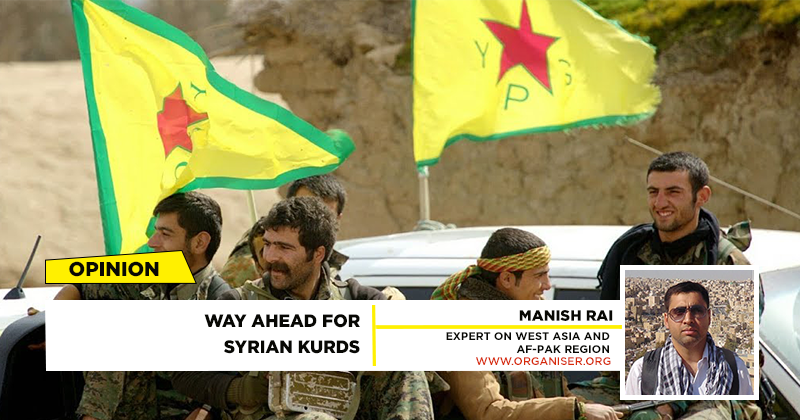
With the recent re-election of President Recep Tayyip Erdogan, Turkey has escalated its attacks on Kurdish-held regions of north and northeast Syria. Erdogan’s animosity toward the Syrian Kurds has not abated. It became evident when Turkish authorities that control parts of northwestern Syria even refused to grant permission for seven days to transport convoys carrying humanitarian supplies to cross over into earthquake-affected areas of Syria controlled by Kurds. And with a recent victory, President Erdogan has got emboldened and is likely to carry on with his aggressive policies towards Kurds. It’s not that Syrian Kurds don’t have any support from the United States. The small contingent of American troops has supported Syrian Kurds in Syria since 2015.

The Kurdish experiment of self-rule inside Syria, long facilitated by the US military presence, is looking precarious now. While the United States says it has no intentions of leaving Syria anytime soon, with the war in Ukraine and the strategic challenge from China, Syria is no longer a top priority for the Pentagon. The US commitment is dwindling, and its ongoing military presence is unlikely indefinite. The Kurds would be playing a risky game depending on long-term US protection. Their immediate and biggest neighbour, i.e. Turkey, poses an existential threat to them.

At this stage, the only thing that might make Syrian Kurds safer, in the long run, is a political deal with the Syrian regime. The Kurds will ultimately need to reach an accommodation with the Syrian state, as they have in Iraq, to secure a sustainable existence. But that’s not as simple because the Kurdish dream of holding onto their autonomous entity in a future federated Syrian state is threatened by Turkey and by a resurgent Syrian regime opposed to any autonomous zones in Syria. But some common grounds for mutual cooperation can be explored between Damascus and Kurds. Syria’s Baathist state and Kurds have broadly stayed out of each other’s way during the conflict, despite occasional clashes. There was always a tacit understanding between President Assad and Kurds with regard to the administration of the region from which the Syrian Army withdrew in 2012. For example, the state government employees serving in this region continued receiving salaries from Damascus. The regime controlled the airport in the Kurdish-dominated city of Qamishli and maintained some security centres there.

This basic understanding can be used for future detailed negotiations. Though Syrian President Bashar al-Assad has vowed to take back “every inch” of his country, he still lacks the forces to do it, and more than a decade of war has severely damaged and eroded the capabilities of the Syrian armed forces. If the battle-hardened Kurdish forces can be integrated with the Syrian Army, it will be a great added advantage to Damascus. The Kurds need help from the Assad forces to protect them from Turkey’s onslaught, and the Syrian Arab Army will find Kurds essential for ruling north Syria and policing against both rebels and ISIS attacks.

But to reach certain accommodations, both parties must accept the truth. For Kurds, it is a hard reality that under current circumstances when they have Turkey standing on their head and with little support from the US or West. They must abandon the demands for extensive autonomy within a decentralised federal state in Syria and preserve the Kurdish forces as an independent military force, as Damascus will never accept these demands. On the other hand, President Assad must also acknowledge that although he emerged victorious in this conflict, he still can’t rule Syria with the same authoritative mindset of pre-war times. Moreover, Kurds are not unreasonable in their demands. The two million Kurds in Syria, accounting for 10-15 per cent of the total population, have only aspired before the civil war to nothing more than a degree of autonomy, an aspiration always denied to them. Syrian Kurds never thought to break away from the country. At least some of their basic demands can be fulfilled by Damascus, like- cultural rights and some autonomy for local governance.

Syria is a multiethnic society consisting of Sunni Arabs, Kurds, Assyrians, Armenians, Turkomans, Alawites and Yazidis. All of them must realise that they must rebuild Syria collectively to ensure their well-being. To start with, the Syrian Government and Kurds have to come together as the territory held by Assad and the Kurds account for most of Syria. In the 2000s, President Erdogan of Turkey led his AKP party to victory in the general election and formed his first government; a deal was reached with the outlaw PKK. Some cultural rights were granted to Kurds, like- the Kurdish language began to be used in broadcasting, education and print media. In return, PKK also softened their demands for a separate state for Kurds. If Turkey and Kurds can come to some deal, why not Assad and Syrian Kurds? Only sincere and honest efforts are required from both sides.


Topics: Sunni ArabsAssyriansTurkomansMultiethnic societySyriaTurkeyArmeniansSyrian KurdsKurdsPresident Recep Tayyip Erdogan
Manish Rai
Manish Rai
The writer is a Political Analyst for West Asia and Af-Pak Region. [Read more]
Share1TweetSendShareSend
✮ Subscribe Organiser YouTube Channel. ✮
✮ Join Organiser's WhatsApp channel for Nationalist views beyond the news. ✮
Previous News

‘Swa’ and ‘Sanatan’ in Gita Press

Next News

Anti-Sanatan people alleges President Droupadi Murmu kept away from idols in Jagannath temple, Delhi— Here’s the truth

Related News

Prestige Denim Mills' $20 million project marks India's industrial entry into one of Africa's fastest-growing textile hubs

India enters Egypt’s textile battlefield, challenging Chinese, Turkish and Pakistani dominance in Africa

India's firm national security response after Operation Sindoor reshaped ties with Turkey, forcing Celebi's exit from the country's aviation sector

Operation Sindoor Impact: Turkish firm Celebi Aviation says India exit erased Rs 4,700 crore overnight

From Armenia and Greece to Cyprus, India's defence diplomacy is creating new pressure points for Turkey

How India’s Mediterranean Push and Indo-Pacific rise unsettle Turkey’s strategic calculus

The return of ISIS widows has triggered one of Australia’s most divisive security debates in recent years

Australia Split on ISIS Widows: The return of Caliphate brides rekindle fear of extremism and terror 

Cyprus President Nikos Christodoulides’ India visit signals a strategic Mediterranean shift as New Delhi expands its defence and geopolitical footprint beyond South Asia

Why India-Cyprus defence ties become a strategic nightmare for Turkey-Pakistan Islamic axis?

Opposition party of Turkey launches massive protest against the autocratic rule of President Erdogan

“Democracy dead in Turkey”, says opposition: Protest against President Erdogan dictatorship; Police intensify crackdown

Load More

Latest News

Exposing Western Media’s Climate Hypocrisy: When Europe burns it’s just weather, When India heats up it’s a crisis

Rahul Gandhi’s 2018 Panama Papers Remark: Congress leader apologetic in MP High Court, but political fallout continues

UP Govt orders audit of various coaching centres that are illegally constructed

Lucknow Coaching Fire: UP CM Yogi Adityanath orders statewide fire safety audit, forms special teams across districts

India’s education debate needs clarity, not noise

Scuffle at the Tiruvananthapuram Municipal Corporation on June 25

Keralam: Nine BJP councillors injured as CPM protest demanding Mayor’s resignation turns violent at Thiruvananthapuram

India's textile ambitions are being woven through local manufacturing strengths, innovation, sustainability and an expanding global trade footprint

National Textile Export Roadmap 2030: India’s strategic push for a $100 billion global textile presence

Vishva Hindu Parishad's International President Alok Kumar

Ram Mandir Donation Row: VHP’s Alok Kumar seeks fast-track trial; says culprits must be punished by court

Bhagwant Mann Government accused of promoting Christianity?

Punjab: Bhagwant Mann Government promoting Christianity? Over 15 crores allocated for Christian community buildings

Fifty years after the Emergency, India reflects on a defining test of democracy, freedom and citizen resilience

The Emergency at Fifty: Democracy’s darkest hour, India’s finest test

History of Venezuela Earthquakes: How the oil rich nation remains engulfed in natural, political, economic & crises

Load More
  • Privacy
  • Terms
  • Cookie Policy
  • Refund and Cancellation
  • Delivery and Shipping

© Bharat Prakashan (Delhi) Limited.
Tech-enabled by Ananthapuri Technologies

  • Home
  • Search Organiser
  • Bharat
    • Assam
    • Bihar
    • Chhattisgarh
    • Jharkhand
    • Maharashtra
    • View All States
  • World
    • Asia
    • Africa
    • North America
    • South America
    • Europe
    • Australia
  • Editorial
  • Operation Sindoor
  • Opinion
  • Analysis
  • Defence
  • Culture
  • Sports
  • Business
  • RSS @ 100
  • Entertainment
  • More ..
    • Sci & Tech
    • Vocal4Local
    • Special Report
    • Education
    • Employment
    • Books
    • Interviews
    • Travel
    • Health
    • Politics
    • Law
    • Economy
    • Obituary
  • Subscribe Magazine
  • Read Ecopy
  • Advertise
  • Circulation
  • Careers
  • About Us
  • Contact Us
  • Policies & Terms
    • Privacy Policy
    • Cookie Policy
    • Refund and Cancellation
    • Terms of Use

© Bharat Prakashan (Delhi) Limited.
Tech-enabled by Ananthapuri Technologies