Way ahead for Syrian Kurds
August 26, 2026
  • Read Ecopy
  • Circulation
  • Advertise
  • Careers
  • About Us
  • Contact Us
Android AppiPhone AppArattai
Organiser
  • ‌
  • Bharat
    • Assam
    • Bihar
    • Chhattisgarh
    • Jharkhand
    • Maharashtra
    • View All States
  • World
    • Asia
    • Europe
    • North America
    • South America
    • Africa
    • Australia
  • Editorial
  • International
  • Opinion
  • RSS @ 100
  • More
    • Op Sindoor
    • Analysis
    • Sports
    • Defence
    • Politics
    • Business
    • Economy
    • Culture
    • Special Report
    • Sci & Tech
    • Entertainment
    • G20
    • Azadi Ka Amrit Mahotsav
    • Vocal4Local
    • Web Stories
    • Education
    • Employment
    • Books
    • Interviews
    • Travel
    • Law
    • Health
    • Obituary
  • Subscribe
    • Subscribe Print Edition
    • Subscribe Ecopy
    • Read Ecopy
  • ‌
  • Bharat
    • Assam
    • Bihar
    • Chhattisgarh
    • Jharkhand
    • Maharashtra
    • View All States
  • World
    • Asia
    • Europe
    • North America
    • South America
    • Africa
    • Australia
  • Editorial
  • International
  • Opinion
  • RSS @ 100
  • More
    • Op Sindoor
    • Analysis
    • Sports
    • Defence
    • Politics
    • Business
    • Economy
    • Culture
    • Special Report
    • Sci & Tech
    • Entertainment
    • G20
    • Azadi Ka Amrit Mahotsav
    • Vocal4Local
    • Web Stories
    • Education
    • Employment
    • Books
    • Interviews
    • Travel
    • Law
    • Health
    • Obituary
  • Subscribe
    • Subscribe Print Edition
    • Subscribe Ecopy
    • Read Ecopy
Organiser
  • Home
  • Bharat
  • World
  • Operation Sindoor
  • Editorial
  • Analysis
  • Opinion
  • Culture
  • Defence
  • International Edition
  • RSS @ 100
  • Magazine
  • Read Ecopy
Home World

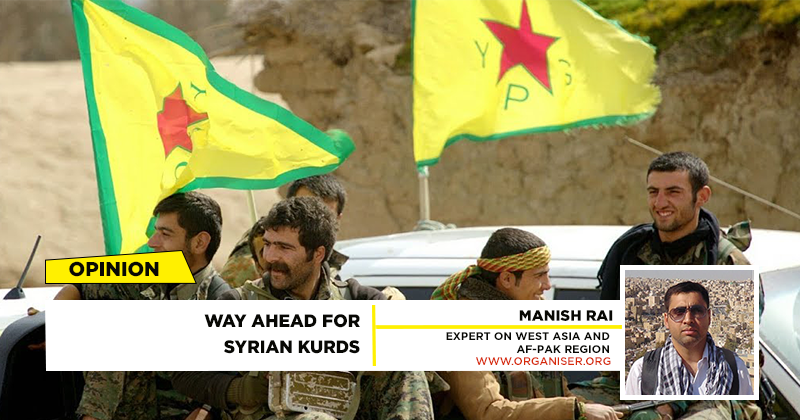
Way ahead for Syrian Kurds

The Kurdish experiment of self-rule inside Syria, long facilitated by the US military presence, is looking precarious now

Manish RaiManish Rai
Jun 27, 2023, 08:30 pm IST
inWorld, Opinion
Follow on Google News
Facebook
Twitter
WhatsAppTelegramEmail

With the recent re-election of President Recep Tayyip Erdogan, Turkey has escalated its attacks on Kurdish-held regions of north and northeast Syria. Erdogan’s animosity toward the Syrian Kurds has not abated. It became evident when Turkish authorities that control parts of northwestern Syria even refused to grant permission for seven days to transport convoys carrying humanitarian supplies to cross over into earthquake-affected areas of Syria controlled by Kurds. And with a recent victory, President Erdogan has got emboldened and is likely to carry on with his aggressive policies towards Kurds. It’s not that Syrian Kurds don’t have any support from the United States. The small contingent of American troops has supported Syrian Kurds in Syria since 2015.

The Kurdish experiment of self-rule inside Syria, long facilitated by the US military presence, is looking precarious now. While the United States says it has no intentions of leaving Syria anytime soon, with the war in Ukraine and the strategic challenge from China, Syria is no longer a top priority for the Pentagon. The US commitment is dwindling, and its ongoing military presence is unlikely indefinite. The Kurds would be playing a risky game depending on long-term US protection. Their immediate and biggest neighbour, i.e. Turkey, poses an existential threat to them.

At this stage, the only thing that might make Syrian Kurds safer, in the long run, is a political deal with the Syrian regime. The Kurds will ultimately need to reach an accommodation with the Syrian state, as they have in Iraq, to secure a sustainable existence. But that’s not as simple because the Kurdish dream of holding onto their autonomous entity in a future federated Syrian state is threatened by Turkey and by a resurgent Syrian regime opposed to any autonomous zones in Syria. But some common grounds for mutual cooperation can be explored between Damascus and Kurds. Syria’s Baathist state and Kurds have broadly stayed out of each other’s way during the conflict, despite occasional clashes. There was always a tacit understanding between President Assad and Kurds with regard to the administration of the region from which the Syrian Army withdrew in 2012. For example, the state government employees serving in this region continued receiving salaries from Damascus. The regime controlled the airport in the Kurdish-dominated city of Qamishli and maintained some security centres there.

This basic understanding can be used for future detailed negotiations. Though Syrian President Bashar al-Assad has vowed to take back “every inch” of his country, he still lacks the forces to do it, and more than a decade of war has severely damaged and eroded the capabilities of the Syrian armed forces. If the battle-hardened Kurdish forces can be integrated with the Syrian Army, it will be a great added advantage to Damascus. The Kurds need help from the Assad forces to protect them from Turkey’s onslaught, and the Syrian Arab Army will find Kurds essential for ruling north Syria and policing against both rebels and ISIS attacks.

But to reach certain accommodations, both parties must accept the truth. For Kurds, it is a hard reality that under current circumstances when they have Turkey standing on their head and with little support from the US or West. They must abandon the demands for extensive autonomy within a decentralised federal state in Syria and preserve the Kurdish forces as an independent military force, as Damascus will never accept these demands. On the other hand, President Assad must also acknowledge that although he emerged victorious in this conflict, he still can’t rule Syria with the same authoritative mindset of pre-war times. Moreover, Kurds are not unreasonable in their demands. The two million Kurds in Syria, accounting for 10-15 per cent of the total population, have only aspired before the civil war to nothing more than a degree of autonomy, an aspiration always denied to them. Syrian Kurds never thought to break away from the country. At least some of their basic demands can be fulfilled by Damascus, like- cultural rights and some autonomy for local governance.

Syria is a multiethnic society consisting of Sunni Arabs, Kurds, Assyrians, Armenians, Turkomans, Alawites and Yazidis. All of them must realise that they must rebuild Syria collectively to ensure their well-being. To start with, the Syrian Government and Kurds have to come together as the territory held by Assad and the Kurds account for most of Syria. In the 2000s, President Erdogan of Turkey led his AKP party to victory in the general election and formed his first government; a deal was reached with the outlaw PKK. Some cultural rights were granted to Kurds, like- the Kurdish language began to be used in broadcasting, education and print media. In return, PKK also softened their demands for a separate state for Kurds. If Turkey and Kurds can come to some deal, why not Assad and Syrian Kurds? Only sincere and honest efforts are required from both sides.


Topics: SyriaTurkeyArmeniansSyrian KurdsKurdsPresident Recep Tayyip ErdoganSunni ArabsAssyriansTurkomansMultiethnic society
Manish Rai
Manish Rai
The writer is a Political Analyst for West Asia and Af-Pak Region. [Read more]
Share1
Tweet
SendShareSend
✮ Subscribe Organiser YouTube Channel. ✮
✮ Join Organiser's WhatsApp channel for Nationalist views beyond the news. ✮
Previous News

‘Swa’ and ‘Sanatan’ in Gita Press

Next News

Anti-Sanatan people alleges President Droupadi Murmu kept away from idols in Jagannath temple, Delhi— Here’s the truth

Related News

Israeli Prime Minister Benjamin Netanyahu,Prime Minister Narendra Modi, Turkish President Recep Tayyip Erdogan

Turkey Targets India in Israel Row: Ankara casts New Delhi as part of a wider strategic challenge to its interests

(From Left to Right): Turkish President Recep Tayyip Erdoğan, Pakistan Prime Minister Shehbaz Sharif and Chinese President Xi Jinping

Is China-Turkey brewing secret military operation in Pakistan? 60 hour airlift spikes speculations; India on alert!

Ousted President of Syria Bashar al-Assad sentenced to death

Syria: Ousted President Assad sentenced to death for crimes against humanity; Will verdict aid extradition from Russia?

Saudi Arabia’s first test of the “Islamic NATO” exposes the alliance’s weakness as Pakistan backs away from the Houthi threat.

Sunni NATO Vanishes in Days? Pakistan runs away from Houthi fire, leaving Saudis helpless and humiliated

Did Trump Board Catering Truck in Turkey? White House conceals truth to escape Iran’s assassination threat

Turkey’s President Recep Tayyip Erdogan, Saudi Crown Prince Mohammed bin Salman, and Pakistan Prime Minister Shehbaz Sharif

Islamic NATO or Sunni Bloc? Saudi-Pakistan-Turkey pact faces question over Islam and sectarian divide

Load More

Latest News

Home minister Priyank Kharge tells no case registered against RSS in Karnataka

Rajasthan High Court

Rajasthan High Court orders major school food reform, bans chips, fizzy drinks within 50 metres of schools

A representative image

FSSAI Flags Bournvita Claims: Mondelez removes health, nutrient claims from e-commerce platforms

The Supreme Court of India

“Can the court direct fresh elections like this?”: SC questions TMC plea over West Bengal SIR voter deletion

A representative image

NADCP Impact: FMD outbreaks fall from 132 to 40, brucellosis cases also decline since 2019

A representative image

Regenerative Agriculture: Why India needs to restore soil, save water and build climate-resilient farms

A representative image generated using AI

Hindu Hate Watch-A Weekly Tracker: 66 cases of abuses, assault and killings of Hindus reported this week

Empowering Indian youth with Cloud and AI skills, building a future-ready workforce for the digital economy (This image is generated by AI)

Scaling India’s AI Talent Pool: NSDC and AWS target 1.6 Lakh future tech professionals

‘Must Have Hit One of the Hills’: Gen Chauhan on Kirana Hills During Op Sindoor

Kirana Hills in Pakistan hit during Operation Sindoor? Gen Anil Chauhan says loitering munition may have struck site

The social cost of Gulf migration goes beyond money, as Islamic conservative social norms return to Keralam with migrant communities.

Keralam’s Gulf Money, Radical Return: World Bank study exposes how conservative Islamic norms come home with migrants

Load More
  • Privacy
  • Terms
  • Cookie Policy
  • Refund and Cancellation
  • Delivery and Shipping

© Bharat Prakashan (Delhi) Limited.
Tech-enabled by Ananthapuri Technologies

  • Home
  • Search Organiser
  • Bharat
    • Assam
    • Bihar
    • Chhattisgarh
    • Jharkhand
    • Maharashtra
    • View All States
  • World
    • Asia
    • Africa
    • North America
    • South America
    • Europe
    • Australia
  • Editorial
  • Operation Sindoor
  • Opinion
  • Analysis
  • Defence
  • Culture
  • Sports
  • Business
  • RSS @ 100
  • Entertainment
  • More ..
    • Sci & Tech
    • Vocal4Local
    • Special Report
    • Education
    • Employment
    • Books
    • Interviews
    • Travel
    • Health
    • Politics
    • Law
    • Economy
    • Obituary
  • Subscribe Magazine
  • Read Ecopy
  • Advertise
  • Circulation
  • Careers
  • About Us
  • Contact Us
  • Policies & Terms
    • Privacy Policy
    • Cookie Policy
    • Refund and Cancellation
    • Terms of Use

© Bharat Prakashan (Delhi) Limited.
Tech-enabled by Ananthapuri Technologies