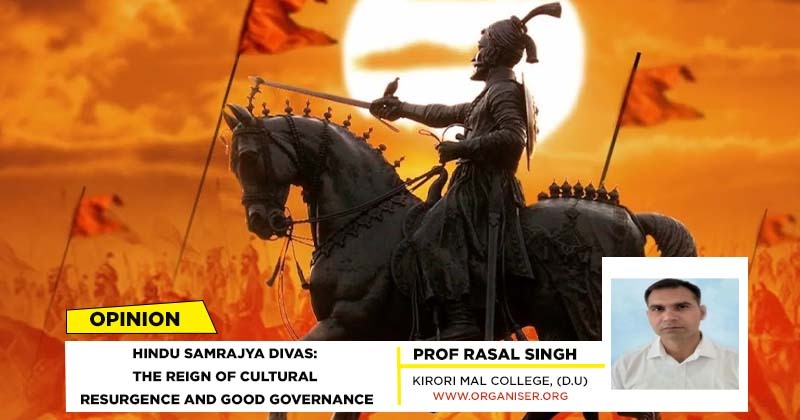
Shivaji Maharaj, an eminent warrior king, established an enduring legacy as the founder of the Hindavi Swarajya in the 17th century. In a significant event on June 6, 1674, he ascended to the throne as the Chhatrapati, the “supreme sovereign,” with great grandeur. In the Hindu calendar, his coronation ceremony was held on the 13th day (trayodashi) of the first fortnight of the month of Jyeshtha in the year 1596. This auspicious occasion not only represented his formal assumption of kingship but also signified the recognition of the Hindavi Swarajya as a sovereign and independent entity.
The coronation of Chhatrapati Shivaji Maharaj marked a turning point, laying the foundation for the future of this Hindu Empire, solidifying its strength and ensuring its enduring heritage. As we commemorate the 350th year of Chhatrapati Shivaji Maharaj’s coronation, known as the ‘Shivrajyabhishek Sohala’ according to the Shiva Shaka calendar, we pay homage to his remarkable achievements and profound contributions to the establishment of the Hindu Kingdom.
Indian history abounds with tales of illustrious kings, valiant warriors, and visionary leaders who have left an indelible mark on the course of time. Among these legends, the extraordinary life of Chhatrapati Shivaji Maharaj shines brightly as an embodiment of courage, leadership, unwavering determination and pro-people administration. India in the 17th century was on the brink of catastrophe. Hindus were hopelessly divided, leading to a disenfranchised and stagnant existence under Muslim rule. India’s intellectual landscape was barren as Hindutva struggled for survival.
During this time, the son of the soil not only built an empire from scratch but also ignited the revival of Hinduism nationally in the face of divisive and oppressive Islamic rule. Inspired by the highest ideals instilled in him by his mother, Samartha Guru Ramdas and other saints of India, he awakened the dormant conscience of the Hindus. He showed them that it was possible to defy Mughal power and attain freedom from Muslim rule successfully.
Shivaji established a sovereign Hindu kingdom where the interests of the common people were safeguarded. As a staunch proponent of Hindu nationalism and the preserver of Hindu interests, he actively sought to assert Hindu identity, revive sanatan sanskriti, and protect/patronage and construct temples in his empire. Shivaji’s unwavering commitment resonated with countless individuals, paving the way for subsequent movements and ideologies centred on Hindu nationalism. Under his leadership, policies promoting Indian languages such as Sanskrit and Marathi etc., as well as the patronage of Hindu scholars and artists, were implemented.
Shivaji forged the Hindus into a superb mobile fighting force. The indomitable spirit and military prowess of the great leader came to the forefront during his teenage years when he fearlessly captured the Torna Fort from the Adil Shahi Sultanate in 1646. This audacious feat marked the beginning of his relentless campaign to liberate various forts and territories from formidable powers such as the Mughal Empire and the Adil Shahi Sultanate. Later, in the Battle of Purandhar, he defeated the army led by Fattekhan.
In the Battle of Pratapgad, the forces of Shivaji triumphed over those of the Bijapur Sultanate. Under his guidance, the Hindus emerged as a formidable national force, challenging the hegemony of the mighty Mughal Empire in the Deccan region. He challenged the Mughal Empire when it was at the height of its glory under Aurangzeb and prevented the later in his ultimate agenda of forced conversions of non-muslims to Islam across India.
This led to the establishment of the cornerstone of the illustrious Empire, which later became one of the most influential and powerful kingdoms in Indian history. At its peak, the empire extended from Attock, which is now part of Pakistan, to Thanjavur in Tamil Nadu. The Hindus not only defeated the Mughals, rather successfully prevented British forces from attacking India for most of the 18th century.
The army, under the leadership of Shivaji, employed unique strategies in battle. Their unconventional guerrilla warfare (Ganimi Kava) tactics, meticulous strategic planning, and unwavering bravery were the cornerstones of their triumphs on the battlefield. They revolutionised warfare by pioneering the concept of establishing a strategic network of forts, known as “gadhi mazi ladki” or “forts are our strength.”
These fortified strongholds served as crucial bastions and operational bases for the forces, enabling them to challenge and overcome larger, more established adversaries. Shivaji’s military successes not only showcased his exceptional strategic brilliance but also served as a timeless source of inspiration for generations of warriors yet to come. Recognising the strategic importance of maritime security, he took bold steps to establish a formidable naval fleet.
He understood the significance of controlling the Arabian Sea and securing the coastal regions. His navy not only protected the Konkan coast from maritime threats but also challenged the dominance of European powers in the Indian Ocean trade routes.
This empire’s supremacy extended beyond military conquests to the realm of governance, where a series of transformative reforms were introduced. Recognising the importance of efficient administration, he implemented policies that emphasised local governance, swift justice system, and streamlined revenue collection in his empire.
The aim was to establish a well-organised system that prioritised the welfare and protection of common people.
Decentralisation of power and democratisation of governance were the pillars of Hindavi Swarajya. He truly believed and practiced ‘sabka sath, sabka vikas’. The emphasis was on creating system-based governance instead of individual-centred governance. One notable initiative was the formation of the “Ashta Pradhan” or the Council of Eight Ministers. This council comprised experts in various fields and played a crucial role in decision-making and policy implementation.
Their collective wisdom and expertise ensured efficient governance throughout the empire. Furthermore, a reformed revenue assessment system, which included a fair and transparent method of tax collection, was introduced. This not only ensured that the empire received its due revenue but also minimised corruption and protected the interests of the farmers, traders and artisans. These administrative practices set a benchmark for other regional powers and had a lasting impact on the governance systems of India.
The governance principles in the state were rooted in the concept of “Hindavi Swarajya”, or self-rule, wherein local communities were empowered and given autonomy to govern their own affairs. Inspired by the teachings of his guru, Samarth guru Ramdas, Shivaji encouraged the unity of all Hindus and propagated ‘Sanatana Dharma.’ which meant a liberal religion free from caste discrimination, elevated the status of women, preferred Bhakti over rituals, and curtailed the excesses of polytheism.
Emphasis was placed on treating people of different religions and castes with respect and fairness. Patronage was extended to scholars, artists, and poets from various backgrounds. Social justice and equality were the cornerstones of his administration, and proactive measures were taken to ensure that everyone had access to a fair and impartial judicial system. Thus, his rule was characterised by inclusive policies and respect for different socio-cultural communities.
Furthermore, considerable efforts were made to augment the economy of the Hindu kingdom diligently. Significant strides were made in refining the revenue system established by Dadaji Konddev, particularly by standardising land measurement and estimating yields based on soil types. It was recognised that incentivising farmers to cultivate previously uncultivated land was crucial for economic growth. To achieve this, a range of incentives empowering farmers to embark on farming ventures in unexplored territories were introduced.
Moreover, courageous decisions to abolish revenue collection by watandars not only bolstered tax revenue for the central government but also directly benefited the peasants. This reform ensured that a greater portion of taxes reached the hands of hardworking farmers, significantly improving their economic prospects. Thus, the multifaceted economic reforms fostered prosperity and provided a solid foundation for the burgeoning Hindu Empire.
In less than 40 years, Shivaji Maharaj consolidated a kingdom so powerful that it acted as a strong foundation for the Hindu Empire that rose during the early 18th century. The next few decades witnessed the spread of Hindutva power all over the country. The path shown by this visionary king led to the peak of prosperity and development. The Hindus’ unwavering struggle against oppressive regimes and their resolute determination to establish an independent kingdom served as a wellspring of inspiration for subsequent freedom movements in India. Their immortal heritage, built upon principles of self-governance, cultural pride, Sanatana Dharma, and unwavering resistance against foreign domination, left an indelible mark on the minds of influential figures like Bal Gangadhar Tilak, Veer Savarkar and many more that carried forward the legacy during the Indian Swarajya movement and in post-independent India.
The news of the coronation is blacked out in all the Mughal documents. From these one can imagine how sad this incidents must have been for the Mughals as well as Qutub Shah. This established the sovereignty of the Hindus and the whole of India.
Overall, he created a comprehensive system of epoch-making governance. And in light of all these illustrations and episodes, it can be said that Shivaji was the true builder of modern India.