Harappa, Mohenjo-Daro civilisation should be named the Saraswati Civilisation, not Indus Civilisation
June 22, 2026
  • Read Ecopy
  • Circulation
  • Advertise
  • Careers
  • About Us
  • Contact Us
Android AppiPhone AppArattai
Organiser
  • ‌
  • Bharat
    • Assam
    • Bihar
    • Chhattisgarh
    • Jharkhand
    • Maharashtra
    • View All States
  • World
    • Asia
    • Europe
    • North America
    • South America
    • Africa
    • Australia
  • Editorial
  • International
  • Opinion
  • RSS @ 100
  • More
    • Op Sindoor
    • Analysis
    • Sports
    • Defence
    • Politics
    • Business
    • Economy
    • Culture
    • Special Report
    • Sci & Tech
    • Entertainment
    • G20
    • Azadi Ka Amrit Mahotsav
    • Vocal4Local
    • Web Stories
    • Education
    • Employment
    • Books
    • Interviews
    • Travel
    • Law
    • Health
    • Obituary
  • Subscribe
    • Subscribe Print Edition
    • Subscribe Ecopy
    • Read Ecopy
  • ‌
  • Bharat
    • Assam
    • Bihar
    • Chhattisgarh
    • Jharkhand
    • Maharashtra
    • View All States
  • World
    • Asia
    • Europe
    • North America
    • South America
    • Africa
    • Australia
  • Editorial
  • International
  • Opinion
  • RSS @ 100
  • More
    • Op Sindoor
    • Analysis
    • Sports
    • Defence
    • Politics
    • Business
    • Economy
    • Culture
    • Special Report
    • Sci & Tech
    • Entertainment
    • G20
    • Azadi Ka Amrit Mahotsav
    • Vocal4Local
    • Web Stories
    • Education
    • Employment
    • Books
    • Interviews
    • Travel
    • Law
    • Health
    • Obituary
  • Subscribe
    • Subscribe Print Edition
    • Subscribe Ecopy
    • Read Ecopy
Organiser
  • Home
  • Bharat
  • World
  • Operation Sindoor
  • Editorial
  • Analysis
  • Opinion
  • Culture
  • Defence
  • International Edition
  • RSS @ 100
  • Magazine
  • Read Ecopy
Home Bharat

Harappa, Mohenjo-Daro civilisation should be named the Saraswati Civilisation, not Indus Civilisation

Terracotta figurines, and seals, all found in the Saraswati-Indus civilisation, testify to the continuity of that Rig-Vedic/Saraswati-Indus civilisation with today’s Hindu culture

Sudip Narayan GhoshSudip Narayan Ghosh
Apr 24, 2023, 08:00 pm IST
in Bharat, Opinion, Culture
Follow on Google News
FacebookTwitterWhatsAppTelegramEmail

For about 2000 years’ foreign invaders came to this country — first Persians, Greeks, Shaks, Huns, Scythians, Pathans, Mongols, Turks, Mughals, and Nadir Shahs etc. Then came the European invaders by sea. Finally, the British colonised India. They did not accept Indianness. They created a new history in a foreign guise; Leftist historians like Romila Thapar, Irfan Habib, etc., strongly supported him during the post-colonial period.

What was in it? —Aryan attack theory. Max Müller etc., states that the Aryans of North India entered India from the Anatolian steppes of Central Asia and Turkey around 1500 BC; they destroyed the advanced ‘Indus Valley Civilisation’ of the Dravidian tribes of India. They drove the Dravidians south of the Vindhya Mountains with the great massacre. So the Britishers are foreign invaders just like Aryans, ancestors of present-day Hindus; their anger at British colonialism in India is unwarranted.

This theory did not hold up. There were no signs of large-scale massacres. Only 38 skeletons were found in one place and 12 skeletons in another place. They were not injured by sword or spear. When the Aryan invasion theory did not hold up, the Indo-Aryan migration theory was introduced, which states that the Indus civilisation gradually declined. The Aryans entered India in droves from Central Asia. They were primarily pastoralists; The Dravidians did not have horses or horse-drawn chariots with which the invading Aryans defeated the Dravidians.

When the British left, the Americans took their place; they wanted to pit the Dravidians and Dalits (?) against the Hindus to carve up India. They ignored the great philosophical value of the Vedas and dismissed the Saraswati as a mythical fantasy that projected the Indus as the vessel of Indian civilisation.

In his book The Saraswati Civilisation, Major General Dr GD Bakshi proved the anti-establishment historical fact on this subject. He said images sent by artificial satellites (sent by US Landsat in 1970-80 and later by ISRO satellites) clearly showed the existence of a mighty river that once flowed from the Himalayas to the ocean. The river fully flowed 6000 years ago and almost completely dried up in 1900 BC. Saraswati is worshipped as the greatest river in the Rig Veda. Carbon dating of Rakhigiri and Virana places the age of the so-called Indus Valley Civilisation at 9500-8000 years ago. Remains of a chariot found at Baghpat in Uttar Pradesh have been carbon-dated to 4000 years before the so-called Aryan invasion/invasion (1500 BC). Gene mapping of haplogroups does not support the Arya-Dravidian split. The genes of the Indian population north-south of the Vindhya Mountains are mixed. R1A1A gene mapping and language studies have shown similarities between groups from southern Europe, central Asia and northern India. Similarly, linguistic similarity has also been found. The oldest gene was found in India, not in Central Asia or Southern Europe.

Colonial chronicles claim that agriculture was imported into India from Mesopotamia 10,000-12,000 years ago. They were the first to establish a permanent settlement from a nomadic life.

But with the help of geological surveys, satellite images, archaeological evidence, linguistic evidence, remote sensing, anthropological studies, genetic analysis, astronomical evidence and carbon-dating, what is consistent is:

A tectonic collision 4700 years ago caused the Saraswati to move to the west and the Yamuna to the east; the Shatdru joined the Indus, thereby cutting off the Himalayan glacier water that the two rivers used to feed the Saraswati and making the Saraswati a rain-fed river. Secondly, the monsoon also moves slowly towards the east.

As a result, Saraswati dried up completely 3900 years ago. It is unacceptable that the Aryans came from outside in that arid region 3500 years ago. Genome sequencing has revealed that 50-60 per cent of the Indian population is descended from proto-Indians who came from Africa 65,000 years ago, as in other countries/continents.

So Aryans did not enter India from the outside, but the opposite happened. The vast wealth of ancient Sanskrit literature and scriptures and the paucity of contemporary literature from other Indo-European language groups prove that Sanskrit is the mother of all Indo-European language groups. Central Asia is not the birthplace of civilisation. The Harappan civilisation region coincides with the geographical area described in the Rig Veda.

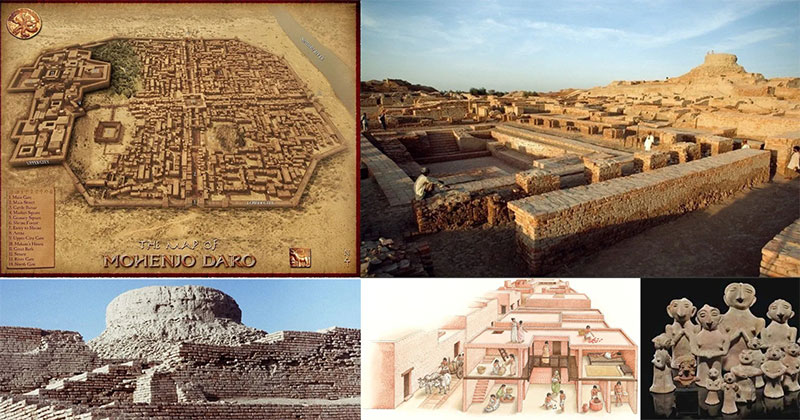
Therefore, the Harappan and the Rigvedic civilisations are the same and the oldest. Terracotta figurines, and seals, all found in the Saraswati-Indus civilisation, testify to the continuity of that Rig-Vedic/Saraswati-Indus civilisation with today’s Hindu culture. The civilisation called the Indus Civilisation has been found at about 2000 sites in India on the banks of the Saraswati River, which erupted 3800-3900 years ago. Therefore, it is reasonable to call this civilisation Saraswati civilisation.

Topics: HarappaIndus Valley CivilisationSaraswati-Indus civilisationSaraswati CivilisationMohenjo-Daro civilisation
Share5TweetSendShareSend
✮ Subscribe Organiser YouTube Channel. ✮
✮ Join Organiser's WhatsApp channel for Nationalist views beyond the news. ✮
Previous News

Human Remains of Nagas to Repatriate from UK Museum

Next News

Why Namaz on Roads is a problem?

Related News

People practicing Yoga

International Yoga Day: Beyond the mat, rediscovering Yoga’s timeless essence

The terracotta dice that challenges historical assumptions and highlights India's millennia-old civilisational heritage

How a 4,500-year-old terracotta dice is reviving the debate on India’s civilisational continuity & Vedic heritage

The Pashupati Seal of the indus valley civilisation and the continuity of India’s shaivite spiritual traditions

Pashupati Seal of Mohenjo-daro: The 4,300-year-old symbol of India’s unbroken spiritual & civilisational continuity

Renaming of streets in Lahore

Restoring Lahore’s old names won’t hide Pakistan’s minority persecution

Ratadiya Ri Dheri

Ratadiya Ri Dheri: A recently discovered Saraswati-Indus Civilization site in Jaisalmer

Ancient India: A golden age of women’s power

Load More

Latest News

Another Vande Mataram moment for Bengal

“Mamata Banerjee has been in denial mode on crime against women from 2012 itself”: Sukhendu Sekhar Roy, former TMC MP

Tiruparankundram Deepam row: Madras HC asks TN govt to end dispute through talks; TVK cites Supreme Court appeal

Endowments Andhra Pradesh Minister Anam Ramanarayana Reddy (Left Side)

Andhra Pradesh: TDP govt reports Rs 813 crore for development of 692 temples in last two years

Post Poll Violence 2021: Bengal’s Daughters Await Justice…

Ambubachi Mela 2026: Why Kamakhya devi’s annual retreat draws sants, sadhus and seekers from across Bharat

Laughter or Vulgarity? The growing crisis in India’s stand-up comedy culture

Madurai CPM MP Su Venkatesan speaking to media on June 21, 2026

BJP Tamil Nadu calls Su Venkatesan’s ‘Vande Mataram’ remarks in Assembly an insult to the freedom movement’s legacy

The BJP-led Mahayuti alliance secured a landslide victory in the Maharashtra MLC elections, winning 16 of 17 seats

Maharashtra MLC Elections: BJP-led Mahayuti sweeps 16 of 17 seats, delivering a crushing blow to the opposition

Scotland Honours Maharshi Sushruta: Statue unveiled at Royal College; Celebrating India’s ancient medical legacy

Load More
  • Privacy
  • Terms
  • Cookie Policy
  • Refund and Cancellation
  • Delivery and Shipping

© Bharat Prakashan (Delhi) Limited.
Tech-enabled by Ananthapuri Technologies

  • Home
  • Search Organiser
  • Bharat
    • Assam
    • Bihar
    • Chhattisgarh
    • Jharkhand
    • Maharashtra
    • View All States
  • World
    • Asia
    • Africa
    • North America
    • South America
    • Europe
    • Australia
  • Editorial
  • Operation Sindoor
  • Opinion
  • Analysis
  • Defence
  • Culture
  • Sports
  • Business
  • RSS @ 100
  • Entertainment
  • More ..
    • Sci & Tech
    • Vocal4Local
    • Special Report
    • Education
    • Employment
    • Books
    • Interviews
    • Travel
    • Health
    • Politics
    • Law
    • Economy
    • Obituary
  • Subscribe Magazine
  • Read Ecopy
  • Advertise
  • Circulation
  • Careers
  • About Us
  • Contact Us
  • Policies & Terms
    • Privacy Policy
    • Cookie Policy
    • Refund and Cancellation
    • Terms of Use

© Bharat Prakashan (Delhi) Limited.
Tech-enabled by Ananthapuri Technologies