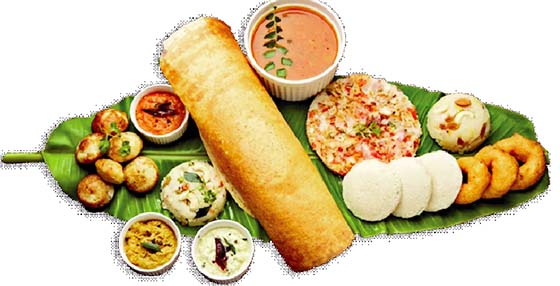
How old is the ‘dosa’ or ‘masala dosa’ that has made the world go crazy about it? No body can tell anything with certainty, but it certainly existed 2,000 years ago! Thus, as one explores the known resources and documents of history, one gets to know that the tastiest ‘dosa’ was eaten in South India about 2,000 years ago.
This is very important. The richness of Indian culture did not remain confined to architecture alone, nor only arts or theatre, nor merely spirituality but also included a rich food culture. Of course, it was perfected with completeness of human life.
Our ancestors gave deep thought to the food culture. Indian culinary science propounded all the information thousands of years ago, the kind of information that modern culinary science tells us today. Our forefathers had written a few thousand years ago that “diet and body, diet and mind, diet and attitude of mind are related to each other” This was indeed amazing. No reference of any such thing can be found even remotely in Greek, Egyptian or Chinese cultures that were well developed during those days.
“5,060 years ago, India’s exports passed through two cities in Italy – Genoa and Venice, and both these cities were the richest cities of Europe at the time because of trade in spices”
The book Bhagavad Gita is estimated to be at least 5,000-6,000 years old. Even going by the guesses made by Western scholars, it is certain that the Gita was written at least 3,500-4,000 years ago. In the 17th adhyaya (chapter) of the Gita, shlokas 8, 9 and 10 explain the results that appear due to our diet on our life. Persons having three types of nature- sattvik, rajasic and tamsic-show the tendency to consume three types of foods and people’s deeds depend on the three mental attitudes of a person.
Let’s look at the eighth shloka, for example:
Ayuh sattvabalaabarogya sukhpreetvivardhana:,
rasyaah, snigdhaah, sthiraah,
hridyaah, aahaarah, sattvikpriyaah ||8||
Persons with a sattvik attitude love to eat food that increases life, intellect, strength, health, happiness and bliss, is tasty and appears pleasing to the mind.
Ours is the only country on this Earth with a perfect, scientific and ancient food culture. References are found in the Rigveda where statements like Yajasvam tatram tatsvam… (nourish your body and honour it) appear very often. It is also said that the meal should consist of wheat, barley and milk. Sukta 140/2 of the sixth adhyaya (chapter) of Atharvaveda says that “Food made from rice, barley, urad dal (lentils) and sesame constitute the right food.”
Many evidences corroborating such claims are found in the excavations carried out at Mehergadh, Harappa and Mohenjodaro. They reveal that our ancestors were aware of food made from wheat, barley, milk, etc. nearly 8,000 years ago. Interestingly, Indian cuisine makes use of cinnamon and black pepper since the last few thousand years.
Mehrgarh is a small village in Baluchistan in present-day Pakistan. Jean-François Jarige, a French archaeologist, started excavating here in 1974 and found remains of the 7,000 year-old village. Significantly, evidences of the oldest system of farming in the world were found during the excavations. Of course, it can easily be said on the basis of the evidences available today that the concept of farming was introduced first in the Indian subcontinent.
The core concept of India’s traditional culinary science is: “Diet and body, diet and mind, diet and attitude of mind are related to each other”
Cultivation of different kinds of pulses (lentils like tur dal, etc.), wheat and grinding it to make atta (flour), preparing different recipes from wheat-all this was taking place nearly 8,000-9,000 years ago.
What is India’s biggest contribution to the global food culture? Spices! Spices were exported from India at least 2,000-3,000 years ago in large quantity and plenty of evidence is available about this. During the Berenike excavation project, eight kg of black pepper was found in a closed box at Berenike port. It dates back to AD 30-70 as per carbon dating. This is an undeniable evidence of the fact that spices were exported from India. Indians had discovered spices like black pepper, cinnamon, bay leaf, coriander, etc. thousands of years ago.
Later, different recipes came up in India based on the different geographical features. These recipes helped in preparation of tasty food, which is why Indian cuisine enticed foreign travellers some thousand years ago. Angus Maddison, originally from Britain, was a professor of economics at Groningen University in the Netherlands. His book entitled, The World Economy: Millennial
Perspective is considered to Be standard reference in many universities. It says that 5,060 years ago from today, the goods going out from India passed through mainly two cities in Italy – Genoa and Venice and both these cites were considered to be the richest cities of Europe at the time because of trade in spices.

However, the Indian spices were used mostly in Europe in cooking meat. The Westerners could not handle the technique of cooking vegetarian recipes. There were two reasons for this- the number of plants growing there was relatively low because of climatic disparities and they were ignorant of diversity in vegetarian cuisine.
Some years ago, I had gone to Zurich to meet my client. He took me to an Indian restaurant after our meeting. During our conversation, he told me that he had decided to become a vegetarian a few days ago. As a start, he decided to go completely vegetarian at least for 30 days. However, he was bored of this food within five to six days. He somehow survived the next 10-15 days on vegetarian food but after just three weeks, he went back on his resolve and switched to non-vegetarian diet.
I asked, “Why so?”
He said, “I was fed up eating of such grass and leaves every day, man. How can someone eat the same raw vegetables, boiled leaves and salad day in and day out?”
I said, “Man, why eat just raw and boiled vegetables? We have literally thousands of recipes in vegetarian diet. Look here and now in this restaurant..”
He said, “True, but I didn’t know this earlier. We think vegetarianism means raw or boiled vegetables! How could we know that tasty recipes can be made by adding spices to them and by eating with bread?”
India gave an extremely tasty, delicious and nutritious food culture to the whole world. Today, an Indian restaurant can be found anywhere on the surface of the Earth where the population is more than 50,000! The Indian food culture has spread to every nook and corner of the world and is as popular as Chinese and Italian foods; nay, a bit more in some aspects. Domino’s, etc. took Italian pizza and pasta to the world, but unfortunately, we could not establish chains of restaurants that could serve foods like idli, dosa, vada-pav, chhole-bhature, etc. at the global level.
And what a diversity we have! Tagging them just under South Indian food is not enough; Andra Pradesh, Tamil Nadu, Karnataka and Kerala have their own different food items. Dosa and vadas were prepared in India since 2,000-2,500 years, but idli is not fron India. It is Indian, but came from abroad. Ldli was prepared through the fermentation process by cooks in the service of Indian kings of Java-Sumatra (Indonesia). It came to India from Java and became known worldwide. The foremost mention of idlis found in the Kannada language book, Vaddaradhane by Shivkoti Acharya in Bellary district, in AD 920.
The Indian curry is popular worldwide. Many celebrities in the world are addicted Indian curry. The wor, cadetyr refers to the gravy made with tardan spices. It can be both vegetarian and non-vegetarian food. The history of curry is interesting and ancient. The word is derived from kalkaart in Tamil. Kaikaari means vegetables cooked with different spices.
The practice of praying before a meal is followed in different parts of the world. It is especially practiced by Christians, Jews, etc. and holds importance for Indians also. Pre-meal prayer of Indians is very significant, relevant and purposeful with different meanings. We look upon food as purnabrahma. Panini had given Dhatusutra as the etymology of the word bhojan-bhuj palan ayavaharayo. Going a little further, the mantras that we recite before having a meal are:
Aum annapate annasya no dehyanamivasya susminah.
Pra pra dataram tarish urjam no dehi dwipade chatushpade.
Or
Aum brahmarpanam brahmahavirbrahmagnau
Brahmana hutam.
Brahmaiva tena gantavyam brahmakarma samadhina.
Aum sahanavavatu sahanau bhunaktu
sahaviryam karavavahai.
Tejasvinavadhitamastu ma vidvishavahai.
Aum shantih, shantih, shantih!
Overall, we are bearers of a perfect, scientific and nourishing ancient food culture. There is nothing wrong in taking pride in this culture. On the contrary, propagating this rich food culture to the world is necessary!