Bharat’s relationship with energy is as ancient as civilisation itself. Long before solar panels gleamed across our deserts or wind turbines dotted our coasts, our ancestors looked to the heavens and saw the Sun not merely as light, but as life. The Rigveda called him Savita the nurturer of all creation while the builders of the Sun Temple at Konark enshrined that reverence in stone, capturing the movement of the solar cycle through intricate architecture. This early celebration of solar energy reflected not just devotion, but a scientific appreciation of nature’s rhythm. That deep respect for natural forces flowed into everyday life. Across the Himalayan valleys, the gharats and panchakkis traditional watermills powered communities by harnessing the kinetic force of flowing rivers. These simple yet elegant technologies were the precursors of today’s hydropower systems. They remind us that Bharat’s understanding of renewable energy is not a modern discovery; it is a civilisational inheritance grounded in harmony with nature.
Sustainable Development Goals
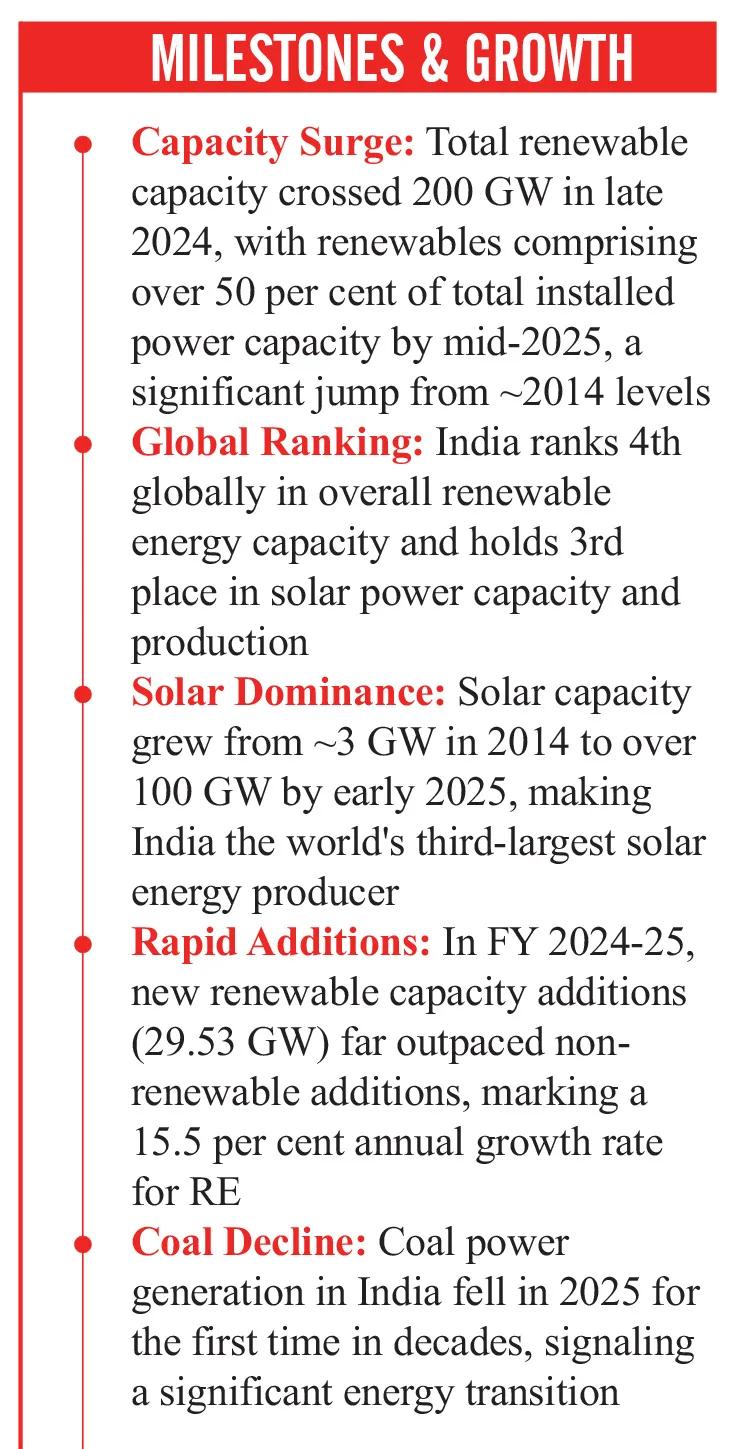
Under the leadership of Prime Minister Narendra Modi, Bharat embarked on a transformational renewable energy journey starting in 2014, when the country’s renewable energy capacity was at 76 GW. Today, in 2025, this capacity has surged to 226.9 GW, representing 49 per cent of Bharat’s total installed power capacity. In the single fiscal year of 2024–25 alone, Bharat added a record 29.52 GW, with solar energy contributing 23.8 GW of that growth. These milestones position Bharat well on the path to achieving SDG 7, which aims to increase the share of renewables in the global energy mix by 2030.
Solar power, in particular, has been the engine of this transformation. From a modest 2.8 GW in 2014, solar capacity now exceeds 110 GW, marking a 4,000 per cent increase. But the story goes beyond capacity; it is about resilience and self-reliance. Through the Rs 41,000 crore Production Linked Incentive (PLI) scheme, Bharat’s solar photovoltaic manufacturing capacity has expanded from just 2.3 GW to over 100 GW, reducing import dependence and creating thousands of new jobs. This directly advances SDG 8 Decent Work and Economic Growth, proving that green energy can also be a catalyst for inclusive employment and industrial resurgence.
Complementing Solar’s rise is the steady growth of wind energy. Bharat’s wind power capacity has now surpassed 51 GW, placing the country fourth globally. Together with hydropower and biomass, these renewables form the backbone of our low-carbon future, a future that delivers on SDG 13 Climate Action by cutting emissions, strengthening energy security, and building resilience against climate risks.
Noteworthy Initiatives
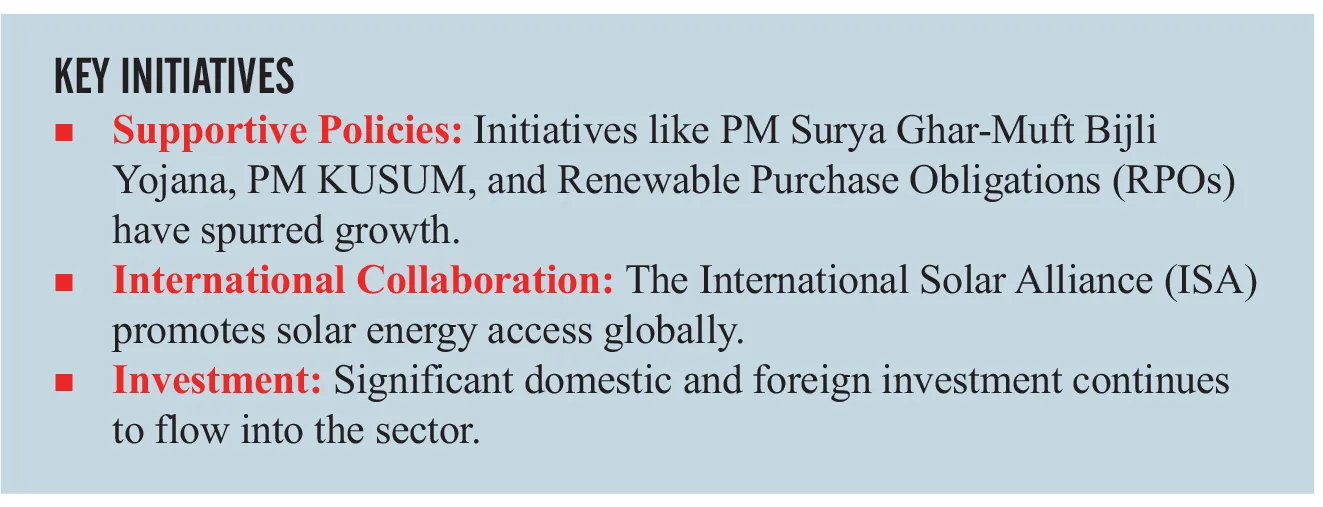
Behind these results lies thoughtful policy and purposeful reform. Initiatives like the National Solar Mission, PM Surya Ghar: Muft Bijli Yojana, PM-KUSUM and the National Green Hydrogen Mission have redefined Bharat’s approach to sustainable energy. The Green Hydrogen Mission, targeting 5 million metric tonnes of annual production by 2030, is set to revolutionise industrial energy use and establish Bharat as a global hub for clean fuels. Transparent, competitive bidding processes have also driven solar tariffs down from Rs 10.95 per unit in 2010 to Rs 1.99 in 2021 among the lowest in the world demonstrating that clean power can also be the most affordable.
This transformation extends naturally into our cities, where sustainable energy is reshaping the urban experience. Rooftop solar systems, decentralised grids, and electric mobility are being woven into city planning, supporting SDG 11: Sustainable Cities and Communities. Through initiatives like the PM Surya Ghar Yojana, households are turning into micro-power producers, reducing pressure on urban infrastructure while cutting costs and emissions. Bharat’s energy transition is thus not just national in scale it is local in spirit, empowering citizens to participate directly in the green revolution.
Bharat’s leadership, however, transcends its borders. In 2015, Prime Minister Narendra Modi launched the International Solar Alliance (ISA), the world’s first treaty-based intergovernmental organisation dedicated to solar cooperation. With 122 member countries today, ISA has become a cornerstone of global energy diplomacy, uniting nations under a shared commitment to harness the power of the Sun. Worldwide, Bharat now ranks third in solar, fourth in wind and fourth overall in total renewable capacity achievements that mirror both domestic ambition and global stewardship.
Our progress has also attracted unprecedented investment. In 2023 alone, the renewable energy sector drew Rs 42,000 crore (US$ 4.88 billion) in FDI, with cumulative inflows since 2020 exceeding Rs 1.6 lakh crore (US$ 18.6 billion). Innovation thrives through floating solar plants, renewable energy SEZs and green hydrogen corridors that are redefining industrial and infrastructural frontiers. Yet, some of the most powerful examples of transformation are found in our villages. Palli village in Jammu & Kashmir now Bharat’s first carbon-neutral panchayat runs entirely on solar power, embodying the perfect convergence of technology, community and sustainability.
From the ancient gharats of Uttarakhand to the solar rooftops of Palli, from the chariot wheels of Konark to the wind farms of Tamil Nadu, Bharat’s conversation with energy has always been a dialogue with nature. In an age of climate anxiety, Bharat offers a model of balance proving that economic growth and environmental stewardship are not opposites but allies. As we move towards Viksit Bharat @2047, our renewable journey remains both a continuation of ancient wisdom and a commitment to future generations.
Traditional Bharatiya practices offer valuable insights for today’s energy and climate challenges. Indigenous architectural knowledge optimised solar orientation, natural ventilation and daylight to maintain thermal comfort long before the advent of mechanical cooling, significantly reducing energy demand. Decentralised systems such as stepwells, tanks and rainwater harvesting structures ensured efficient resource use and community resilience. Biomass-based energy use, solar drying of food and water-powered systems like gharatas illustrate how renewable resources were harnessed sustainably at the local level. Equally important is IKS’s contribution to climate resilience and adaptation. Traditional ecological knowledge derived from long-term observation of weather patterns and ecosystems enabled the cultivation of drought-resistant crops, adaptive farming techniques and sustainable forest management. Community-led conservation practices, including the protection of sacred groves (Devrai), have preserved biodiversity, strengthened carbon sinks, and regulated local microclimates for generations. These practices align directly with SDG 13 (Climate Action) and SDG 15 (Life on Land), demonstrating that climate-aware governance has deep cultural roots in Bharat.
Integrating this time-tested knowledge with modern renewable energy technologies creates a powerful development model—one that is locally grounded, socially inclusive, and environmentally resilient. As Bharat advances in decentralised solar, green hydrogen, energy-efficient buildings and community-led sustainability initiatives, the principles of the Bharatiya Knowledge Systems offer ethical guidance and contextual intelligence that pure technology alone cannot provide.
In this synthesis of ancient wisdom and modern innovation lies the uniqueness of Bharat’s energy transition. It is not merely a shift in fuel sources, but a reaffirmation of a civilisational ethic—where development advances in balance with nature, communities remain at the center, and progress is measured not only in megawatts, but in harmony, resilience, and shared prosperity.