When the prospect of joining a medical camp in the districts of Punjab adjoining the India-Pakistan border, under the ambit of the inaugural Bhai Kanhaiya Svasthya Seva Yatra (BKSSY) organised by the North Zone team of National Medicos Organisation (NMO) came up, I took up the offer as an opportunity to explore the state threadbare in a different way than as a mere tourist on the one hand and to gain a first-hand peek into the realities of healthcare at the ground level outside the ivory tower of a tertiary care institution on the other. After considering the various means of reaching Amritsar, I gathered the courage to drive down the 250-odd kilometres from Chandigarh, a distance longer than any I had driven across.
I am glad that I took up the challenge to drive by myself as not only were the broad and smooth roads a delight to drive on, they also gave a major confidence boost to the driver in me. The FasTag system has virtually eliminated the congestion at the Toll Plazas, and apart from a few spots where flyover bridge construction was ongoing, the roads were pretty much in good shape.
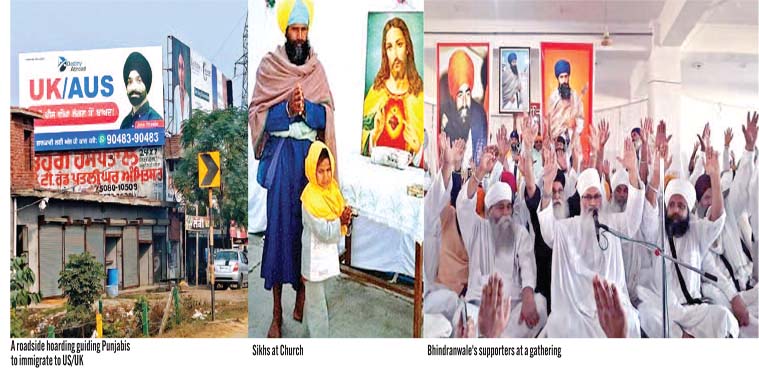
They say, ‘advertising reflects the mores of society, but it does not influence them.’ If this is true, one would not be wrong to say that the number one issue which rules the minds and hearts of Punjab today is immigration, immigration and immigration. Most billboards along the way from Chandigarh to Amritsar advertised either IELTS trainers or visa consultants who claimed to get visas to countries as far apart as Canada in the north-west to Australia in the south-east.
A close second were advertisements by so-called prophets and pastors inviting people to ‘Christ Satsang’ and special Christmas celebrations, going on to highlight the extent to which these activities have penetrated the state of Punjab (about which we shall talk later in this article). The health camps by themselves were a very different experience in health care than what we are used to in tertiary care hospitals. The instructions from the organisers (NMO North Zone) were clear—make do with whatever medications are available in the kits provided and no prescribing other medications or ordering investigations. For someone whose primary work as a resident is drawing samples almost daily for a myriad of work-ups, this was a culture shock at its max.
The bigger shock, as the team leader, was the person whom everyone from the local organisers to medical students who were a part of our team looked up to for instructions ranging from the time at which the camp was to be set up, the nitty gritty of setting it up to diagnostic dilemmas and queries regarding what medications to prescribe.
A close second were advertisements by so-called prophets and pastors inviting people to ‘Christ Satsang’ and special Christmas celebrations, going on to highlight the extent to which these activities have penetrated the state of Punjab
This was in sharp contrast to my day-to-day work as a junior resident, where I rushed to the senior residents or consultants for any and every sort of doubt I might have. For the instructed to become the instructor was quite a change and initially surely a bit overwhelming. By the final day, though, things went a bit more smoothly since our machinery was well-oiled, and I must thank the medical students who were part of my team for being excellent and receptive team members. The kit put together by the NMO Punjab the team was comprehensive and meticulously prepared, and the efforts put in by the organisers shone through.
The other stark difference between working in the field and a tertiary care referral centre is that most patients have simple problems in the former. The largest chunk is that of the elderly with chronic disorders like diabetes, reflux, hypertension and ageing-related illnesses like osteoarthritis, followed by children with allergic concerns, anaemia, failure to thrive and respiratory infections. Wherever we could, we tried to provide medicines for the relevant problems, but what we definitely gave to one and all was a patient ear, empathy and counselling regarding simple home remedies, lifestyle changes, further follow-ups etc., and more often than not, these measures made a more significant impact than medications alone.
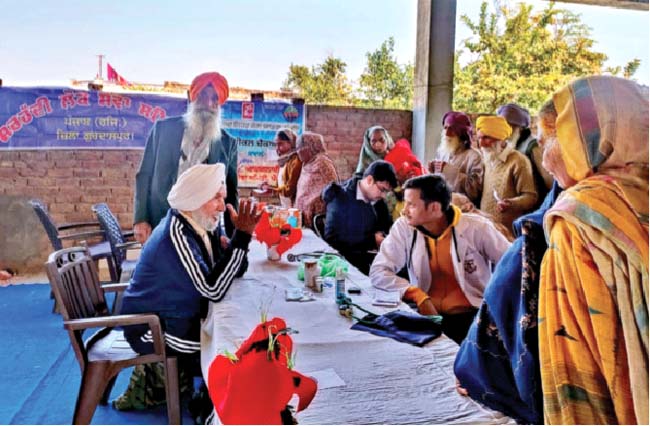
The going became smoother as we started to understand the local language and dialect better, for example after the first day itself, we came to know that ‘daaru’ in these parts also means ‘drops’ to put in eyes or ears and not the other meaning most of us are familiar with. A huge shout out to the local organising team from Sarhadi Lok Seva Samiti and backroom management by NMO North Zone which ensured that the camps in three different villages went through extremely smoothly with minimal glitches. Everywhere we went, the elders of the village accorded us a gracious welcome and the camp was often set up in the premises of the village Gurudwara, whose public address system was used to inform and invite villagers to the health camp.
The famous Punjabi hospitality came to the fore, and in every village, we were offered repeated rounds of tea over and above hygienic, nutritious and tasty meals. The local organising team of Sarhadi Lokseva Samiti did their best to ensure that we were comfortable. When we were setting up camp on a chilly Sunday morning, I heard some peculiar song playing from a nearby house. It sounded like a bhajan of some sort, but the lyrics felt a bit out of place. Led by my curiosity, I ended up going towards the source of the sound to listen clearly, and what I heard intrigued me. It was a bhajan all right, but dedicated to Jesus and Jehovah. Similarly, what also struck my mind was to see many children with English-sounding names like Samson, David, Angel and whatnot.
I finally ended up asking some of the parents whether they understood what these names mean, and most replied in the negative. So I asked them who chose the names in the first place, and the answer usually was ‘pastor ji ne rakhiya si’ (the pastor has kept it). If one needed any further evidence of the extent to which the Churches of various denominations have spread in rural Punjab, here it was. Incidentally, our team had set up camp in Gurdaspur District, which possibly has the highest proportion of Christians in Punjab. The other observation was the lasting popularity of Jarnail Singh Bhindranwale.
The location where we had set up camp on day 1 had just above our head a large poster featuring Bhindranwale on one side and Deep Sidhu on the other, going on to show how the recent agitation against the farm laws had potentially given a new lease of life to the weakened Khalistani movement. It was indeed a bit uncomfortable to be sitting under the gaze of someone who, for much of India outside Punjab, was a dreaded extremist. We also heard accounts from another team that had gone to Tarn Taran about how some elements there told them that the day Khalistan is a reality, Tarn Taran would be its hub. On the other hand, one must also note that the average Punjabi Hindu and Sikh lives are extremely intertwined, with many a Sikh visible in temples and an equal number, if not more, of Hindus regularly visiting Gurudwaras and playing Sukhmani Sahib at home.
The evenings were spent exploring the nearby places— courtesy our wonderful local team. We got to see the Indian outpost at Kartarpur Sahib from where Pakistan was a stone’s throw away. What one of the local organising team members said stirred us all deeply- ‘I will not pay $20 to Pakistan for visiting the shrine across the border, I will rather wait for the day this border no longer exists and there is Bharat on both sides to visit. The border did not exist before 1947 and it need not necessarily exist in the future.’ All hail Akhand Bharat!
We also got to know that Akbar has crowned Emperor at Kalanaur in Gurdaspur, and the platform where the coronation took place exists till date. One saddening part was to see the numerous scribbling and engravings defacing this historical site, even though it is supposed to be an ASI-protected monument. We also got the opportunity to visit many local temples and shrines. Coming back to Amritsar, the thing which struck me the most in the closing ceremony was how deeply the Rashtriya Swayamsevak Sangh (RSS) understands the reality of various parts of Bharat and how hard it works to assimilate with each and every sphere in the national interest. Two senior functionaries from the RSS addressed the entire team, one at the inauguration of the BKSSY and one at its conclusion and to uphold the local sentiments, both spoke exclusively in fluent Punjabi, even though as an organisation, the Sangh usually functions in Hindi.
That Sangh has among its numerous affiliates, one like the Sarhadi Lok Seva Samiti, exclusively focused on border areas was another heartening thing to know. The Sangh is truly unparalleled when it comes to working towards promoting Bharatiya interests. Amritsar as a city also seemed better organised than I had expected it to be. There is a BRTS system which covers major roads and many flyovers. The older city, which my visit to the famous Kesar Dhaba took me to, is a bit congested. The food at Kesar was average at best and to me the hype surrounding that place did not make sense. On the other hand, Kanha Sweets lived up to its reputation with scrumptious chole-bhature and gajar halwa, while the chai at Giani Chaiwallah was pretty decent too. I took back with me aam papad and urad papad, both delicious. Driving back from Amritsar to Chandigarh was another good ride. All in all, this one of its kind experience made me more confident on multiple levels, as a driver, a doctor and a leader. I am greatly indebted to the National Medicos Organisation for this opportunity and look forward to more such exciting experiences in the future for service to the nation.