Decolonising Minds : Fulfilling Mahatma’s Vision
October 4, 2026
  • Read Ecopy
  • Circulation
  • Advertise
  • Careers
  • About Us
  • Contact Us
Android AppiPhone AppArattai
Organiser
  • ‌
  • Bharat
    • Assam
    • Bihar
    • Chhattisgarh
    • Jharkhand
    • Maharashtra
    • View All States
  • World
    • Asia
    • Europe
    • North America
    • South America
    • Africa
    • Australia
  • Editorial
  • International
  • Opinion
  • RSS @ 100
  • More
    • World Hindu Congress 2026
    • Op Sindoor
    • Analysis
    • Sports
    • Defence
    • Politics
    • Business
    • Economy
    • Culture
    • Special Report
    • Sci & Tech
    • Entertainment
    • G20
    • Azadi Ka Amrit Mahotsav
    • Vocal4Local
    • Web Stories
    • Education
    • Employment
    • Books
    • Interviews
    • Travel
    • Law
    • Health
    • Obituary
  • Subscribe
    • Subscribe Print Edition
    • Subscribe Ecopy
    • Read Ecopy
  • ‌
  • Bharat
    • Assam
    • Bihar
    • Chhattisgarh
    • Jharkhand
    • Maharashtra
    • View All States
  • World
    • Asia
    • Europe
    • North America
    • South America
    • Africa
    • Australia
  • Editorial
  • International
  • Opinion
  • RSS @ 100
  • More
    • World Hindu Congress 2026
    • Op Sindoor
    • Analysis
    • Sports
    • Defence
    • Politics
    • Business
    • Economy
    • Culture
    • Special Report
    • Sci & Tech
    • Entertainment
    • G20
    • Azadi Ka Amrit Mahotsav
    • Vocal4Local
    • Web Stories
    • Education
    • Employment
    • Books
    • Interviews
    • Travel
    • Law
    • Health
    • Obituary
  • Subscribe
    • Subscribe Print Edition
    • Subscribe Ecopy
    • Read Ecopy
Organiser
  • Home
  • Bharat
  • World
  • Operation Sindoor
  • Editorial
  • Analysis
  • Opinion
  • Culture
  • Defence
  • International Edition
  • RSS @ 100
  • Magazine
  • Read Ecopy
Home Education

Decolonising Minds : Fulfilling Mahatma’s Vision

It is the National Education Policy 2020 (NEP), unveiled by the Modi Government, that has laid the foundation of an education system that Mahatma Gandhi envisioned

Ajay KashyapAjay Kashyap
Dec 8, 2022, 05:30 pm IST
inEducation
Follow on Google News
Facebook
Twitter
WhatsAppTelegramEmail

One thing that the Mahatma wanted to effectively change post-Independence, apart from the disbanding of the Indian National Congress, was the state of education in India. He wished for a complete overhaul of our education, which he was convinced that it was thrust down upon us, to make things easier for the British to keep ruling over India. After all the years gone by, it is the National Education Policy 2020 (NEP) that has laid the foundation of an education system that  Mahatma Gandhi envisioned.

Gandhi wrote in Gujarati about the changes he wanted to see in our education system, this was translated by VG Desai into English and appeared in Harijan on July 15 and August 5, 1950.

Gandhi knew that teachers must recognise the talent of each student from an early age, as encouraging the students to pursue their talents will reap great benefits for the country. He says “The special aptitudes of each child should be recognised in determining the kind of work he (or she) should do.”

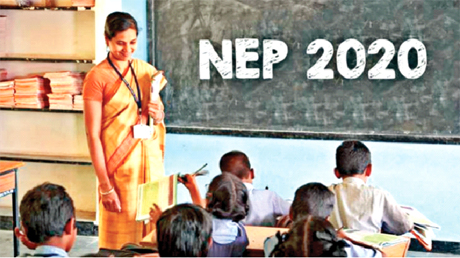
The NEP also recognises this need and focuses on critical thinking, inquiry and analysis-based teaching, which will help identify the talents of students from a young age itself. Many students and parents complain that some subjects or teaching patterns are carried out only for the sake of the curriculum, without providing any rationale for its inclusion and the future prospects of studying such subjects. Gandhi, however, was firm, he wrote “The reasons for every process should be explained when the process is being carried on.”

Inculcating Scientific Temper Among Students

In furtherance of this, the National Education Policy envisions development of scientific temper among students from junior school itself. It also states that there must be focus on digital literacy, coding and moral reasoning. Many of us have observed that despite having a grasp over subjects taught in schools, many students lack basic general knowledge. This perhaps was the case in pre-Independence era as well, as the Mahatma articulates, “General knowledge should be imparted to each child as he begins to understand things. Learning to read or write should come later.”

He was adamant that a child must only be taught subjects he wishes to study, adding that “Nothing should be taught to a child by force.” This remains true for so many students pushed into streams they do not wish to undertake in the 11th and 12th standard, or even those students who are forced by parental and peer pressure into fancy coaching institutes, which literally ruins the most important years of a child in school.

The 21st century belongs to India, and for this, our young minds need to be brought up and educated in the right manner. It is time we begin the process of decolonising our mind, which will happen by creating a structure of education keeping Gandhi’s suggestions in mind and India’s best interests at heart

Gandhi was a religious man, he had no qualms in calling himself a devout Hindu and hence, he suggested “Religious education is indispensable and the child should get it by watching the teacher’s conduct and by hearing him talk about it.” As controversial as it may seem in today’s India, it is imperative that we understand the reasoning behind the suggestion to introduce religious education. When people talk about India’s social fabric and the need to preserve it, this move to inculcate the best of religious teachings to students will not only make them a better individual and a citizen, but it will be a thread that will bind all Indians together.

The NEP lays the foundation of a New India, but these foundations are based on India’s ancient civilisational values of truth, honesty, non-violence and patriotism.

But above all suggestions, Mahatma Gandhi was uncompromising on the medium of education. He remarked “All education should be imparted through the mother tongue.” He added that “English should be taught only as one of the several languages.”

Macaulay’s Education Enslaved Indians

Adamant on his call for learning Indian languages, Gandhi wrote, “To give millions a knowledge of English is to enslave them. The Foundation that Macaulay laid of education has enslaved us.” He warned that “The foreign medium has caused brain fag, put an undue strain upon the nerves of our children, made them crammers and imitators, unfitted them for original work and thought, and disabled them for filtrating their learning to the family or the masses.”

The statesman that he was, Gandhi makes us think on the very fundamentals of modern education in India “No country can become a nation by producing a race of imitators. Think of what would have happened to the English if they had not an authorised version of the Bible.”

It is often said that a small section of the English-speaking elite in India control the entire narrative in our country. Gandhi envisioned that this would happen in the future. His words hold true even today, more than a century after he said and warned, “It is we, the English-knowing men, that have enslaved India. The curse of the nation will rest not upon the English but upon us.” To rid India of this curse, the NEP lays down guidelines for the medium of instruction to be the local language until Class 5. This one change will truly usher India into a new era.

Gandhi knew that the future of a strong, self-reliant India lies in Indians accepting its civilisational values, being unapologetic about our past and to move ahead without compromising on our culture and beliefs. He knew that this could only be achieved if substantial changes were made in our education system, for the present day system was introduced only to help the British enslave Indian minds.

The 21st century belongs to India, and for this, our young minds need to be brought up and educated in the right manner. It is time we begin the process of decolonising our mind, which will happen by creating a structure of education keeping Gandhi’s suggestions in mind and India’s best interests at heart.
Topics: Mahatma GandhiModi governmentScientific Temper Among StudentsNational Education Policy 2020 (NEP)
Share
Tweet
SendShareSend
✮ Subscribe Organiser YouTube Channel. ✮
✮ Join Organiser's WhatsApp channel for Nationalist views beyond the news. ✮
Previous News

Afghanistan under Taliban- 2:0 and India’s New Chapter in Central Asia 

Next News

PM Modi thanks “champion” BJP karyakartas after historic win in Gujarat

Related News

Birth Anniversary of Mahatma Gandhi: Examining Hind Swaraj through the lens of the Thirukkural

Prime Minister Narendra Modi while addressing the BRICS Summit on September 12

18th BRICS Summit: Setting the agenda for global south

AI-generated Image

Modi’s Politics of Performance: Kerala railways funding jumps from Rs 372 cr to Rs 3,795 cr; exposes Left-Congress

National Bamboo Mission (AI-generated Image)

From Forest Weed to Economic Seed: How India’s Bamboo revolution is transforming livelihoods and green growth

The Rs 10,998-crore Varuna Elevated Corridor will ease Varanasi traffic and boost connectivity while preserving Kashi’s heritage

From ancient Kashi to modern connectivity: How Modi government’s Varuna Elevated Corridor will transform Varanasi

The Ford Foundation vacated its long-standing New Delhi office at Lodhi Estate after its lease expired

Unmasked: How the Ford Foundation spent decades bankrolling anti-India agendas before its eviction from Lodhi Estate

Load More

Latest News

India Hits Back at Pakistan Over Ferozepur Infiltration, Rejects ‘Baseless’ Claims

Ferozepur Infiltration: India summons Pakistan envoy over cross-border drug networks

Elderly man dies at unauthorised protest of CJP at Shivaji Park in Mumbai

CJP Protest in Mumbai’s Shivaji Park: Elderly man dies of heart attack at unauthorised demonstration

Indian Men's Hockey team which won gold medal in Asian Games 2026

Asian Games 2026: India retains men’s hockey gold, defeat Malaysia

Israeli passenger Tzvika Manes recounts how passengers overpowered Omani terrorist co-pilot Hamam al-Hammami during the Flydubai cockpit crisis.

“Crew were asking us to untie the terrorist”: Israeli passengers recall second threat during Flydubai hijack chaos!

Akhil Bharatiya Vanvasi Kalyan Ashram Addressing the press conference

Rajasthan: Vanvasi Kalyan Ashram passes resolution seeking ‘National Memorial Status’ for Mangarh Dham

Government approves five Centres of Excellence for Classical Assamese, Bengali, Marathi, Pali and Prakrit

Tamil Nadu: TVK faces student opposition over memorial for its five declared icons on Madras University ground

ECI controversy resembles Bangladesh regime change playbook; Is it a CIA conspiracy to destabilise India?

The Shrichakra Rangoli reflects the ancient Indian interplay of geometry, mathematics, spirituality and cosmic symbolism

Shrichakra Rangoli: How ancient India turned geometry, mathematics and cosmic thought into a sacred art form

The Rigveda’s cosmic wheel with 12 spokes and 360 divisions reflects the ancient Vedic understanding of time and its endless cycles

The Cosmic Wheel of Time: Decoding the Rigveda’s mysterious twelve spokes and 360 divisions

Load More
  • Privacy
  • Terms
  • Cookie Policy
  • Refund and Cancellation
  • Delivery and Shipping

© Bharat Prakashan (Delhi) Limited.
Tech-enabled by Ananthapuri Technologies

  • Home
  • Search Organiser
  • Bharat
    • Assam
    • Bihar
    • Chhattisgarh
    • Jharkhand
    • Maharashtra
    • View All States
  • World
    • Asia
    • Africa
    • North America
    • South America
    • Europe
    • Australia
  • Editorial
  • Operation Sindoor
  • Opinion
  • Analysis
  • Defence
  • Culture
  • Sports
  • Business
  • RSS @ 100
  • Entertainment
  • More ..
    • Sci & Tech
    • Vocal4Local
    • Special Report
    • Education
    • Employment
    • Books
    • Interviews
    • Travel
    • Health
    • Politics
    • Law
    • Economy
    • Obituary
  • Subscribe Magazine
  • Read Ecopy
  • Advertise
  • Circulation
  • Careers
  • About Us
  • Contact Us
  • Policies & Terms
    • Privacy Policy
    • Cookie Policy
    • Refund and Cancellation
    • Terms of Use

© Bharat Prakashan (Delhi) Limited.
Tech-enabled by Ananthapuri Technologies