Ramlila in Varanasi - A German traveler's first experience of the grand event 36 years ago
June 6, 2026
  • Read Ecopy
  • Circulation
  • Advertise
  • Careers
  • About Us
  • Contact Us
Android AppiPhone AppArattai
Organiser
  • ‌
  • Bharat
    • Assam
    • Bihar
    • Chhattisgarh
    • Jharkhand
    • Maharashtra
    • View All States
  • World
    • Asia
    • Europe
    • North America
    • South America
    • Africa
    • Australia
  • Editorial
  • International
  • Opinion
  • RSS @ 100
  • More
    • Op Sindoor
    • Analysis
    • Sports
    • Defence
    • Politics
    • Business
    • Economy
    • Culture
    • Special Report
    • Sci & Tech
    • Entertainment
    • G20
    • Azadi Ka Amrit Mahotsav
    • Vocal4Local
    • Web Stories
    • Education
    • Employment
    • Books
    • Interviews
    • Travel
    • Law
    • Health
    • Obituary
  • Subscribe
    • Subscribe Print Edition
    • Subscribe Ecopy
    • Read Ecopy
  • ‌
  • Bharat
    • Assam
    • Bihar
    • Chhattisgarh
    • Jharkhand
    • Maharashtra
    • View All States
  • World
    • Asia
    • Europe
    • North America
    • South America
    • Africa
    • Australia
  • Editorial
  • International
  • Opinion
  • RSS @ 100
  • More
    • Op Sindoor
    • Analysis
    • Sports
    • Defence
    • Politics
    • Business
    • Economy
    • Culture
    • Special Report
    • Sci & Tech
    • Entertainment
    • G20
    • Azadi Ka Amrit Mahotsav
    • Vocal4Local
    • Web Stories
    • Education
    • Employment
    • Books
    • Interviews
    • Travel
    • Law
    • Health
    • Obituary
  • Subscribe
    • Subscribe Print Edition
    • Subscribe Ecopy
    • Read Ecopy
Organiser
  • Home
  • Bharat
  • World
  • Operation Sindoor
  • Editorial
  • Analysis
  • Opinion
  • Culture
  • Defence
  • International Edition
  • RSS @ 100
  • Magazine
  • Read Ecopy
Home Bharat

Ramlila in Varanasi – A German traveler’s first experience of the grand event 36 years ago

Maria Wirth is a German and came to India on a stop over (that’s at least what she thought) on her way to Australia. She visited the Ardha Kumbha Mela in Haridwar in April 1980 where she met Sri Anandamayi Ma and Devaraha Baba, two renowned saints. With their blessing she continued to live in India and never went to Australia.

WEBDESKWEBDESK
Oct 6, 2022, 02:01 pm IST
in Bharat, Culture
Follow on Google News
FacebookTwitterWhatsAppTelegramEmail

In December 1985, I was sitting at the back of a small temple at the outskirts of Chamba near Tehri when some boys discovered me and, typically for Indian kids, who are never shy, started asking me questions.

“Where you are from? Do people there also know about Ram?”

“No, where I am from, people don’t know about Ram”, I replied.

They looked disappointed. Only then I realised that the crackling of loudspeakers that I heard from a village downhill, was in preparation for the Ramlila.

A year later, I attended the grand Ramleela in Varanasi over 30 evenings and wrote about it for a German magazine to give Germans also the chance to know about Ram, the Prince and later King of Ayodhya.

I reproduce the article here in a shorter version, since it is again that special time of the year, when Ram’s story is staged in Varanasi and other places all over the country, probably in very much the same way as it has been way back in 1986.

Here is my shortened English translation:

Ram, the prince of Ayodhya, lived many thousand years ago. Yet even today most people in India know in detail his eventful life story, which is recounted in the Ramayana. Not only in India – in Nepal, Myanmar, Laos, Thailand and Indonesia, too, Ram had great influence on art and literature. An international Ramayana festival last year in Bangkok made clear, how alive Ram is even today and which great importance the Ramayana has in Southeast Asia. ‘If Asia has an epic in common, it is the Ramayana’, was declared in Bangkok.

In the land of its origin, however, the Ramayana is more than a grand epic. It is a sacred scripture that contains all what one needs to know to live a dignified life and to conduct oneself in an ideal way in the different relationships. Ram is not only an exemplary human being, but an avatar, a conscious embodiment of the divine principle that comes down to earth whenever the bad is gaining the upper hand, and humanity strays from the dharmic path.

Valmiki, supposedly a contemporary of Ram, narrates in 24,000 Sanskrit shlokas vividly the life story of the prince, who later becomes the king of Ayodhya. In the 17th century Tulsidas wrote the story of Ram in colloquial Hindi and made it even more popular. Ram is an ideal, an outstanding example for others – noble, just, brave, ever protecting the weak, and doing the right thing at the right time. He is ready rather to die than to break his word and prepared to wage a war to rescue his wife Sita who had been kidnapped by a demon king.

Sita, the princess who marries Ram, possesses all the virtues, which a woman is supposed to have according to the ancient rishis. She is modest, chaste, always intent on the wellbeing of her husband, warm hearted, full of trust in the Divine, considerate, graceful – and exquisitely beautiful.

Feminist groups, which also exist in India, are likely to find fault with Sita, yet the majority of Hindu women do not care. Many revere Sita as their ideal even today.

For Ram to be a model for others, he has to have a difficult life. And he indeed faces countless, unexpected complications and hardship. For example, on the very day, when the handsome, much-loved prince is to ascend the throne, his father Dasaratha, caused by an intrigue in the palace, has to send him into exile for 14 long years. It breaks his father’s heart. Ram calmly takes off the festive robes and dresses in a simple gown. Sita and his brother Lakshman insist on joining him. And so the three of them walk out of the town into the forest – and the whole of Ayodhya weeps.

To my very western question when this happened, I always got the same answer: “Many thousand years ago for sure. But the exact date is not important. Important is, to let Ram come alive in your inner vision and learn from him for your own life.”

This ‘present’ view or attitude has no doubt a valid point and is probably the reason, why Indians do not get tired to listen again and again to Ram’s story, or to watch it in village plays. In Varanasi, I met a man who had attended the Ramlila there 35 times. Each year he followed Ram with devotion and attention for 30 nights.

The Ramlila in Varanasi is staged in Ramnagar on the other side of the Ganga, under the patronage of the Maharaja, with great pomp, yet very traditionally. There were no loudspeakers in spite of thousands of spectators and people were not allowed to take photos with a flash.

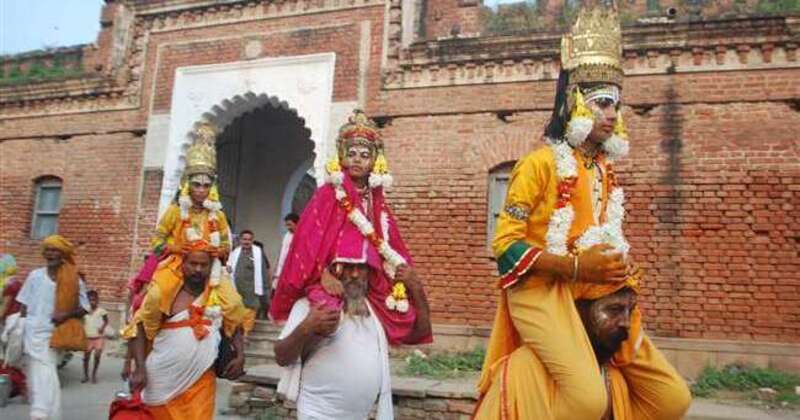
The Lila culminates after Dassehra, when Ram returns to Ayodhya after his exile and takes over as king. Every evening before the play, pooja is performed for the actors and thereafter they are considered to be true embodiments of their roles. Many people touched respectfully the feet of the 12-year-old boy who played Ram, when there was an occasion during breaks. The actors were right in the midst of the crowd. There was a festive atmosphere with food carts and stalls selling trinkets. When Ram went into exile, several thousand spectators walked with him around two kilometres to the place, where the next episode would unfold. An amazing experience in itself.

The Maharaja moved high up on a fabulously decorated elephant through the crowd. The Yuvaraja was sitting on another elephant, which was also splendidly decorated.

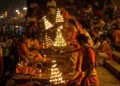
I have particularly fond memories of the journeys back across the Ganges in the middle of the night after the play. Mainly men crossed over to the town on countless, crowded boats in the stillness of the night – once it was even 4 o’clock in the morning. They narrated excitedly to each other, how admirably Ram had conducted himself today and how exemplarily Sita had reacted –as if it had just really happened and they had had the good fortune of having been present. When the talking occasionally stopped, they started singing “Sita Ram, Sita Ram” – everyone in his own tune and rhythm. Towards the end of the boat ride, when we were gliding past a Shiva temple on the ghats of Varanasi, they interrupted their “Sita Ram” for a moment and full throatily shouted a salutation to Shiva: “Hara Hara Mahadev!”

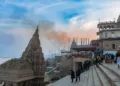
I was not afraid of riding alone in a cycle rickshaw at that late hour from the Ganges to the tourist bungalow near the railway station through unusually empty streets.  My trust was never disappointed. Varanasi is a fascinating, intense city, where life and death are present side by side and this world and the beyond merge into each other. Kashi (light) was the name of the city in ancient times. In all likelihood it is the most ancient of all towns on this earth and has its origin in an age, when the world was still more transparent for its luminous essence and less dense in the material sense.

By Maria Wirth

Topics: KashiGangaramlilaDassehraRamayanaVaranasiHinduism
Share10TweetSendShareSend
✮ Subscribe Organiser YouTube Channel. ✮
✮ Join Organiser's WhatsApp channel for Nationalist views beyond the news. ✮
Previous News

He showed who is the real Shiv Sena: Fadnavis hails Maharashtra CM Shinde’s Dussehra rally

Next News

Amid Dussehra festivity Assam police foil several attempts of cow smuggling; Rescue 74 cows and arrest 8 cow smugglers

Related News

Bhayyaji Joshi, Akhil Bharatiya Karyakarini Member of the Rashtriya Swayamsevak Sangh at the release of the Marathi translation of American Jewish author Dana Mariam’s book The Untold Story of Sita

Ramayana must be read with an open-mind, not merely through faith: Bhayyaji Joshi of RSS

The extraordinary concept of cosmic time in Hindu scriptures

Time Relativity in Hindu Scriptures: How ancient Indian cosmology explained different flows of time across lokas

RSS Sarsanghchalak Dr Mohan Bhagwat delivering a Special Lecture on ‘Social Harmony as a Catalyst for National Development’ at JSS Mahavidyapeetha, Mysuru, Karnataka

Words and conduct should unite and not alienate: Dr Mohan Bhagwat at Mysuru

Rabindranath Tagore

Rabindra Jayanti: How Rabindranath Tagore saw Sri Ram as Bharat’s civilisational ideal

Gautam Adani(File Photo)

“Every Contribution Matters”: Gautam Adani invokes Ramayana in Labour Day address, Calls workforce as ‘Nation Builders’

Sarnath, a sacred confluence of Hindu, Jain, and Buddhist traditions

Sarnath: A triveni of faiths where Hindu, Jain and Buddhist traditions converge across millennia

Load More

Latest News

Union Home Minister Amit Shah addressing BSF personnel at the Lankamura Border Outpost along the India-Bangladesh border in West Tripura district on June 5, 2026

Amit Shah at Bangladesh Border: “India will have an impregnable security grid soon”

India slams Pakistan’s bid to hold elections in Gilgit-Baltistan, demands end to illegal occupation

Maharashtra government approves central wage structure for Pune Metro Contract Workers; Major victory for BMS

India seals robust 7.7% GDP Growth in FY26: Reflects economic resilience amid West Asia crisis & other global headwinds

A representative image

After TCS, Corporate Jihad allegations reach SBI: Married Hindu employee conversion claims trigger FIR in Mumbai

MEA spokesperson Randhir Jaiswal highlights India's resolve to deport illegal Bangladeshi migrants via bilateral mechanisms

India reiterates strong resolve to deport illegal Bangladeshis; Flags delay of bilateral procedures from Dhaka

Kerala HC rejects CMRL appeal, clears way for ED probe against Pinarayi Vijayan’s daughter in money laundering case

Uttar Pradesh leads in Bharat's green transformation

World Environment Day 2026: On his birthday, Yogi Adityanath’s green vision powers Uttar Pradesh’s transformation

As Khalistani networks seek new platforms beyond the West, Azerbaijan has emerged as a key venue for conferences, campaigns and narratives aligned with the Pakistan-Turkey axis against India.

Khalistan’s New Grazing Ground: Azerbaijan emerges as new hub for Turkey-Pakistan backed anti-India networks

Kochi IPL Mystery: Why Did Sunanda Pushkar Surrender Stake Amid Benami Claims Tied to Shashi Tharoor, Sonia Gandhi?

Kochi IPL Mystery: Why Did Sunanda Pushkar Surrender Stake Amid Benami Claims Tied to Shashi Tharoor, Sonia Gandhi?

Load More
  • Privacy
  • Terms
  • Cookie Policy
  • Refund and Cancellation
  • Delivery and Shipping

© Bharat Prakashan (Delhi) Limited.
Tech-enabled by Ananthapuri Technologies

  • Home
  • Search Organiser
  • Bharat
    • Assam
    • Bihar
    • Chhattisgarh
    • Jharkhand
    • Maharashtra
    • View All States
  • World
    • Asia
    • Africa
    • North America
    • South America
    • Europe
    • Australia
  • Editorial
  • Operation Sindoor
  • Opinion
  • Analysis
  • Defence
  • Culture
  • Sports
  • Business
  • RSS @ 100
  • Entertainment
  • More ..
    • Sci & Tech
    • Vocal4Local
    • Special Report
    • Education
    • Employment
    • Books
    • Interviews
    • Travel
    • Health
    • Politics
    • Law
    • Economy
    • Obituary
  • Subscribe Magazine
  • Read Ecopy
  • Advertise
  • Circulation
  • Careers
  • About Us
  • Contact Us
  • Policies & Terms
    • Privacy Policy
    • Cookie Policy
    • Refund and Cancellation
    • Terms of Use

© Bharat Prakashan (Delhi) Limited.
Tech-enabled by Ananthapuri Technologies