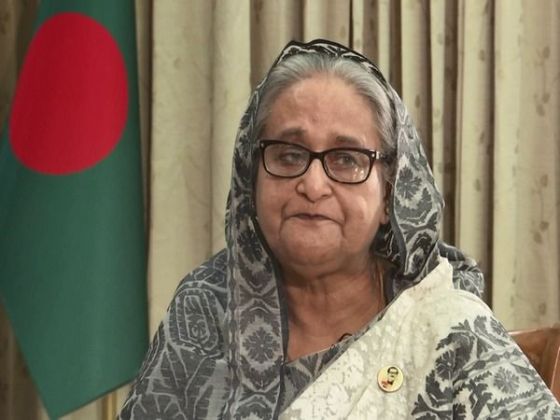
Dhaka [Bangladesh]: On the eve of her four-day visit to India, Bangladesh Prime Minister Sheikh Hasina revealed that she was once a secret resident of Delhi’s posh Pandara Road, where she lived with her children under an assumed identity trying to escape attention of those who assassinated her father Sheikh Mujibur Rehman.
Nearly five decades later, Hasina, in an emotional television interview with ANI, opened up about the piercing traumas that haunted her for decades.
Eyes moist, Hasina vividly recounted the fast-paced events of 1975 when she left Bangladesh to join her nuclear scientist husband in Germany. It was the 30th of July in 1975 and family members had come to the airport to see Hasina and her sister off. It was a happy farewell and Hasina had no inkling that it would turn out to be her last meeting with her parents.
“Because my husband was abroad, so I used to live in the same house (with parents). So that day everybody was there: my father, mother, my three brothers, two newly-wedded sisters-in-law, everybody was there. So all the siblings and their spouses. They came to the airport to see us off. And we met father, mother. That was the last day, you know,” recounted Hasina on one of the darkest chapters in Bangladesh’s history.
A fortnight later, on the morning of August 15, Hasina received news that she found hard to believe. Her father, the legendary statesman Bangabandhu Sheikh Mujibur Rehman, had been killed. The horrors didn’t stop at learning about her father’s death, but got further compounded when she received news of the summary execution of more members of her family.
“It was really unbelievable. Unbelievable, that any Bengali could do it. And still we didn’t know how, what really happened. Only there was a coup, and then we heard that my father was assassinated. But we didn’t know that all the family members were, you know, they were assassinated,” Hasina said, fighting back tears.
India was one of the first countries to extend help, Hasina recalled.
“Mrs Indira Gandhi immediately sent information that she wanted to give us, I mean, security and shelter. So we received, especially from Marshal Tito from Yugoslavia, and Mrs Gandhi. We decided to come back here (Delhi) because we had in our mind that if we go to Delhi, from Delhi we’ll be able to go back to our country. And then we’ll be able to know how many members of family are still alive,” the Bangladesh Prime Minister said.
Five decades have passed, but the pain still reflects in Hasina’s voice. “It’s very difficult time,” she said. The then Bangladesh Ambassador to Germany Humayun Rashid Chaudhary was the first person to give an account of her family’s massacre.
“For few moments I didn’t know where I was. But I thought about my sister, she is, actually she’s 10 years younger than me. So, I thought how she will take it. It is so difficult for her. Then when we returned to Delhi, at first they put us in a house with all security, because they were also worried about us,” recounted Hasina.
Asked if she felt that she too was a possible target, Hasina said the miscreants who had attacked her father had also carried out attacks at the houses of other relatives and killed some of her kin. “Almost 18 members and some, mostly my relatives and then some maid servants and their children and then some guests, my uncle,” were among those killed, she said.
The conspirators had a clear aim that nobody from Bangabandhu’s family should ever come back to power.
“My younger brother was only 10 years old, so they did not spare him too. So when we returned to Delhi, it was perhaps 24th August, then I met Prime Minister Mrs Gandhi. She called us and we… so there we came to know that nobody is alive. Then she made all the arrangements for us,a job for my husband and this Pandara Road house. We stayed there. So first 2-3 years actually it was so difficult to accept this, my children, my son was only 4-years-old. My daughter, she’s younger, both of them used to cry. Come (let’s) go to my mother, my father and they still remembered my younger brother mostly,” Hasina recounted.
So much had been lost, yet, Hasina also realised somewhere that she had to think ahead. “So… but then gradually, we have and well… as because I have children. My sister is there, so this sorrow, pain, just very difficult but still we have, well … We have to think what to do…We should do something…we should, we cannot live like this,” she said.
The pain, however, would not go away. “This crime, not only killed my father, also they changed the ideology of our liberation war. Everything just, just one night, everything just changed. And those killers…they were actually still haunting us. That they’re trying to find out where we are, so when we lived in Pandara road; even we did… we couldn’t, our name was changed,” said the Awami League leader.
Having lost her parents, Hasina was forced to hide her identity. “Different name. And it is so painful that you cannot use your own name, own identity… Because of the security purpose they didn’t allow us,” said Hasina as she tried to muster the strength to recount the harrowing time.
Bangabandhu Sheikh Mujibur Rehman and members of his family were killed in cold blood on August 15th, 1975 by senior army officers, which plunged Bangladesh into political chaos and resulted in a military regime running the country for a number of years, thereby suspending the democratic process.
For the next six years, till 1981, Hasina lived in Delhi under a different name, under an assumed identity. However, many people back in Bangladesh wanted her to lead the Awami League party just like her father did.
“Definitely I wanted to come back to my country. But taking responsibility of such a big party, I never thought about it,” she said. However, Hasina travelled to different countries during this time and even addressed a public meeting in London’s York Hall on 16th August 1980 demanding punishment for her father’s killers.
“To bring them to justice or bring them to book, so that the trial should take place, because there was immunity granted to them. There was an ordinance, they shoot, so you cannot demand or file any case against the killers. Killers got all type of facilities and immunity, this is very unlawful. The killer… and they killed… and it is in open and they claimed that yes, they committed this crime and they were very vocal. Because they thought they are very powerful,” said Hasina.
She continued with the campaign roping in many eminent people. “On one hand we lost everybody, and other hand I cannot ask for justice. Justice was denied. So that was the situation that time. Then again I returned to Delhi, end of 80 or 81,” she said.
However, by this time there was another important development in Bangladesh. “Awami League had a conference, at that time they, in my absence, they declared me as the president of the party,” said Hasina, who eventually moved to Bangladesh and again reached the top position in the country’s political arena.
“They tried to kill me, several times, yeah, but I survived. Even though in the broad daylight there was a grenade attack. I don’t know how I survived. Our party leaders, workers they just covered me, made human shields so they received all the splinters but I… I was totally safe. Then there was open fire in my meeting, I survived. They placed a huge bomb in my meeting place. Somehow it was discovered by just a simple man. So I survived. I don’t know its… you can ask God, Allah. Allah is helping me perhaps, maybe Allah has given me some job to do,” she said. (ANI)