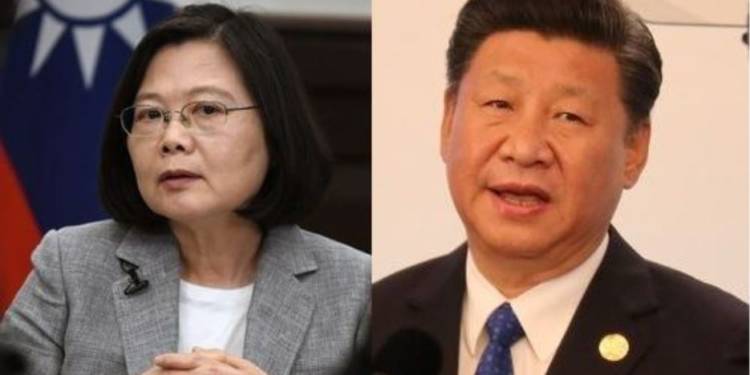
New Delhi [India], July 27 (ANI): Taiwan’s Defence Minister Chiu Kuo-chang expressed concern that China’s People’s Liberation Army (PLA) would have the ‘complete capability’ to attack Taiwan by 2025.
The Minister expressed concern while also highlighted sanctions as the means to deter aggression during a virtual seminar titled “Taiwan: is it key to the continuing world order?” organised by The Democracy Forum (TDF), a non-profit organisation, against the backdrop of rising tension and intimidation in the Taiwan Strait.
Moderator Humphrey Hawksley, a former BBC Asia Correspondent, called the future of Taiwan ‘perhaps the most pivotal international issue of our time’, before opening the floor to TDF President Lord Bruce.
Taiwan Defence Minister said Taiwan’s global significance in terms of trade, technological innovation and democratic values, its complex relationship with China, andthe fallout, both regional and global,of a potential Chinese invasion, were among points for discussion at The Democracy Forum’s July 26 virtual seminar, titled ‘Taiwan: is it key to the continuing world order?’
Taiwan’s defence minister Chiu Kuo-chang, who was also part of the seminar, had expressed the belief by his government that the People’s Liberation Army (PLA) would have the ‘complete capability’ to attack Taiwan by 2025, making the current situation ‘the most dangerous’ the minister had seen in more than 40 years in the military.
Taiwan’s global significance in terms of trade, technological innovation and democratic values, its complex relationship with China, and the fallout, both regional and global, of a potential Chinese invasion, were among the main points for discussion at the seminar.
TDF President Lord Bruce cited the former head of US Indo-Pacific Command Admiral (Retired) Phil Davidson’s assessment that a Chinese attack on Taiwan would ‘manifest in the next six years’.
However, in referring to a recent Japanese government white paper on defence spending that warned of escalating national security threats, ‘including… China’s intimidation of Taiwan, and vulnerable technology supply chains’, Lord Bruce also quoted China’s response, in which Wang Web in, a foreign affairs spokesman, urged the Japanese government to ‘immediately stop the erroneous practice of exaggerating security threats in its neighbourhood and finding excuses for its own strong military arsenal’.
With Taiwan currently dominating the global market for semiconductor manufacturing, particularly the most advanced chips, Lord Bruce noted that, although the threat of military escalation is considered marginal by specialist risk managers, the prospect of sanctions imposed as an economic weapon to deter aggression is considered much more likely.
In either scenario, a concerted plan to reduce the vulnerability of western trade and manufacturing is already underway in the US and EU, he added. But, despite the inevitable ‘bellicose rhetoric’ that seems currently to dominate the language of diplomacy, Lord Bruce concluded by citing the longer view of China analyst Charles Parton: that, in spite of the posturing by the CCP on the fate of Taiwan, ‘war or forceful unification will not happen in the foreseeable future’, as the risk – and costs – of failure are simply too great for the CCP realistically to countenance.
Syaru Shirley Lin, Compton Visiting Professor in World Politics at the University of Virginia’s Miller Center, and Chair of the Center for Asia-Pacific Resilience and Innovation (CAPRI), highlighted the importance of Taiwan’s democratic governance as an alternative for countries which have a strong economic relationship with China, especially in the Asia Pacific,
She further argued that Taiwan matters to the world, not only because it produces the most advanced semiconductors but also because it can be a leader in innovative public policy. As the world’s only Chinese democracy, Taiwan’s achievements in promoting economic development and safeguarding public health through democratic governance can show the path forward for other developing societies in the Asia Pacific.
However, despite its many successes, Taiwan also faces many complex internal threats, as well as external ones from China. Lin spoke of Taiwan’s isolation in the world, and of the ‘five Ps’ – population decline, power generation, political polarisation, parochialism and the pandemic. These issues are at the forefront of people’s minds in Taiwan, even more than the threat of armed conflict with China. The urgent socioeconomic, environmental, and political challenges that Taiwan and other high-income societies in the Asia-Pacific are facing will require innovative and interdisciplinary thinking to solve. In recognition of this, Lin and her colleagues founded CAPRI in Taipei, a non-partisan, independent think tank that recognises the role Taiwan can play in developing solutions and sharing best practices for addressing these problems, past, present, and future.
In answer to the central question posed by the seminar, Dr James Lee, a Postdoctoral Research Associate at the University of California’s Institute on Global Conflict and Cooperation, gave a resounding ‘yes’. This is because the threat that Taiwan faces raises the question of whether or not the international order is able to resist attempts to annex territory by authoritarian great power, and if China were successful in annexing Taiwan, it would threaten a fundamental pillar of the post-World War II international order. Since many countries that have a One China policy do not recognise Taiwan as an independent state, China wants us to think that this means we have to recognise Taiwan as part of China. But there is a third path, said Dr Lee, which is that taken by the US, the EU, the UK and others: they do not recognise Taiwan as an independent state, nor do they recognise Chinese sovereignty over Taiwan. Dr Lee addressed the history of the dispute surrounding this intermediate legal status of Taiwan – including how China’s claim to Taiwan is based on highly contested arguments about what happened after WWII- focusing on the different positions adopted by the US, China, and Taiwan itself.
Digitalisation and Taiwan’s democracy were focal points forChun-Yi Lee, Associate Professor and Director of the Taiwan Studies Program at the University of Nottingham. Underscoring Taiwan’s importance in trade and in the ‘electronic world order’, she considered how, despite tensions, the China-Taiwan trade connection is still very strong and integrated but, in terms of production, Taiwan is ‘high end’, bringing tech skills and research, while China is ‘low end’, contributing unskilled capital such as factory workers. She addressed the ‘hardware of digitalisation’ – that is, the importance of Taiwan’s TSMC – to the semiconductor global value chain, as well as the ‘software of digitalisation’, Taiwan’s digital democracy, including reference to the 2014 ‘Sunflower movement’, a protest by civic hackers that demanded more open government, with policy and information made simpler for ordinary people to understand. Dr Chun-yi discussed, too, how Taiwan had built a ‘digital fence’ during COVID, which is not on the basis of state power censoring civic society, as has been seen in China. Rather, Taiwan is to invite civic engineers or ‘hackers’ to work with the government, creating digital means to combat the global pandemic.
Dr Simona Grano, a Senior Lecturer at the University of Zurich and Director of the Taiwan Studies Project at UZH, considered key shifts that have led to changing attitudes toward Taiwan in Europe -most notably, the Covid pandemic; China’s increasing attempts to marginalise Taiwan economically and internationally; and the Russian invasion of Ukraine. She touched on mistrust of China engendered by the pandemic, Taiwan’s importance in global supply chains, the impact the invasion has had on small states within the EU and the greater importance they subsequently attach to having like-minded partners. This includes Taiwan, which, beyond economic ties, shares many values with the West: a system of governance based on democracy, rule of law, respect for human rights, a market economy, etc.
Dr Grano also focused more specifically on changes in attitudes towards Taiwan in Italy and Switzerland – her homeland and adopted country respectively – which are not, she argued, happening in a vacuum but at a European level. In the wake of Russian aggression in Ukraine and the ideologically charged debate on democracy versus autocracy, Taiwan shows that Chinese values are not incompatible with Western values. It is important, therefore, Grano concluded, to communicate to China that the West will not stand idly by while Beijing attempts to change the status quo.
Also bringing in the Taiwan-Ukraine parallel was Dr Raymond Kuo, a Political Scientist at the Rand Corporation. Would an invasion of Taiwan by China inspire the same reaction as Russia’s invasion of Ukraine, he wondered, even though it is not officially recognised by most countries? Kuo said there is widespread recognition that a Chinese invasion of Taiwan would still be a violation of sovereignty, as there are other types of sovereignty than territorial. He argued that Taiwan has the added advantage of being a much larger economy than Ukraine, more integrated into global trade flows, and integral to East and Southeast Asian security planning. Also, as China has already shown a reluctance to abide by international constraints- for example, it is engaged in coercion with India – other Asian countries view Taiwan as a litmus test to see if China will abide by international laws.
Looking back in time, as well as forward, Shelly Rigger, Professor of Political Science at Davidson College, focused on the historical angle vis-a-vis Taiwan, especially the link between its identity and democratisation, and its relationships with the PRC and the US. She also spoke of how the PRC, as well as Chinese nationalism from both within Taiwan and across the Taiwan Strait, have become obstacles to Taiwan’s identity and self-actualisation, and an enemy of democracy.
In summing up the event, TDF Chair Barry Gardiner MP praised the panellists for their insights, though he expressed surprise that the issue of Hong Kong had not come up in the discussion. It is difficult to see how any military invasion of Taiwan could be successful, he reflected – after all, Ukraine fought back fiercely, despite having a greater and more recent entanglement with Russia. So, if a union between China and Taiwan doesn’t come voluntarily, he concluded, it is unlikely it can come at all. (ANI)