Dr Shakti Kumar Pandey
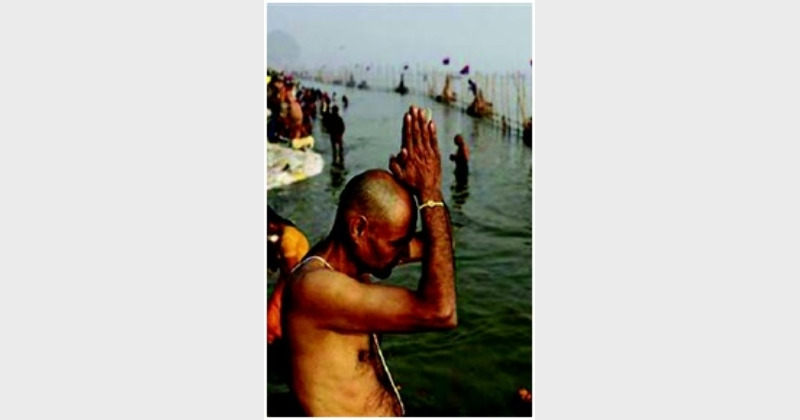
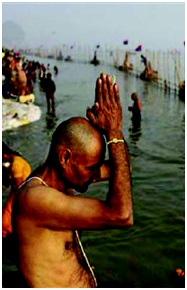 THE Maha Kumbh Mela, an eight-week long Hindu festival, is held during the months of January-February every 12 years in holy Prayag, Allahabad. It is considered to be the largest temporary human gathering on the planet. And interestingly, this happens with a religious motive. It draws not only pilgrims from the world over, but also researchers and social scientists from overseas, who wants to study it from sociological point of view.
The tent city, that had sprung up to accommodate millions of pilgrims, has already disappeared from the sandy banks of the Ganges and Yamuna rivers, with only a mass of vast sand heaped all around visible there. But back in US, the real work of understanding the vast temporary city has just begun. Having collected their data during the festival, these researchers and scientists have now begun to analyse their data with a view to reach some conclusions that may help future students to understand the human and endeavours of religious communities in country like India.
Throughout January and February, nearly 50 Harvard professors, students, doctors, and researchers made a pilgrimage to Maha Kumbha, which housed roughly 3 million people for its 55-day duration and drew as many as 20 million visitors on peak river-bathing days. The data was collected there, from thousands of pilgrims and even patients at the clinics and hospitals, gathered water samples from the Ganges and measured the temporary holy city’s grids and elevations. These researchers felt that for many who participate in the melas, these huge human gatherings are opportunities for the practice of commerce, politics, services of many kinds, or public health. Presenters from the Harvard Divinity School, Harvard School of Public Health, and the Francois-Xavier Bagnoud Centre for Health and Human Rights described their findings and they are in the process of analysing it, all of which the project’s coordinators hope to make available online with the help of the Harvard libraries.
The likes of Tiona Zuzul and Vaughn Tan were just stupified. Walking along a crowded thoroughfare in the afternoon fog, they stopped to argue over the cacophony of motorcycles engines, distant drumming, and loudspeakers blaring Hindi chants. The sight that captured their interest wouldn’t have surprised the average observer. On one stretch of dusty road, vendors were lined up along corrugated metal dividers selling the same thing: aloo chaat, a snack of curried potatoes, which they scooped from the same large, flat pans for customers. To the two doctoral students at Harvard Business School (HBS) — Zuzul studies strategy and Tan is pursuing a joint Ph.D. in organisational behaviour and sociology — the set-up was downright stunningly uncommon.
“We share an interest in places where people are innovating without a lot of structure. The Kumbh — an instant megacity constructed every 12 years in Allahabad to accommodate up to 80 million Hindu pilgrims over six weeks — is a perfect example of how people collaborate when there aren’t established rules of the game”, Zuzul said. The pair wandered, snapping photos of vendors who lined main roads. Some sold their wares — spices, beads, pipes, shawls and saris, western-style men’s underwear — from blankets spread on the ground. Others sold dry goods and cigarettes from hand-drawn carts. Some had legal permits; many scattered at the sight of police officers wielding nightsticks that seemed largely for show. They stopped with their translator to question a family of booksellers, quizzing the father on how much he sold, how he protected his wares at night, and how business at the Kumbh differed from his normal routine in Allahabad. “It really does seem like certain things that are true of a city have happened here, given three months planning and one month of development,” Zuzul said.
In addition to Zuzul and Tan’s fieldwork, a group of professors from Harvard, Stanford, and Columbia, led by HBS’s Tarun Khanna, came to study the development of networks and supply and demand issues, using massive amounts of cellphone usage data from one of India’s major telecommunications providers. “An enormous amount of urban planning, civil engineering, governance and adjudication, and maintenance of public goods — physical ones like toilets as well as intangibles such as law and order — and plans to deal with unexpected events go into the creation of this city,” Khanna, the Jorge Paulo Lemann Professor and director of the South Asia Institute, said during the Kumbh in January. “Those are pretty much the main elements surrounding the creation of any city in the world”, he added by saying that government administrators’ ability to create distinctive neighbourhoods in a temporary space could hold lessons for first-world real estate and commercial developers.
John Macomber, a senior lecturer in finance at HBS, came to Kumbh with his own mission: to turn its organised chaos into a Business School case study. He wracked his brain for management insights from the mela that could be shaped into useful lessons for M.B.A. and Executive Education students in his courses on sustainable city development. Macomber agrees with New York Mayor Michael Bloomberg: “Nations talk. Cities act.”
As more of the world’s population relocates into cities, Macomber believes, they will become more powerful entities, like the city-states of ancient Greece. Cities also are becoming ever more important as centres of economic development, particularly in India. According to United Nations figures Macomber cited, 400 to 500 million Indians will move to cities in the coming decades. “Those people aren’t all going to Mumbai, Delhi, and Calcutta — these megacities can’t absorb all the rest of these people,” Macomber said, “They’ll have to go to tier-two and tier-three cities like Allahabad.”
Macomber theorises that cities must provide three essentials in place to help their citizens thrive, and they just so happen to be the things the Kumbh administrators focused on delivering: transit, water, and electricity. “The Kumbh’s organisers let everything else be handled by non-government entities like the akharas,” or religious orders, Macomber said. “People really stepped up for a lot of other soft-infrastructure components.”
?