Kafka: An icon of surrealism
June 20, 2026
  • Read Ecopy
  • Circulation
  • Advertise
  • Careers
  • About Us
  • Contact Us
Android AppiPhone AppArattai
Organiser
  • ‌
  • Bharat
    • Assam
    • Bihar
    • Chhattisgarh
    • Jharkhand
    • Maharashtra
    • View All States
  • World
    • Asia
    • Europe
    • North America
    • South America
    • Africa
    • Australia
  • Editorial
  • International
  • Opinion
  • RSS @ 100
  • More
    • Op Sindoor
    • Analysis
    • Sports
    • Defence
    • Politics
    • Business
    • Economy
    • Culture
    • Special Report
    • Sci & Tech
    • Entertainment
    • G20
    • Azadi Ka Amrit Mahotsav
    • Vocal4Local
    • Web Stories
    • Education
    • Employment
    • Books
    • Interviews
    • Travel
    • Law
    • Health
    • Obituary
  • Subscribe
    • Subscribe Print Edition
    • Subscribe Ecopy
    • Read Ecopy
  • ‌
  • Bharat
    • Assam
    • Bihar
    • Chhattisgarh
    • Jharkhand
    • Maharashtra
    • View All States
  • World
    • Asia
    • Europe
    • North America
    • South America
    • Africa
    • Australia
  • Editorial
  • International
  • Opinion
  • RSS @ 100
  • More
    • Op Sindoor
    • Analysis
    • Sports
    • Defence
    • Politics
    • Business
    • Economy
    • Culture
    • Special Report
    • Sci & Tech
    • Entertainment
    • G20
    • Azadi Ka Amrit Mahotsav
    • Vocal4Local
    • Web Stories
    • Education
    • Employment
    • Books
    • Interviews
    • Travel
    • Law
    • Health
    • Obituary
  • Subscribe
    • Subscribe Print Edition
    • Subscribe Ecopy
    • Read Ecopy
Organiser
  • Home
  • Bharat
  • World
  • Operation Sindoor
  • Editorial
  • Analysis
  • Opinion
  • Culture
  • Defence
  • International Edition
  • RSS @ 100
  • Magazine
  • Read Ecopy
Home General

Kafka: An icon of surrealism

Archive ManagerArchive Manager
May 20, 2012, 12:00 am IST
in General
Follow on Google News
FacebookTwitterWhatsAppTelegramEmail

KAFKA: AN ICON OF SURREALISM

Dr R Balashankar

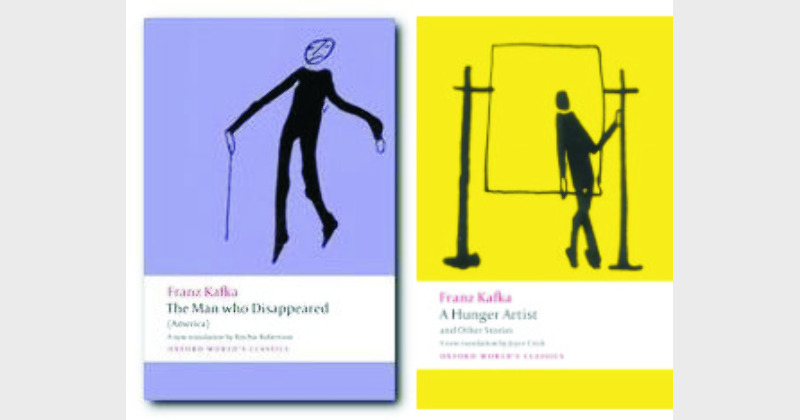
The Man who Disappeared (America) by Franz Kafka, translated by Ritchie Robertson, Pp 215 (PB),  $13.95

A Hunger Artist and other Stories by Franz Kafka, translated by Joyce Crick, Pp 218 (PB), $13.95

Kafka—the name is legend. So much so that ‘Kafkaesque’ is part of the English dictionary. Writer and novelist, Kafka influenced several generations of readers and writers.  Born a German Jew, most of Kafka’s works, several of them unfinished, were published posthumously. Kafkaesque, incidentally means to have a surreal distortion, often of an impending danger. A senseless, disorienting and a menacing complexity.

That defined, one can now understand what to expect from his writings. The Oxford University Press in its Oxford World Classics series has recently published two of Kafka’s books The Man who Disappeared (America) and A Hunger Artist and other Stories. The former is a novel, set in America, a country Kafka never visited and the latter is a collection of stories and writings.

The Man who Disappeared has been translated by Ritchie Robertson, with a sumptuous introduction. Robertson is Taylor Professor of German at Oxford and a Fellow of the Queen’s College. This was Kafka’s first novel. “The Man who Disappeared belongs to the great creative phase that began with Kafka’s literary breakthrough of 22-23 September 1912, when he sat up all night writing the story entitled The Judgement, perhaps the only one of his works with which he was thoroughly satisfied.” Kafka knew about America from both oral and written sources, says Robertson. Several of Kafka’s friends and relatives immigrated to America and came back to tell stories. The novel tells the story of a young (seventeen-year-old) protagonist Karl Rossmann. It makes a dramatic beginning with Karl looking at the statue of Liberty, ‘Goddess of Liberty’ he calls her, holding a ‘sword’ in one hand.

He searches for many occupations and meets with several people until he finally lands in a drama company in Oklahoma. This novel is free of Kafka’s usual darkness and disorientation. 

The book of stories has been translated by Joyce Crick, who taught German at University College London for many years. There are three sections of stories – ‘A Country Doctor: Little Tales;’ ‘A Hunger Artist: Four Stories;’ and ‘Selected Short Pieces.’ There is a selection of Aphorisms of Kafka. Sample some: “The true way passes over a rope which is not stretched high up, but just above the ground. It seems to be intended more for stumbling than for crossing.” “From a certain point on there is no return. This is the point to reach.” “Disparity of views it is possible to have of, say, an apple: the view of the small boy, who has to crane his neck just to see the apple on the table-top, and the view of the master of the house, who takes the apple and freely offers it to his guest at table.”

Kafka lived a relatively short life, born in 1883 he died in 1924. “A concern with religious questions runs through Kafka’s life and work, but his thought does not correspond closely to any established faith. He had an extensive knowledge of both Judaism and Christianity and knew also the philosophies of Nietzsche and Schopenhauer. Later in life, especially after the diagnosis of his illness he read eclectically and often critically in religious classics.”

Robertson says that Kafka’s fiction is “characteristic of modernism in demanding an active reading. The reader is not invited to consume the text passively, but to join actively in the task of puzzling it out, in resisting simple interpretation, and in working, not towards a solution, but towards a fuller experience of the text on each reading.”

Both the books have elaborate notes and introduction on the book and translation. There is also a list of bibliography. Both Robertson and Crick have translated Kafka before.

(Both published by Oxford University Press, Great Clarendon Street, Oxford OX2 6DP)

ShareTweetSendShareSend
✮ Subscribe Organiser YouTube Channel. ✮
✮ Join Organiser's WhatsApp channel for Nationalist views beyond the news. ✮
Previous News

BJP emerging force in Tamil Nadu

Next News

The Chrysler Takeover – When the  mouse helped the trapped lion

Related News

Tamil Nadu Chief Minister Joseph Vijay in the Legislative Assembly

Tamil Nadu: CM Vijay seeks Centre’s intervention on Mekedatu dam, avoids confrontation with Congress ally in Karnataka

7 killed and 3 injured in a twin blast at Khyber Pakhtunkhwa

Pakistan: 7 killed, 3 injured in twin blasts in Wazir sub-division of Khyber Pakhtunkhwa

The wisdom of sattvik food: Nourishing inner balance

Uniform Civil Code (UCC): A step towards ensuring equality, justice & national integration

Illegal Bangladeshi migrants detained by Assam Police

Assam: Police detain 14 suspected Bangladeshi infiltrators from Guwahati lodge in a verification drive

BJP Keralam State president Rajeev Chandrasekhar; Keralam CM VD V D Satheesan (Left to Right)

BJP Keralam calls VD Satheesan’s first Budget a mockery of the poor, says ‘Indira Guarantee’ promises ignored

Load More

Latest News

Tamil Nadu Chief Minister Joseph Vijay in the Legislative Assembly

Tamil Nadu: CM Vijay seeks Centre’s intervention on Mekedatu dam, avoids confrontation with Congress ally in Karnataka

7 killed and 3 injured in a twin blast at Khyber Pakhtunkhwa

Pakistan: 7 killed, 3 injured in twin blasts in Wazir sub-division of Khyber Pakhtunkhwa

The wisdom of sattvik food: Nourishing inner balance

Uniform Civil Code (UCC): A step towards ensuring equality, justice & national integration

Illegal Bangladeshi migrants detained by Assam Police

Assam: Police detain 14 suspected Bangladeshi infiltrators from Guwahati lodge in a verification drive

BJP Keralam State president Rajeev Chandrasekhar; Keralam CM VD V D Satheesan (Left to Right)

BJP Keralam calls VD Satheesan’s first Budget a mockery of the poor, says ‘Indira Guarantee’ promises ignored

UK grooming gang has 95% Pakistani Muslim men; Did media, govt & civil society conceal it fearing Islamophobic label?

The Political Winter of Pakistan occupied Jammu & Kashmir – A Crisis of Oppression and Global Apathy

India has achieved a major environmental milestone with 100 Ramsar Sites, including 74 designated since 2014

100 Ramsar Sites: India’s wetland revival and the new model of decentralised environmental governance

Yoga teaches the harmony of body, mind and spirit, the foundation of enduring civilizations and enlightened leadership.

From Self-Mastery to World Harmony: Yoga as the foundation of civilizational survival and progress

Load More
  • Privacy
  • Terms
  • Cookie Policy
  • Refund and Cancellation
  • Delivery and Shipping

© Bharat Prakashan (Delhi) Limited.
Tech-enabled by Ananthapuri Technologies

  • Home
  • Search Organiser
  • Bharat
    • Assam
    • Bihar
    • Chhattisgarh
    • Jharkhand
    • Maharashtra
    • View All States
  • World
    • Asia
    • Africa
    • North America
    • South America
    • Europe
    • Australia
  • Editorial
  • Operation Sindoor
  • Opinion
  • Analysis
  • Defence
  • Culture
  • Sports
  • Business
  • RSS @ 100
  • Entertainment
  • More ..
    • Sci & Tech
    • Vocal4Local
    • Special Report
    • Education
    • Employment
    • Books
    • Interviews
    • Travel
    • Health
    • Politics
    • Law
    • Economy
    • Obituary
  • Subscribe Magazine
  • Read Ecopy
  • Advertise
  • Circulation
  • Careers
  • About Us
  • Contact Us
  • Policies & Terms
    • Privacy Policy
    • Cookie Policy
    • Refund and Cancellation
    • Terms of Use

© Bharat Prakashan (Delhi) Limited.
Tech-enabled by Ananthapuri Technologies