BOOKMARK-7-8
Dr R Balashankar
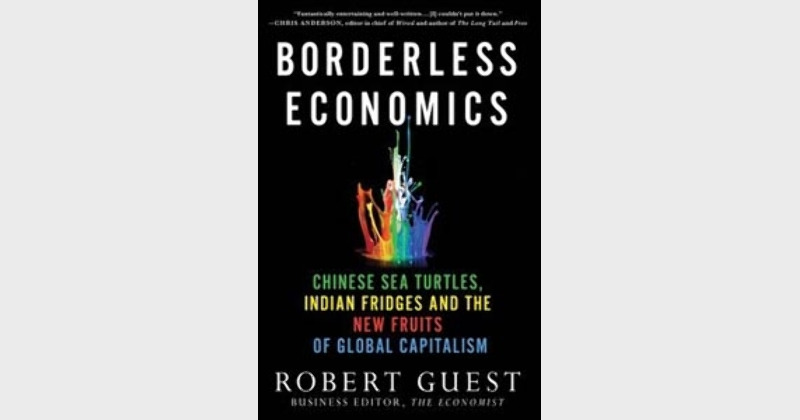
Borderless Economics – Chinese Sea Turtles, Indian Fridges and the New Fruits of Global Capitalism, Robert Guest, Palgrave Macmillan, Pp 250 (HB), $27.00.
As technology becomes all-pervasive, geological boundaries are becoming increasingly irrelevant. People are now moving around the globe, like never before, taking with them their talent, entrepreneurship and looking for opportunities and fortune. At the same time, there is this growing fear among the ‘developed’ nations, to which most migrants are headed, that the local jobs are being taken away by ‘foreigners. ‘Job protection has become a fashionable phrase in American politics. The United Kingdom is tightening norms for immigration. Is this new protectionism good for the world?
Robert Guest, business editor of The Economist in his latest book Borderless Economics forcefully argues for a world without boundaries. “Communities that turn inward tend to stagnate” he says. The book begins dramatically with his experience in North Korea, a society which has nothing called freedom and how people are malnourished and starving.
Guest discusses the history of migrations, and how humanity benefitted by it. This sets the mood for the following chapters. He is optimistic that the overseas Chinese going back home are bound to undermine the Communist Party and bring democracy one day. “One of the difficult things about living in China is that no one knows what is really happening. The government is opaque. Basic statistics that would be freely available in other countries are treated as state secrets.” But as increasing number of people return home, “The result is a clear and imminent threat to the dictatorship in Beijing…” asserts Guest.
The UID in India card is a big hit. It is a success story being discussed world over. Guest believes that the UID could go a long way in cutting corruption, ensuring that welfare measures reach the intended targets. He also discusses the technological strides India has made, with particular emphasis on health care. It is important because health insurance is a major political issue in America. Guest compares the frugal medical help given in India to the useless splurge in the US. He points out how the health insurance money does not come from the employers but the employees themselves, in a roundabout way. “Many Americans with employer-provided health insurance imagine that their employer foots the bill for their health insurance. This is not merely wrong; it is completely wrong. Though it never says so on your pay stub, the cost of corporate health insurance comes out of the pool of money for compensating employees.”
Guest’s conclusion is that ‘America will remain number one.’ “Migrants make up about half of the workers in the United States with science and engineering qualifications, and accounted for two-thirds of the growth in that talent pool between 1995 and 2006.” The academic atmosphere in America is charged, universities work with industries and often professors and students set up ventures. “When America admits migrants, it is not diluting its own culture, but spreading its ideals across the world. No other country has such influence” says Guest. He is emphatic when he says “Immigration keeps America young, strong and dynamic. The country will continue to grow and thrive for the simple reason that people want to live there.”
As a journalist Robert Guest has travelled world over and has had the most advantageous seat to watch events and people. This book reflects that deep understanding he has gained. Lucidly written, with a bit of humour thrown in, Robert Guest discusses the issue of migrations and immigrants at a practical level, trying to make politicians see the sense in it. A book that gives a clear perspective, even to us Indians who relentlessly lament the ‘brain drain.’
(Palgrave Macmillan, St Martin’s Press LLC, 175 Fifth Avenue, New York, NY 10010)
Krupp – the steel of German identity
Dr R Balashankar
 Krupp — A History of the Legendary German Firm, Harold James Princeton University Press, Pp 360(HB), £24.95.
The word Krupp creates the image of steel in the mind. The iconic German company that got so identified with the image and history of Germany was founded in 1811, as a small steel mill by Friedrich Krupp.
It was a hectic period of wars, industrial developments and competitive empire-building. Krupp played a crucial role in putting Germany if not ahead, at least head-to-head with the most developed economy of that time — Great Britain. In a detailed biography, Krupp — A History of the Legendary German Firm, Harold James narrates the gripping growth story of the company, juxtaposing it with developments in the field as well as the political scenario.
It was under Alfred Krupp, the son of Friedrich that the company grew to be an enterprise. He was focused, single-minded in his devotion to work that excluded everything else. So much so that the company history produced on the first centenary said “The life of Alfred Krupp was work, from childhood to the edge of the grave.” What also set him apart from his father were “four other vital ingredients of commercial success: the discovery of new markets for new products or modes of production made possible by new technologies; the cultivation of the state; an answer to the question of how to finance the costly process of expansion; and finally the establishment of an organisational structure that fostered a sufficient degree of loyalty and trust so as to allow the maintenance of consistent quality, even when production expanded and was scaled up to gigantic proportions.”
Alfred Krupp was committed to public good and believed that “The purpose of work should be the common good, then work is a blessing, work is prayer.” He took care to retain skilled workers, closely guarding the technical developments of the company a secret. Then the reins passed on to Friedrich Alfred Krupp, who got involved in politics, almost to the detriment of the business. He became member of the Navy League and a scandal broke out following which he resigned. He died without a male heir and the company, became a joint-stock held enterprise with the family (widow and daughter) holding majority shares. Gustav, the son-in-law took over management. Meanwhile, Krupp had been developing into a war machinery industry, producing guns of the latest model. The company continued to work during the Hitler era, supplying war machinery. Anti-Jew sentiments spread within the Krupp set up. This period in history is one of the toughest to explain. There were reports of forced labour and in fact some of the directors were later tried for war crimes. When the war ended, the company had to politically reorient and re-emerge. Which it did under Gustav’s son Alfred.
What is good about Harold James’ writing is that he does not make judgements or take sides. He allows the reader to do that. It is an interesting account as among several of the German enterprises, Krupp stood as a symbol and identification of the state and the pride of the people. Several factors were responsible for this, which cannot be enumerated here. One must read the biography for that. Harold James is professor of history and international affairs and is an author of many other books.
(Princeton University Press, 41 William Street, Princeton, New Jersey 08540)