The 100th dasaka is the narration of the deity from head to foot and it is believed that careful recitation of Narayaneeyam is a panacea for all ailments. The expression “Hantha! Bhagyam Jananaam!”, comprising the last words of the opening sloka has become the watchword of Guruvayoor.
.
Narayaneeyam occupies a very high place in Sanskrit literature, both because of the intense devotional fervour of the verses, and their extraordinary literary merit. The poet has emphasised the superiority of the path of devotion, as compared with the paths of action (karma) and knowledge (jnana). Srimannarayaneeyam is an immortal devotional hymn in Sanskrit extolling the glory of Sri Krishna, the presiding deity of Guruvayur temple in Kerala. It is a study in poetic form of the Bhagavata Purana by Veda Vyasa and was composed by Melpathur Narayana Bhattathiri, who was born around 1560 in Tirunavaya in Kerala. The Bhagavata Purana is a Hindu scripture comprising of 18,000 verses mainly devoted to the worship of Sri Krishna. Narayaneeyam condenses the Bhagavata Purana into 1034 verses, divided into 100 dasakas (cantos) and each dasaka consisting of approximately 10 slokas.
Melpathur composed Narayaneeyam at the age of 27. He was an erudite scholar, poet and Vedantin. The literary beauty, devotional content and the Vedantic insight of this literary piece is unique. Narayaneeyam is a standing monument to Melpathur’s deep insight in Vedanta.
It is believed that Melpathur was suffering from arthritis and was advised by Thunchathu Ramanujan Ezhuthachan, the father of Malayalam language that he could be cured of his ailment if he “started with fish”. Being a devout Hindu, his disciples could not understand the meaning of the statement but Melpathur understood what Ezhuthachan really meant that he would be cured if he could compose a hymn glorifying the incarnations of Bhagwan Vishnu commencing with Matsya (Fish). Accordingly, he started composing Sreemnnarayaneeyam by reciting one dasaka, consisting of ten verses, every day. The legend has it that after 99 dasakas, the Lord of Guruvayur had appeared before the poet and on the 100th day he wrote about the glorious vision of the Lord in the form of Venugopala after which he was cured of his ailment. In the 100th canto, the poet has named this work as Narayaneeyam because it is about Lord Narayana and his own name is Narayana. From the word ‘Ayurarogyasaukhyam’ appearing at the end of the 100th dasaka, scholars have worked out the date of completion of Narayaneeyam as 28th day of the Malayalam month of Vrichikam corresponding to November 27, 1587. December 13, is being celebrated as Narayaneeya Dinam (Divas).
The 100th dasaka is the narration of the deity from head to foot and it is believed that careful recitation of Narayaneeyam is a panacea for all ailments. The expression “Hantha! Bhagyam Jananaam!”, comprising the last words of the opening sloka has become the watchword of Guruvayoor. The prose order of the verses helps one to understand the poetic diction of Melpathur, whose style is, at times, difficult. In addition, there is a glossary of keywords occurring in the text and an alphabetical index to the verses. Devotees believe that Narayaneeyam, known as the “Gospel of Guruvayoor” is identical with the Sri Krishna who is the same as Brahman, the Supreme Consciousness.
Narayaneeyam occupies a very high place in Sanskrit literature, both because of the intense devotional fervour of the verses, and their extraordinary literary merit. “The poet has emphasised the superiority of the path of devotion, as compared with the paths of action (Karma) and knowledge (Jnana). According to Melpathur, Bhakti grows in the heart of an individual, if he listens to the narrations about the incarnations and the deeds of the Lord.” The first and last 10 dasakas contain the essence of all the Upanishads. Every verse is addressed to the Lord and hence Narayaneeyam is considered suitable for devout reading by devotees.
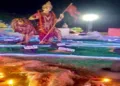
The idol of the Lord at Guruvayoor, is said to have been worshipped by Vasudeva and later by Sri Krishna himself at Dwaraka. Before the divine ascent of the Lord, he had instructed Uddhava, his devotee and minister, that the idol would come floating when Dwaraka would be engulfed by the sea, after his departure. At his behest, Guru (Brihaspati), along with Vayu (wind God), looked for a suitable site which was located by Parasurama, and as instructed by Lord Shiva, installed the same at the present location, which later came to be known as ‘Guru-Vayu-Ooru’, meaning the place of Guru and Vayu, the Sanskritised name being ‘Guru Pavana Puram’. The divine ascent of the Lord was at the beginning of Kaliyuga and the Guruvayoor temple is believed to be about 5,100 years old. As the image had its origin in Vaikuntam, the divine abode of Lord Vishnu, devotees consider this shrine as Vaikuntam on earth, or Bhooloka Vaikuntam.
There are many legends associated with the Guruvayoor temple. There are stories about Janamejaya, Vilvamangalam, Kurooramma, Manjula, Poonthanam etc. but none of them are as colourful as that of Melpathoor, an intelligent Brahmin youth, initially spoilt by materialistic ways, suffering from physical ailment and turning into spiritual ways following sound advice and producing a masterpiece. It is believed that Melpathoor lived a healthy life after completing Narayaneeyam and is said to have lived till the age of 105.
Other monumental works by Melpathur include Prakriyasarvasva, a treatise on Sanskrit Grammar. He composed many devotional hymns, as well as a work on Purva Mimamsa entitled Manameyodaya. There have been several attempts to translate Narayaneeyam into Malayalam. Bhaktaranjini, is a commentary on Narayaneeyam by KG Vancheswara Sastry and R Viswanatha Sastry written in the 1930s. In 1988, SN Sastri published an English commentary and in 2005, another English version of the commentary by KV Gopalakrishna et al was brought out.
(The author is a social activist and Director, Indo-Gulf Consultancy, a Mumbai-based PR consultancy firm. He can be contacted on [email protected])