Vande Mataram: Understanding Bharat’s civilisational identity
September 3, 2026
  • Read Ecopy
  • Circulation
  • Advertise
  • Careers
  • About Us
  • Contact Us
Android AppiPhone AppArattai
Organiser
  • ‌
  • Bharat
    • Assam
    • Bihar
    • Chhattisgarh
    • Jharkhand
    • Maharashtra
    • View All States
  • World
    • Asia
    • Europe
    • North America
    • South America
    • Africa
    • Australia
  • Editorial
  • International
  • Opinion
  • RSS @ 100
  • More
    • Op Sindoor
    • Analysis
    • Sports
    • Defence
    • Politics
    • Business
    • Economy
    • Culture
    • Special Report
    • Sci & Tech
    • Entertainment
    • G20
    • Azadi Ka Amrit Mahotsav
    • Vocal4Local
    • Web Stories
    • Education
    • Employment
    • Books
    • Interviews
    • Travel
    • Law
    • Health
    • Obituary
  • Subscribe
    • Subscribe Print Edition
    • Subscribe Ecopy
    • Read Ecopy
  • ‌
  • Bharat
    • Assam
    • Bihar
    • Chhattisgarh
    • Jharkhand
    • Maharashtra
    • View All States
  • World
    • Asia
    • Europe
    • North America
    • South America
    • Africa
    • Australia
  • Editorial
  • International
  • Opinion
  • RSS @ 100
  • More
    • Op Sindoor
    • Analysis
    • Sports
    • Defence
    • Politics
    • Business
    • Economy
    • Culture
    • Special Report
    • Sci & Tech
    • Entertainment
    • G20
    • Azadi Ka Amrit Mahotsav
    • Vocal4Local
    • Web Stories
    • Education
    • Employment
    • Books
    • Interviews
    • Travel
    • Law
    • Health
    • Obituary
  • Subscribe
    • Subscribe Print Edition
    • Subscribe Ecopy
    • Read Ecopy
Organiser
  • Home
  • Bharat
  • World
  • Operation Sindoor
  • Editorial
  • Analysis
  • Opinion
  • Culture
  • Defence
  • International Edition
  • RSS @ 100
  • Magazine
  • Read Ecopy
Home International Edition India Hindu World View

Vande Mataram: Reclaiming a civilisational legacy against opposition cynicism

Vande Mataram remains a powerful symbol of Bharat’s civilisational heritage and the freedom struggle, transcending religious and linguistic boundaries. The debate surrounding the song, the author argues, often overlooks its national and cultural significance as an expression of love for the motherland

Dr Prashant BarthwalDr Prashant Barthwal
Sep 2, 2026, 09:00 pm IST
inHindu World View, Bharat, Culture
Follow on Google News
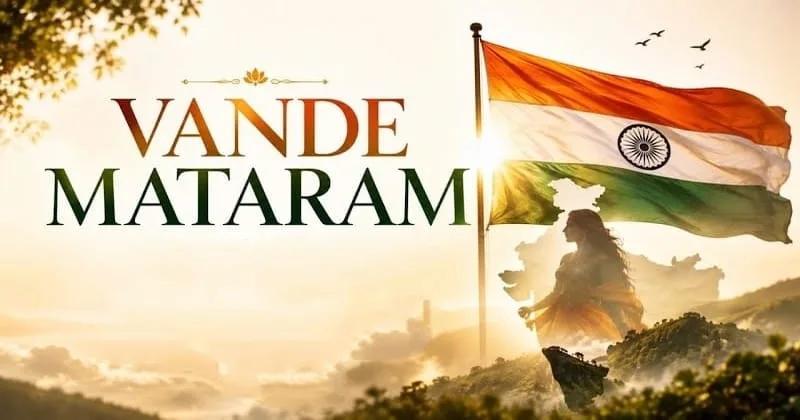
Vande Mataram remains an enduring symbol of Bharat’s civilisational heritage, national unity and deep-rooted love for the motherland

Vande Mataram remains an enduring symbol of Bharat’s civilisational heritage, national unity and deep-rooted love for the motherland

Facebook
Twitter
WhatsAppTelegramEmail

In 1875, when Bankim Chandra Chattopadhyay penned Vande Mataram, he was not even aware of the emotions that it would become the battle cry against the colonisers and thus represent the emotions of all Bharatiya while providing them the idea of integrity among all. A century and a half later, this song still has the same fervour that, due to partial facts, ignites fierce debates. Critics have referred to it as exclusionary and Muslim-baiter, but believers treat it as the Mantra for real Rashtra Bhawna. However, this manufactured controversy obscures a profound truth: it represents a civilizational legacy that transcends all spiritual limits, where everyone has fair and equal space in this nation.

The colonial time in 1875 was suffocating under a specific sort of oppression, i.e. cultural erasure. We were forced to despise the civilisational values, to see traditions as primitive, identity as shameful. Anandamath, where the song appears for the second time in history, after it was published in a Bangadarsan to fill the remaining space of the journal, was penned to highlight the Sannyasi rebellion against the Vidharmi’s. The Mother, he mentioned in the Song, wasn’t a goddess demanding spiritual worship; instead, she was the portrayal of the nation itself. Every culture has grappled for intimate language to express what a rashtra or matrubhumi means. It was observed during these manufactured political debates that they have eroded the understanding between literary metaphor and scriptural doctrine. This song is about the language that everyone readily understands, the source of life and sustenance; this isn’t a worship practice.

Debates have gone in the wrong direction when people used to consider the song as Muslim baiter, but they forget the real Islamic credentials that Islam itself embraces: the love of homeland. Even the Prophet Muhammad himself had a deep attachment to Mecca, even after leaving it. Islamic authors and scholars have articulated the concept of Hubb Al-Watan, or love of homeland, as part of their faith. This is not about raising the question of whether they can love their homeland, but rather about whether this particular action crosses into worship. The obvious answer, for those who genuinely want an honest review, is no.

Let’s put an observation over its stanzas where, in practice, the first two stanzas contain nothing resembling religious worship. Even in the allegedly controversial stanzas, as set by the political differentiation, where’s the theology there? The depiction of the Hindu female trilogy doesn’t necessarily convey theological ideas; rather, it is an artistic or literary style used to express the emotions that a Rashtra is intended to embody. This understanding needs to regard it merely as a literary allusion rather than a spiritual prescription, where it appears to criticise Persian literature for its Islamic mysticism. Even in the historical anecdote, this debate is settled decisively, with Maulana Abul Kalam Azad, who served as the President of the Congress. At the same time, this song was its anthem, and it saw no theological contradiction between the faith and nationalism. He was no exception in this instance, as many others have joined this, such as Hakim Ajmal Khan, Maulana Mohammad Ali, Rafi Ahmed Kidwai, and Asaf Ali- all Muslim leaders who marched to this song’s tune, and who saw nothing blasphemous, but instead expressed their respect for the nation through this song. In Colonial prisons, thousands of Muslim nationalists had sung this against political torture. The gallows had martyrs of all faiths, where many had Vande Mataram as their last words.

In the 1940s, when Muslim leaders insisted on making this song the national mantra for nationalism with sheer inclusivity, and even in the present scenario, millions of Bharatiya Muslims today have no significant problem with this, apart from the political agents who have deliberately wanted to insert hate and fear in their minds. They view this song as a cultural heritage, while understanding the distinction between a national symbol and a religious hymn, which precisely presents their nationalism as monolithic, thereby silencing dissent. This led to the birth of many fundamental concerns about what kind of nation we are. The actual reason behind this where we are unable to understand the fundamental cultural values of this nation where it is not a religious entity at all rather this nation is only a spiritual entity where it permits the 3Ps (profess, practice, and propagate) to all belief and faith and perhaps which is also the part of Constitutional provision set by the founding fathers/mothers in the constituent assembly. Rejecting Vande Mataram on allegedly religious grounds is akin to negating the existence of civilisation in religious compartments.

Also Read: “I would feel like coward”: Swara Bhasker reopens Padmaavat row, questions jauhar, defending Islamist rape mentality

Ultimately, what is even more fascinating is that Bharatiya Muslims have been integral to this nation’s civilisation for centuries, contributing to its literature, architecture, music, language, and other significant fields. This land is based on the concept of Sarva-Dharma-Sambhava, rather than any forcible concepts of Political Secularism. And Vande Mataram does not disrespect anyone’s emotions and sentiments by forcing them to chant this nation’s mantra. Vande Mataram has survived 150 years not by force, but because of its concentrated outlines, which focus solely on the worship of the motherland with a sheer commitment to its growth and welfare for all. It has travelled from Bengal’s one concrete room to every corner of the nation, transcending linguistic and religious boundaries. Despite numerous political controversies and endless debates aimed at demeaning it, the song persists because it conveys the eternal truth that is deeply rooted in the cultural values of the land. What actually creates differences is the process that insists and inserts that we, the Bharatiya, cannot share the values and emotions, which actually divide us, the poverty of imagination that cannot digest the Rashtriya identity comprising heterogeneous qualities.

Thus, Vande Mataram isn’t about theology, idolatry and faith betrayal. It calls for a national identity; it’s about understanding what a motherland should be. It asks us to love this land with fierce, protective pride. Let this anniversary be what makes Bharat more incomparable, arguing passionately yet remaining one, honouring and respecting traditions and customs, while contributing ardent efforts to make the nation great again and that the country celebrates Vande Mataram collectively.

Topics: indian nationalismcultural identityBankim Chandra Chattopadhyaycivilisational heritageRashtra BhawnaBharat"Vande MataramFreedom struggle
Share
Tweet
SendShareSend
✮ Subscribe Organiser YouTube Channel. ✮
✮ Join Organiser's WhatsApp channel for Nationalist views beyond the news. ✮
Previous News

DUSU Polls Pre-Campaign: ABVP’s 13 probable candidates reach out to students across various Delhi University colleges

Next News

Keralam CM VD Satheesan rejects Kanthapuram’s remarks on women, calls them ‘19th-century thinking’

Related News

Agony of Nepal due to floods (This image is generated by AI)

Nepal’s Agony: The Himalayan warning India cannot ignore

Vande Mataram's 150th anniversary is being celebrated across the country

Vande Mataram: Symbol of national identity and integrity

Andhra Pradesh Urdu Academy Chairman Farooq Shibli (Left)

Andhra Pradesh Urdu Academy chairman Farooq Shibli says he will not sing Vande Mataram, cites religious grounds

Vande Mataram: Pandit Paluskar ji, still alive

How Uzbekistan welcomed PM Modi! Tashkent glows in tricolour; Kathak, Tabla, Vande Mataram reflects cultural heritage

Why objection to Vande Mataram? A symbol of national consciousness, struggle & sacrifice!

Load More

Latest News

Tamil Nadu: Rare emerald Murugan murti stolen near Chennai, police probe possible inter-state gang link

Penukonda Fort in Andhra Pradesh

Penukonda Fort in Andhra Pradesh: an enduring emblem of Hindu resilience and civilisational pride

Former Prime Minister Imran Khan & Army Chief Asim Munir

Pakistan: Imran Khan’s sister files fresh contempt plea over denied prison visit & telephone conversation with sons

From Operation Sindoor to Op Ayodhya: The Air Marshal who led India’s air war will now serve Ramjanmbhoomi

A warrior at the feet of Ram: Ayodhya finds its Hanuman

Sudarshan Chakra: Divine shield to restore dharma

Belgium PM Bart De Wever and Prime Minister Narendra Modi

PM Modi-PM De Wever Bilateral Talks: India-Belgium deepen defence, trade, critical minerals & clean energy partnership

Sri Krishna Janmashtami: The divine exists; therefore serve dharma

Air Marshal Jeetendra Mishra (Retd)

Air Marshal Jeetendra Mishra (Retd)- Ten officers in 46 years- the medal that explains the Ram Mandir’s new CEO

Kerala CM Deletes Post on Kanthapuram’s Misogyny After Muslim League Outrage; Sunni Group Meets Satheesan

Kerala CM Deletes Post on Kanthapuram’s Misogyny After Muslim League Outrage; Sunni Group Meets Satheesan

China’s latest legal changes point to a deeper militarisation of society while tighter controls on citizens’ movement raise questions about Beijing’s readiness for a prolonged conflict

Annexing Taiwan? China revises defence law to seize assets, tech & enforce military service; Tightens Exit-entry rules

Load More
  • Privacy
  • Terms
  • Cookie Policy
  • Refund and Cancellation
  • Delivery and Shipping

© Bharat Prakashan (Delhi) Limited.
Tech-enabled by Ananthapuri Technologies

  • Home
  • Search Organiser
  • Bharat
    • Assam
    • Bihar
    • Chhattisgarh
    • Jharkhand
    • Maharashtra
    • View All States
  • World
    • Asia
    • Africa
    • North America
    • South America
    • Europe
    • Australia
  • Editorial
  • Operation Sindoor
  • Opinion
  • Analysis
  • Defence
  • Culture
  • Sports
  • Business
  • RSS @ 100
  • Entertainment
  • More ..
    • Sci & Tech
    • Vocal4Local
    • Special Report
    • Education
    • Employment
    • Books
    • Interviews
    • Travel
    • Health
    • Politics
    • Law
    • Economy
    • Obituary
  • Subscribe Magazine
  • Read Ecopy
  • Advertise
  • Circulation
  • Careers
  • About Us
  • Contact Us
  • Policies & Terms
    • Privacy Policy
    • Cookie Policy
    • Refund and Cancellation
    • Terms of Use

© Bharat Prakashan (Delhi) Limited.
Tech-enabled by Ananthapuri Technologies