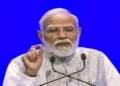
Tashkent: The capital city turned into a vibrant celebration of India-Uzbekistan friendship as Prime Minister Narendra Modi arrived in the Uzbek capital for his fourth visit landmark buildings illuminated in the tricolour and the Indian diaspora extended a warm welcome through music, dance and cultural performances, reflecting India’s soft power and civilisational link between India and Central Asia.
The visit is set to focus on strengthening the strategic partnership between New Delhi and Tashkent across trade, investment, defence, energy, digital connectivity, education and people-to-people ties.
A special welcome, wreath-laying at the Yangi Uzbekistan Monument and interaction with the Indian community…
Here are highlights from yesterday in Tashkent. pic.twitter.com/nQF54An3UB
— Narendra Modi (@narendramodi) August 30, 2026
Tashkent lights up in tricolour
Prominent landmarks across Tashkent, including the iconic Hilton Hotel, were illuminated in saffron, white and green as PM Modi arrived on August 29, Saturday. The striking display offered a symbolic welcome to Prime Minister Modi and reflected the growing warmth in bilateral relations between India and Uzbekistan.
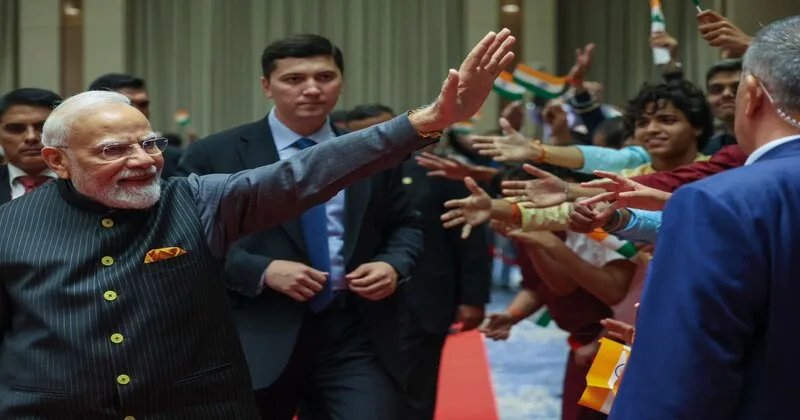
The visual spectacle was followed by an enthusiastic reception from members of the Indian community and local Uzbek artists. The gathering was marked by chants of “Vande Mataram” and “Bharat Mata Ki Jai” as PM Modi interacted with members of the diaspora.
Expressing his appreciation, PM Modi described the welcome as a celebration of the deep cultural ties between the two countries. He highlighted the performances showcasing a blend of Indian and Uzbek artistic traditions.
Kathak meets Andijan Polka
The cultural programme for PM Modi’s welcome brought together diverse forms of Indian and Uzbek performing arts. The Bollywood Battle Group performed to the evergreen Hindi film song Ude Jab Jab Zulfein Teri, while another presentation fused the classical Indian dance form Kathak with Uzbekistan’s energetic Andijan Polka.
Students of the Lal Bahadur Shastri Centre for Indian Culture also presented a Kathak performance, underlining the role and strong presence of Indian cultural essence in Uzbekistan, strengthening people-to-people ties.
Young children from Uzbekistan joined the celebrations with a lively performance to the popular Indian song, further highlighting the popularity of Indian culture in the Central Asian nation. PM Modi later praised the artists on social media, calling the community welcome a “delightful celebration” of India-Uzbekistan cultural ties.
The community welcome in Tashkent was a delightful celebration of India-Uzbekistan cultural ties!
It included:
Performance by the Bollywood Battle Group on the evergreen ‘Ude Jab Jab Zulfein Teri.’
Fusion of Kathak and the energetic Andijan Polka.
Kathak performance by… pic.twitter.com/LFEfPJlIQQ
— Narendra Modi (@narendramodi) August 29, 2026
Tabla, Doira and Chang showcase India-Central Asia musical connect
The cultural exchange extended beyond dance, with PM Modi witnessing a fusion of Indian and Uzbek musical traditions. A performance featuring the Indian tabla alongside Uzbekistan’s traditional Doira and Chang instruments showcased the similarities and complementary rhythms of the two musical traditions.
“The Tabla blends beautifully with the Doira and Chang, showcasing the deep cultural connect between India and Uzbekistan,” PM Modi said, highlighting how cultural exchanges can serve as a bridge between societies.
The enthusiasm was also reflected among Uzbek performers and members of the Indian diaspora. One Uzbek performer expressed her affection for India, saying that although she was from Uzbekistan, her “soul” was from India and that Uzbeks shared a strong affection for Indians.
A captivating fusion of Indian and Uzbek musical traditions!
The Tabla blends beautifully with the Doira and Chang, showcasing the deep cultural connect between India and Uzbekistan. pic.twitter.com/gj80T5kaMY
— Narendra Modi (@narendramodi) August 29, 2026
16,000 Indian students form a living bridge
The large Indian community in Uzbekistan has emerged as an important link between the two countries. Ministry of External Affairs spokesperson Randhir Jaiswal shared photographs of the vibrant reception and underlined the contribution of more than 16,000 Indian students studying in Uzbekistan.
Alongside the wider Indian community, the students were described as a “living bridge” of friendship between India and Uzbekistan.
Members of the diaspora also voiced expectations that PM Modi’s visit would create new opportunities for investment and business cooperation. Indian pharmaceutical companies, in particular, were cited as having a growing presence in Uzbekistan, while members of the community pointed to potential collaboration in healthcare, investment and education.
Diaspora representatives also highlighted the scope for deeper educational partnerships between the two countries.
Overwhelmed by the warmth and affection of the Indian community in Tashkent.
Our diaspora is a living bridge between India and Uzbekistan, strengthening the bonds of friendship between our nations.
Toshkentdagi hind jamoatchiligining samimiy mehri va iliq munosabatidan… pic.twitter.com/PlR5WW50uh
— Narendra Modi (@narendramodi) August 29, 2026
Uzbek President Mirziyoyev recieves PM Modi in airport
Following his arrival, PM Modi met Uzbek President Shavkat Mirziyoyev, who personally received him at the airport. PM Modi described the reception as a “special gesture” and said his fourth visit reflected the depth and growing momentum of India-Uzbekistan bilateral relations.
Upon landing in Tashkent, went to lay a wreath at the Yangi Uzbekistan Monument with President Mirziyoyev.
The Yangi Uzbekistan Monument reflects the aspirations and progress of the Uzbek people. Glad to begin my visit by coming here.
Toshkentga yetib kelganimdan so‘ng,… pic.twitter.com/7VHDC0esBt
— Narendra Modi (@narendramodi) August 29, 2026
The two leaders are scheduled to hold delegation-level talks to review the strategic partnership and set the agenda for future cooperation. Discussions are expected to cover trade and investment, defence, digital connectivity, energy, education and people-to-people ties. The talks are also aimed at advancing the shared visions of “Viksit Bharat” and “Yangi Uzbekistan”.
Landed in Tashkent to a warm welcome by President Shavkat Mirziyoyev. Grateful to him for the special gesture.
This is my fourth visit to Uzbekistan, reflecting the depth and growing momentum of our bilateral relations.
Toshkentga yetib keldim va Prezident Shavkat Mirziyoyev… pic.twitter.com/vAjST9OzuK
— Narendra Modi (@narendramodi) August 29, 2026
The Prime Minister also visited Yangi Uzbekistan Park with President Mirziyoyev and laid a wreath at the Independence Monument. The monument, established to mark the 30th anniversary of Uzbekistan’s independence, symbolises the Uzbek people’s aspirations for freedom and progress, PM Modi stated.
With culture, commerce and strategic cooperation, PM Modi’s Uzbekistan visit signals New Delhi’s continuing effort to deepen its engagement with Central Asia while reinforcing the civilisational and people-to-people bonds that underpin India’s partnership with the region.