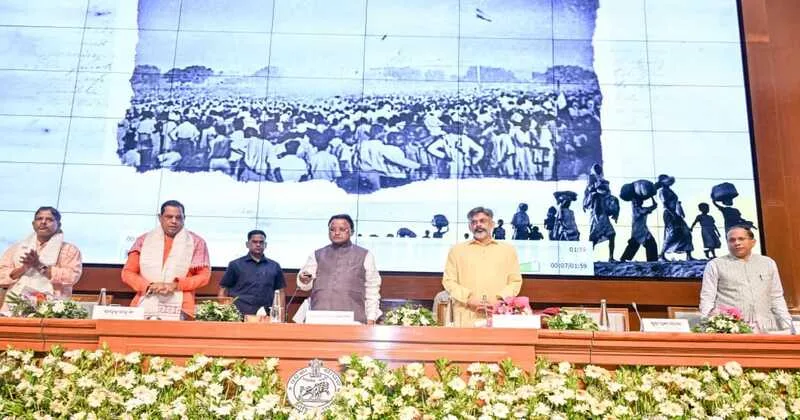
Bhubaneswar: Emphasizing the importance of learning from the painful experiences of Partition, speakers at the state-level Partition Horrors Remembrance Day programme on August 14, Friday stated that remembering the human suffering, displacement and violence of 1947 is essential to ensure such a tragic chapter of history is never repeated. They called for greater awareness among younger generations and reaffirmed the need to safeguard the country’s unity, integrity and social harmony.
Addressing the gathering, Odisha Chief Minister Mohan Charan Majhi said that Partition Horrors Remembrance Day should not be viewed merely as an occasion to remember a tragic chapter of the past. Rather, it should serve as a day of resolve to safeguard the unity, sovereignty, and integrity of the country and to ensure that such a tragedy is never repeated.
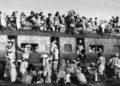
Partition: One of the largest human displacements in history
CM Majhi stated that the Partition of 1947 was not merely a political exercise to redraw the boundaries between two countries, but one of the largest episodes of human displacement in history.
ଆଜି ଲୋକସେବା ଭବନସ୍ଥିତ କନ୍ଭେନ୍ସନ୍ ସେଣ୍ଟରଠାରେ ଆୟୋଜିତ 'ବିଭାଜନ ବିଭୀଷିକା ସ୍ମୃତି ଦିବସ' ଅବସରରେ ଦେଶ ବିଭାଜନର ଅକଥନୀୟ ଯନ୍ତ୍ରଣା, ହିଂସା ଓ ଅତ୍ୟାଚାରର ଶିକାର ହୋଇ ସର୍ବସ୍ୱ ହରାଇଥିବା ଆମର ଅସଂଖ୍ୟ ପୂର୍ବଜଙ୍କ ଅସୀମ ତ୍ୟାଗ ପ୍ରତି ଶ୍ରଦ୍ଧାଞ୍ଜଳି ଅର୍ପଣ କଲି। ୧୯୪୭ ମସିହାର ସେହି ଅତି ସମ୍ବେଦନଶୀଳ ଓ ରକ୍ତାକ୍ତ ଅଧ୍ୟାୟ କେବଳ… pic.twitter.com/SZQKBDhdWe
— Mohan Charan Majhi (@MohanMOdisha) August 14, 2026
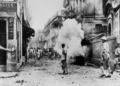
According to estimates cited by the Chief Minister, approximately 15 million people were forced to leave their homes and migrate across the newly created borders. He also referred to the communal violence that accompanied Partition, noting that between 500,000 and two million people lost their lives, while more than 50,000 women reportedly faced abduction, sexual violence and other forms of abuse.
He recalled the tragic accounts of trains arriving from Pakistan carrying bodies, stating that the trauma of Partition continues to affect generations of families even decades later.
A day to resolve to protect Bharat’s unity
The Chief Minister emphasized that remembering the horrors of Partition should strengthen the collective resolve to protect Bharat’s unity and territorial integrity. He said the Partition was the result of several factors, including the British government’s “Divide and Rule” policy and what he described as the narrow political interests and pursuit of power among sections of the leadership of that period.
He also noted that the decisions taken by the Muslim League and the Congress at the time played a significant role in the eventual Partition.
CM highlights the importance of historical awareness
CM Majhi stressed the importance of ensuring that younger generations understand the historical realities surrounding Partition. He said the National Council of Educational Research and Training (NCERT) textbooks now include the history and horrors of Partition so that young people can learn about the events and their consequences.
According to the Chief Minister, historical awareness is essential to prevent misinformation and ensure that future generations understand the enormous human cost of division.
He also highlighted the achievements of several people who migrated during Partition, including former Deputy Prime Minister Lal Krishna Advani, former Prime Minister Manmohan Singh, and legendary athlete Milkha Singh, stating that they overcame immense hardships and rose to prominence through determination and hard work.
Concerns over the fate of minorities
The Chief Minister highlighted the demographic changes affecting minority communities in Pakistan and Bangladesh since Partition. He noted the significant decline in the Hindu population in Pakistan, while ongoing reports of attacks and persecution against Hindus in Bangladesh continue to be a source of concern.
He urged the public to acknowledge the suffering caused by Partition and called for increased vigilance to safeguard India’s unity and national interests.
Partition Remembrance Day since 2021
CM Majhi mentioned that “Partition Horrors Remembrance Day” was instituted in 2021 by Prime Minister Narendra Modi. He stated that this observance serves as a reminder of the repercussions of hatred, communal violence and social division.
As Independence Day is celebrated on August 15, the Chief Minister encouraged citizens to commemorate the nation’s freedom while remaining dedicated to protecting its sovereignty, security, unity, and integrity.
He appealed to the public to ensure that the painful circumstances that led to the 1947 Partition are never repeated.
Remembering partition horrors is essential to prevent repetition of history: Prafulla Ketkar
Horrors Remembrance Day should be observed not merely as a day of mourning, but as an occasion to recall the suffering caused by Partition, draw lessons from history and reaffirm the commitment to national unity, said Prafulla Ketkar, Editor of Organiser Weekly
Addressing the gathering as the chief speaker, Ketkar emphasized that the events surrounding the Partition of Bharat should be studied by successive generations to understand the political, social, and historical circumstances that led to the country’s division.
He described Bharat as a civilizational entity rather than merely a piece of territory, stating that the idea of national unity should remain central to discussions on Partition and its legacy.
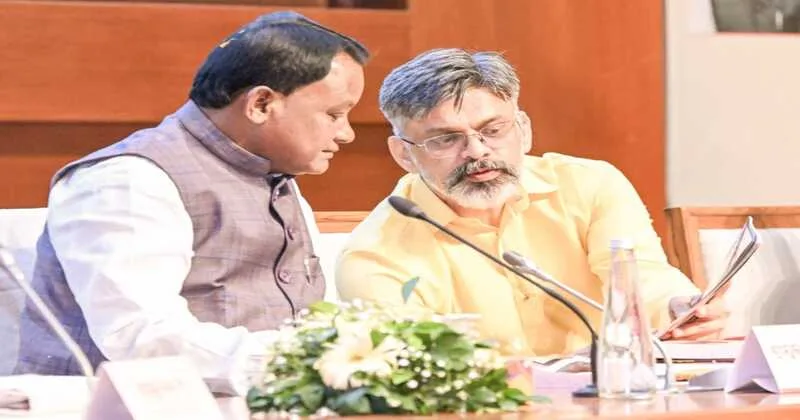
Partition was a civilizational tragedy
Ketkar asserted that Bharat, in his view, could not be regarded simply as a property to be divided for political convenience. “Bharat is not a property that can simply be divided. A son does not divide his mother. For us, this is a civilizational issue,” he said.
Referring to the civilizational significance of the Sindhu region, he noted its important role in the development of Bharatiya civilization. He described the idea of an integrated Bharat as a long-term civilizational aspiration. Ketkar said that Partition Horrors Remembrance Day should therefore be used to remember those who suffered while also reaffirming the importance of national unity.
Why remember partition before Independence Day?
Ketkar acknowledged that some people might question the relevance of recalling the painful memories of Partition when the country is preparing to celebrate Independence Day on August 15. He cited Swami Vivekananda’s emphasis on remembering history, stating that societies that forget their past risk making the same mistakes again.
“The purpose of remembering Partition is not merely to revisit painful memories. It is to learn from history and ensure that such a tragedy is not repeated,” he said. He questioned the circumstances that led millions of people living in territories that later became Pakistan and Bangladesh to suddenly find themselves citizens of another country.
He stressed that the experiences of those who were displaced, separated from their families and communities, or forced to abandon their homes should remain an important part of Bharat’s collective historical memory.
1905 partition of Bengal and the nationalist response
Ketkar traced the history of territorial division during British rule to the 1905 Partition of Bengal. He noted that the British decision to divide Bengal into eastern and western parts triggered widespread opposition across the country. Leaders and intellectuals from diverse backgrounds participated in the movement against this decision.
He recalled the pivotal role of Rabindranath Tagore, Lala Lajpat Rai, Bal Gangadhar Tilak, and Bipin Chandra Pal in mobilizing public opinion against the Partition. According to Ketkar, Vande Mataram became a major symbol of the anti-Partition movement, inspiring people nationwide.
He stated that this widespread movement ultimately contributed to the British government’s decision to annul the Partition of Bengal in 1911.
What changed between 1905 and 1947?
Ketkar questioned how the country transitioned from successfully resisting the Partition of Bengal in 1905 to the division of Bharat in 1947. He pointed out that the 1947 Partition involved not only Bengal but also Punjab, while Sindh became part of Pakistan.
According to Ketkar, some political leaders at the time believed that Partition would resolve the communal and political tensions confronting the country. He said, however, that separatist tendencies did not disappear with the creation of two countries.
British policies and the politics of partition
He highlighted that Vande Mataram, which had once united Hindus and Muslims and inspired them to fight against British rule, was later opposed on communal grounds. By 1937, portions of the song had been omitted. The Muslim League initially opposed the song, and the Congress later agreed to these modifications. At the time, some Congress leaders believed that removing certain lines from Vande Mataram would appease the Muslim League leadership. He argued that the seeds of Pakistan’s creation were sown on the very day Vande Mataram was curtailed.
Ketkar also discussed the origins of the demand for Pakistan, referencing the Muslim League’s 1940 call for a separate homeland and earlier political writings advocating such an idea. He referred to Rahmat Ali’s advocacy of the term “Pakistan” during the 1930s and argued that the idea of political separation had emerged before the Muslim League formally adopted the demand.
Ketkar stated that British strategic interests influenced the political developments surrounding Partition. He said the colonial administration was concerned about the emergence of a strong and united Bharat after independence and cited geopolitical and strategic considerations as part of the broader historical context.
Post-partition challenges and the Liaquat-Nehru pact
Ketkar stated that following Partition, Bharat lacked a specific policy for Hindus who had fled to the country. He noted that in 1949, an agreement, commonly known as the Nehru-Liaquat Pact, was reached between Prime Minister Jawaharlal Nehru and Pakistan’s Prime Minister Liaquat Ali Khan. Under this agreement, Bharat committed to protecting Muslims within its borders, while Pakistan committed to safeguarding Hindus and other minorities residing there.
Ketkar questioned the fate of minorities in the areas that constituted Pakistan at the time of Partition, which included present-day Pakistan and Bangladesh. He pointed out that Hindus, Buddhists, Sikhs, and Christians collectively accounted for over 23 percent of the population at the time of Partition, whereas minorities in Pakistan today constitute less than 3 percent. He contrasted this with the Muslim population in Bharat, which he said stood at around 9 percent after Partition and had risen to approximately 15 percent according to the 2011 Census. He further claimed that this figure could increase to 18–20 percent in the forthcoming Census.
He also raised concerns about the opposition to the Citizenship Amendment Act (CAA), which offers a path to citizenship for certain persecuted religious minorities from neighboring countries. Referring to the condition of Hindus in Pakistan, he questioned why there was little discussion about the decline of the minority population in the region from over 23 percent at the time of Partition to less than 3 per cent in present-day Pakistan.
Partition described as a massive humanitarian tragedy
Highlighting the human cost of Partition, Ketkar described it as one of the largest humanitarian tragedies in modern history. He stated that millions of people were displaced from their homes and communities, and large numbers lost their lives during communal violence. Women were among those who suffered severely during the upheaval, with many facing abduction and sexual violence.
He stressed that the experiences of Partition victims should not be forgotten and that younger generations should be encouraged to study the period through historical documents, memoirs, and scholarly works.
Ketkar recommended books such as socialist thinker Ram Manohar Lohia’s Guilty Men of India’s Partition and former Rashtriya Swayamsevak Sangh Sarkaryavaha H.V. Seshadri’s The Tragic Story of Partition for those seeking to understand the background and consequences of the division.
The divisive mindset remains a challenge
Eight decades after Partition, Bharat must examine whether the political and social tendencies that contributed to the division have completely disappeared, said Ketkar. He argued that separatist and communal tendencies continue to pose challenges to national integration. He also criticized what he described as the use of political considerations, in the name of secularism, to accommodate divisive tendencies.
He urged young people to study the speeches and writings of Dr. Shyama Prasad Mukherjee and Dr. B.R. Ambedkar, particularly their interventions in Parliament and the Constituent Assembly. He referred to Ambedkar’s views on Partition and the question of population exchange between Bharat and Pakistan.
Bharat lost land and people, But the lessons must remain
Eighty years after the Partition of Bharat, Mr. Ketkar observed that the country has lost both territory and people, yet the divisive mindset that led to Partition has not disappeared. He contended that the tendency to exert pressure through mob violence to force demands is still prevalent.
Ketkar questioned whether the situation had fundamentally changed in the 80 years since Partition. He argued that the radical Islamist mindset which he stated was fostered by the British and contributed to the Partition of Bharat continues to persist. He further alleged that this mindset has been sustained under the guise of secular politics.
According to Ketkar, the same tendencies of radicalism and separatism are still present in the country today. He noted that Vande Mataram, which faced opposition before Partition, continues to be opposed in some quarters. He also claimed that, in the name of global Muslim solidarity, some individuals continue to prioritize support for Muslim-majority countries over Bharat’s national interests.
Remember the past, Work towards Akhand Bharat
In conclusion, quoting a poem by former Prime Minister Atal Bihari Vajpayee, he stated that India’s freedom remains incomplete, and “we must work towards Akhand Bharat.” He called upon people to use Partition Horrors Remembrance Day as an occasion to resolve to fulfill this unfinished vision of Akhand Bharat and make sustained efforts in that direction.
He stated that the significance of Partition Horrors Remembrance Day lies not only in remembering the victims of 1947 but also in ensuring that the circumstances which produced such widespread violence and displacement are never allowed to recur. Ketkar urged the younger generation to study history critically, understand the experiences of Partition victims, and contribute toward building a strong, united, and prosperous Bharat.
Speaking at the programme, Ekamra MLA Babu Singh stated that Partition Horrors Remembrance Day is not merely another commemorative occasion, but an opportunity to recall one of the darkest chapters in Bharat’s history. He recounted the suffering, displacement, and sacrifices of countless innocent people who became victims of violence during Partition.
Singh emphasized that forgetting history would mean losing the important lessons it offers to society. He stressed that the foremost identity shared by all citizens is that of being Bharatiya and called upon people to work towards building a prosperous and strong Bharat while honoring the sacrifices of those who suffered during Partition.
He urged people to reject division and instead move forward with faith in unity and national integrity.
Experts and intellectuals attend the event
The programme was attended by Dr. Bijay Ketan Upadhyay, Secretary of the Department of Odia Language, Literature and Culture, Dr. Chandrasekhar Hota, Secretary of the Odisha Sahitya Akademi, Pragya Mahala, National Coordinator of Durga Vahini and Bikram Keshari Mahapatra, Chairman of the Bharatiya Itihas Sankalan Samiti.
The programme concluded with a call to remember the human cost of Partition while drawing lessons from history to strengthen Bharat’s unity, harmony and integrity.