

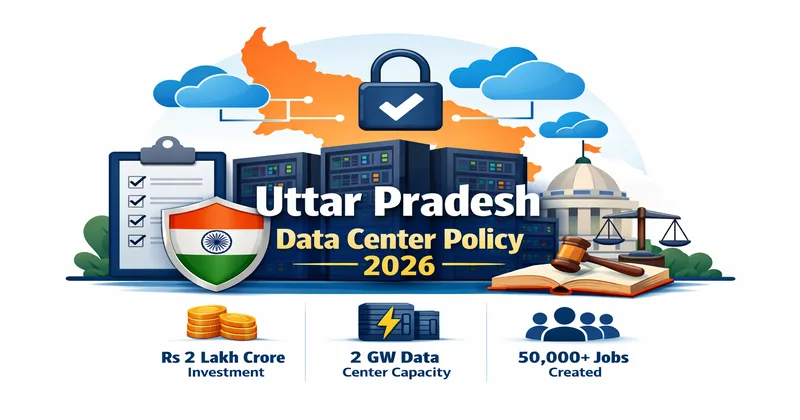
To strengthen Bharat’s digital economy, the Uttar Pradesh Cabinet has approved the Uttar Pradesh Data Centre Policy 2026. It is a forward-looking initiative that aims to transform Uttar Pradesh into the country’s largest data centre destination. With ambitious targets of attracting more than Rs 2 lakh crore in investments, creating over 2 gigawatts (GW) of additional data centre capacity, and generating more than 50,000 employment opportunities, the policy clearly shows Uttar Pradesh’s determination to become a global hub for digital infrastructure. Under the leadership of Chief Minister Yogi Adityanath, Uttar Pradesh has witnessed rapid industrial growth, improved infrastructure, better connectivity, and investor-friendly governance. The Data Center Policy 2026 is another major milestone in this journey, reinforcing the state’s vision of becoming a key contributor to India’s digital economy and the national goal of achieving a $1 trillion economy.
As technologies such as Artificial Intelligence (AI), cloud computing, the Internet of Things (IoT), big data analytics, and digital governance continue to reshape economies across the world, the demand for secure, reliable, and energy-efficient data centers is growing rapidly. The newly approved policy seeks to capitalize on this opportunity by creating an enabling ecosystem for investments while supporting India’s digital transformation.
The Uttar Pradesh Cabinet approved the UP Data Center Policy 2026, paving the way for a stronger digital future.
With a target of ₹2 lakh crore+ investments, 2 GW+ data center capacity, and 50,000 jobs, the policy will accelerate AI, cloud, and digital innovation.
Under the… pic.twitter.com/K1q5SjXIe8— Awanish K Awasthi (@AwasthiAwanishK) July 7, 2026
Why Do Data Centers Matter?
Data centers are often described as the backbone of the digital world. Every online activity, from sending emails and streaming videos to digital payments, e-commerce transactions, government services, AI applications, and cloud computing depends on data centers for storing, processing, and transmitting information. The rapid expansion of digital services has significantly increased the need for modern data infrastructure. India’s internet users now number in hundreds of millions, while digital public platforms such as Aadhaar, UPI, DigiLocker, CoWIN, and various e-governance initiatives continue to generate enormous volumes of data. The rise of AI-driven technologies and machine learning has further accelerated the need for high-capacity computing infrastructure.
Recognizing these emerging trends, the Uttar Pradesh government has designed the Data Center Policy 2026 to ensure that the state remains prepared for future technological advancements while attracting global investments.
Ambitious Investment Targets
One of the most notable features of the policy is its investment target of over Rs 2 lakh crore. Such large-scale investment is expected to significantly boost industrial development while strengthening Uttar Pradesh’s position in India’s digital infrastructure sector. The policy aims to attract both domestic and international companies engaged in data center development, cloud services, AI infrastructure, and digital technology solutions. The investment will support the construction of large-scale data center parks, independent data center units, AI-enabled facilities, and supporting digital infrastructure. These investments will stimulate growth across several related sectors, including construction, electrical engineering, cooling technologies, renewable energy, telecommunications, cybersecurity, software services, logistics, and facility management.
Expanding Data Center Capacity
The policy sets a target of creating more than 2 GW of additional data center capacity, representing one of the most ambitious infrastructure goals by any Indian state. Modern data centers require substantial electrical capacity to operate high-performance computing equipment while maintaining uninterrupted operations through advanced cooling systems and backup power infrastructure. Achieving this target will substantially enhance India’s ability to host cloud services, enterprise applications, AI workloads, and digital platforms within the country.
Greater data center capacity will also improve digital resilience by reducing dependence on facilities located in a few metropolitan regions, enabling businesses and government agencies to access secure and reliable computing infrastructure closer to their users.
Employment Generation and Skill Development
The Data Center Policy 2026 is expected to create over 50,000 direct and indirect employment opportunities. Construction of large data center campuses will generate jobs for engineers, architects, technicians, project managers, electricians, and construction workers. Once operational, these facilities will require skilled professionals in network administration, cybersecurity, cloud computing, AI operations, hardware maintenance, facility management, and energy management.
Indirect employment will also emerge through supporting industries such as transportation, hospitality, equipment manufacturing, security services, and professional consulting. As demand for digital skills continues to grow, educational institutions and training centers across Uttar Pradesh are likely to introduce specialized courses in cloud computing, artificial intelligence, cybersecurity, data engineering, and digital infrastructure management, thereby strengthening the state’s skilled workforce.
Building a Strong AI and Cloud Ecosystem
Artificial Intelligence is playing a major role in modern economy. From healthcare diagnostics and financial services to agriculture, manufacturing, education, and governance, AI applications require enormous computing power and sophisticated digital infrastructure. The Data Center Policy 2026 will build a world-class ecosystem capable of supporting AI research, cloud computing platforms, digital innovation, and emerging technologies. With increased computing capacity available within the state, startups, research institutions, universities, government agencies, and technology companies will gain access to faster, more reliable digital infrastructure. This will encourage innovation while reducing operational costs associated with hosting data in distant locations. Cloud service providers can also expand their presence in Uttar Pradesh, enabling businesses of all sizes to adopt advanced digital solutions more efficiently.
To attract more investment, the policy offers several benefits to companies setting up data center parks, individual data centers, and AI-related facilities. These benefits include financial support, infrastructure assistance, and easier approval processes to help projects start quickly. Since building a data center requires a large investment in land, buildings, power supply, cooling systems, internet connectivity, and backup facilities, the government is planning to reduce these costs through various incentives. This will make Uttar Pradesh a more attractive and competitive destination for data center investments.
Special Focus on Purvanchal and Bundelkhand
Balanced regional development remains an important objective of the new policy. While western Uttar Pradesh already benefits from relatively stronger industrial infrastructure, the government has provided additional incentives for projects established in Purvanchal and Bundelkhand. These regions have long been identified as priority areas for industrial expansion and employment generation. By encouraging data center investments in these districts, the government aims to create new economic opportunities while reducing regional disparities. The initiative is expected to stimulate infrastructure development, improve urban services, attract ancillary industries, and generate employment closer to local communities.
Large data centers consume substantial amounts of electricity and require efficient cooling systems. Recognizing the importance of sustainability, the Uttar Pradesh Data Center Policy 2026 emphasizes environmentally responsible development. Developers are encouraged to adopt green building practices, energy-efficient technologies, advanced cooling systems, renewable energy integration, and globally recognized sustainability standards.
Environment-friendly infrastructure not only reduces carbon emissions but also lowers operational costs over the long term. Green-certified facilities are increasingly preferred by multinational corporations seeking environmentally responsible digital infrastructure. The emphasis on sustainable development aligns with India’s broader climate commitments while ensuring that digital expansion remains environmentally balanced.
The new policy builds upon the progress achieved under the state’s earlier data center initiatives. Several data center parks and independent data center projects have already received government approvals, attracting investments worth tens of thousands of crores. These projects demonstrate growing investor confidence in Uttar Pradesh’s improving business environment.
The state’s strategic location in northern India, excellent road network, expanding expressways, international airports, dedicated freight corridors, robust power infrastructure, and improving connectivity make it an ideal destination for large-scale digital infrastructure. As more projects become operational, Uttar Pradesh is expected to emerge as one of India’s largest clusters for data center development.
Beyond industrial development, the policy will strengthen public service delivery. Government departments increasingly rely on digital platforms for citizen services, online records, financial transactions, healthcare, education, policing, and administrative management. Enhanced local data storage and processing capabilities will improve system performance, reduce latency, strengthen cybersecurity, and enhance disaster recovery capabilities. This will support faster delivery of digital government services while ensuring greater reliability and data security for millions of citizens.
As digital data becomes a strategic national asset, countries across the world are investing heavily in domestic data infrastructure. India’s growing digital economy requires secure storage and processing of sensitive government, financial, healthcare, and enterprise data within the country. Expanding domestic data center capacity contributes to greater digital sovereignty by reducing dependence on overseas infrastructure. The Uttar Pradesh Data Center Policy 2026 supports this national objective by creating world-class facilities capable of serving both domestic and international organizations while complying with evolving data governance requirements.
The impact of the policy extends well beyond the technology sector. Large-scale data center investments create demand for construction materials, electrical equipment, power systems, fiber connectivity, renewable energy, manufacturing, transportation, logistics, financial services, and professional consulting. This multiplier effect stimulates broader economic activity while encouraging innovation across multiple industries. Small and medium enterprises also benefit by gaining access to improved digital infrastructure, cloud services, and business technology solutions. As digital infrastructure expands, Uttar Pradesh is likely to attract greater investment in fintech, health-tech, ed-tech, e-commerce, software development, AI startups, and research institutions.
Beyond creating infrastructure, the initiative seeks to establish a comprehensive ecosystem that supports artificial intelligence, cloud computing, digital innovation, cybersecurity, and advanced technology industries. Special incentives for less-developed regions, emphasis on sustainability, investor-friendly provisions, and continued infrastructure development further strengthen the policy’s long-term vision.
As India continues to adopt digital technologies in every sector, Uttar Pradesh is becoming an important hub for digital growth. With strong government support, careful planning, and increasing participation from the private sector, the state is attracting major investments in digital infrastructure. The Uttar Pradesh Data Center Policy 2026 is more than just an investment policy. It is a long-term plan to promote innovation, create jobs, attract global companies, and help build a stronger digital economy for both the state and the country.