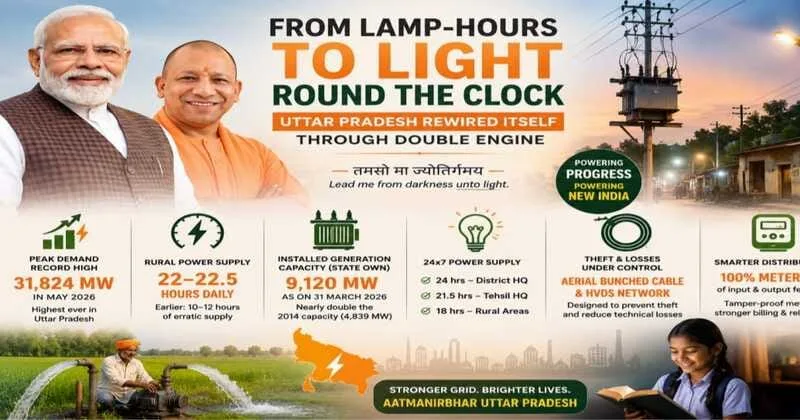
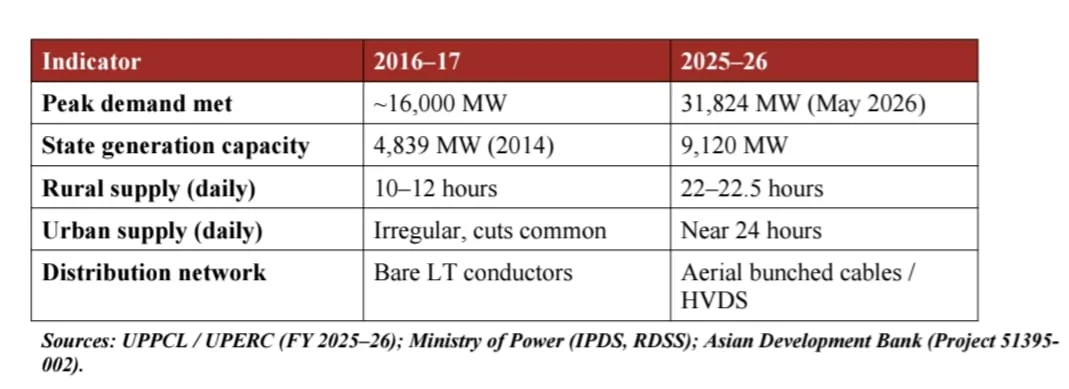
For a generation, the evening in much of Uttar Pradesh began not with a switch but with a sigh. The lantern was kept filled, the inverter kept charged and phrases such as “bijli aa gayi”: the power has come were greeted as events rather than expectations. That expectation has now inverted. In May 2026, the state met a record peak demand of 31,824 MW, the highest ever recorded in its history, while sustaining supply through a summer in which most districts crossed 40°C. A decade earlier, in 2016–17, peak demand of roughly 16,000 MW could not be reliably met at all. Demand has doubled in a decade, representing economic development. The single inversion, more load, fewer cuts, is the measure of what has changed in a decade.
The Arithmetic Of Capacity
As of 31 March 2014, the state’s own installed generation capacity stood at about 4,839 MW. It climbed to 5,474 MW by 2019, 6,134 MW by 2022, 7,140 MW in 2024, 7,800 MW in 2025 and reached 9,120 MW by 31 March 2026, nearly double the 2014 figure. Capacity alone does not keep a bulb burning, but without it, every downstream reform would collapse under peak load. The state paired this expansion with a firm supply roster of 24 hours for district headquarters, 21.5 hours for tehsil headquarters and 18 hours for rural areas. It also confirms that, under the present demand that routinely exceeds, towns and cities need to ensure a near-continuous supply.
Reliability is an industrial policy by another name, which has improved. No entrepreneur commissions a unit, and no investor underwrites a factory, in a district where the line falls silent for eight hours a day, the diesel generator that once bridged the gap was a tax on every ledger it touched. Stable supply has therefore done quite a work on steadying the industrial output, lowering the input cost of power for traders and manufacturers, and removing one of the standing excuses for capital to look elsewhere. A state that seeks to be the manufacturing floor of a self-reliant Bharat cannot ask its enterprises to run on an unreliable grid; the megawatts and the meaning of Aatmanirbharat meet precisely here on the factory’s feeder.
The village at the centre of Aatmanirbhar Bharat
The biggest change is in rural regions, because that is where the deprivation was deepest. Where villages once received barely 10 to 12 hours of erratic supply, rural Uttar Pradesh now draws between 22 and 22.5 hours daily. This is not merely a convenience metric but a reliable rural power that alters the economics of irrigation, cold storage, flour mills, small workshops and the study hours of a schoolchild. The state’s tariff design reinforces the intent that domestic consumers in Gram Panchayat areas are billed on a lower rural schedule, beginning near Rs 3.35 per unit against the urban Rs 5.50, with a reduced fixed charge, an explicit Antyodaya calculation that places the last household first rather than last.
A rural network of bare low-tension conductors strung across long spans is a network that leaks, through resistance and sag, and commercially through the ease with which a hook can be thrown over an exposed line. Uttar Pradesh once carried among the heaviest such burdens in the country. In the previous decade, the state was estimated to lose over a third of its power to theft and non-technical loss. Round-the-clock supply is meaningless if a third of it never reaches a paying meter. The reform of hours had made agriculture and other rural setups a successful model.
The single wire that steals less
Here lies the quiet engineering revolution. The conventional bare overhead conductor invites the classic katiya—the illegal hook, because any point along the naked line is a point of access. The remedy adopted across the state is the aerial bunched cable, in which the phase and neutral conductors are twisted together and insulated, so that the familiar single sagging wire is replaced by a sealed, bundled cable. A hook thrown over insulated bunched cabling draws nothing; tampering becomes conspicuous and physically difficult. Paired with this is the High Voltage Distribution System (HVDS), which pushes 11 kV lines using compact 16 kVA and 25 kVA transformers, far closer to the consumer, shrinking the vulnerable low-tension stretch where both theft and line loss concentrate. Less exposed low-tension wire means less to steal and less to lose in transit.
The distinction matters for how one reads the achievement. Theft here is not being fought only by inspectors and disconnection drives, worthwhile as those are, but it is being engineered out of the physical network. When the conductor itself refuses the hook, enforcement stops being a running battle and becomes an exception. That is the difference between a system patched against loss and a system designed against it.
IPDS and the scaffolding of reform
The instrument that funded much of this modernisation is the Integrated Power Development Scheme (IPDS), the Union government’s flagship for urban distribution. IPDS financed load bifurcation and feeder separation, 11 kV HVDS, aerial bunched conductoring in dense and theft-prone pockets, the metering of all input and outgoing feeders, and the replacement of old electromagnetic meters with tamper-proof electronic and smart meters. Its logic was accountability by measurement; if every input point and every outgoing feeder is metered with downloadable meters, the leak between what enters an area and what is billed becomes visible, and what becomes visible can be closed. Ayodhya received a dedicated IPDS sanction as a showcase of integrated urban distribution.
IPDS did not act alone. Its rural counterpart, the Deendayal Upadhyaya Gram Jyoti Yojana, drove the separation of agricultural from domestic feeders so that villages could be rationed daytime irrigation power without starving households of evening light. Both schemes have since been subsumed into the Revamped Distribution Sector Scheme (RDSS), which carries forward the same toolkit for agricultural feeder separation, solar-pump integration, aerial bunched cables and HVDS for loss reduction and smart metering. These are now aimed squarely at cutting aggregate technical and commercial (AT&C) losses and delivering genuine 24×7 supply. A parallel ADB-supported Power Distribution Rehabilitation Project replaced bare rural conductors with aerial bundled cables across the state’s distribution companies, explicitly to reduce AT&C loss and restore the financial health of rural supply.
The steady replacement of legacy electromagnetic meters with tamper-proof electronic and smart meters, rolled out alongside the wire and feeder works, closes the loop that insulation and HVDS begin. A smart meter cannot be slowed by a magnet or read by a compliant hand; it reports consumption remotely, flags anomalies and, in its prepaid form, aligns payment with use in the very rural and peri-urban pockets where recovery was once weakest. Where the aerial bunched cable denies the hook its current, the smart meter denies the reader his discretion. Together they convert honesty from an act of enforcement into a default condition of the network, which is the only form in which honesty scales across a state of Uttar Pradesh’s size.
The distribution companies still carry a heavy accumulated deficit, and a proposed tariff revision to bridge a multi-thousand-crore revenue gap remains under regulatory consideration, which is a reminder that the financial turnaround trails the physical one. Loss reduction, though steep, is not yet complete and a network this vast demands continuous maintenance rather than a single ceremonial switch-on. The honest verdict is not that the work is finished but that the direction has decisively reversed the curve of capacity, of hours supplied, and of loss contained, now all point the right way at once.
The road ahead is already visible in the state’s own plans, the solarisation of agricultural feeders under PM-KUSUM, rooftop generation under PM Surya Ghar and the phased solarisation of some fifty lakh agricultural pumps to lift the subsidy burden while greening rural irrigation. As Uttar Pradesh reaches toward a one-trillion-dollar economy, peak demand may climb toward 40,000–45,000 MW, and the grid that once could not serve 16,000 MW must be built to serve nearly thrice that.
But the civilisational point stands apart from the megawatts. A society that promises light and delivers it keeps faith with its most ordinary citizen. The Upaniṣadic prayer to be led from darkness to light was never only metaphysical; in a village where the child can now read past dusk and the pump runs when the field needs it, that ancient plea has been answered in copper, insulation and steel. Uttar Pradesh’s power story is, at bottom, a story of a promise kept and of the unglamorous engineering, the single insulated wire and the metered feeder that made keeping it possible.