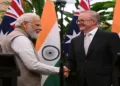
Jakarta: Prime Minister Narendra Modi’s visit to the Southeast Asian nation of Indonesia concluded with a landmark agreement which resonates with the electoral transparency, thriving democracy and state-of-the-art voting tech-based voting mechanisms prevailing in India. The EVM(Electronic Voting Machine) system adopted in India, now has global recognition and demand. Jakarta has sealed an MoU with New Delhi, to adopt India’s EVM system for the elections in Indonesia.
Indonesia has hailed India’s EVM system as a pivotal electoral reform and reiterated that it will adopt the model to its elections. In this regard, the Election Commission of India will assist with knowledge sharing, human resource exchange and with other technology or administrative inputs, which will aid Indonesia to develop a domestic EVM pattern that aligns with the needs & necessities and the electoral patterns of Indonesia.
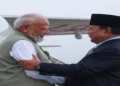
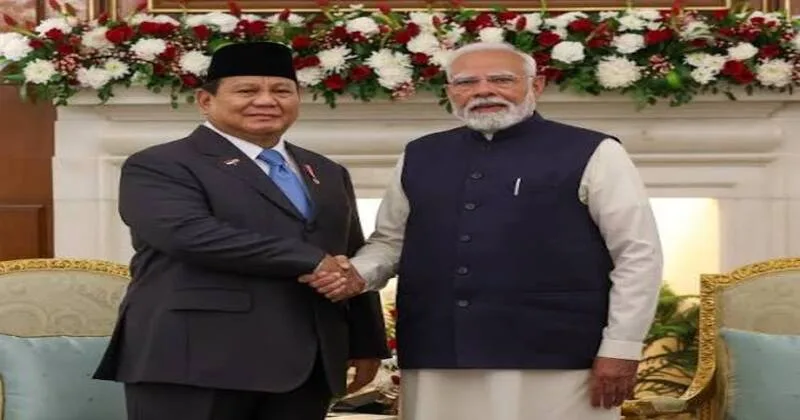
This global recognition and adoption of India’s EVM system is a testament to the fact that India’s EVMs are credible, transparent and are not manipulated or politicised, as alleged by the opposition parties. Prime Minister Narendra Modi during the bilateral meeting with the Indonesia President Prabowo Subianto, hailed the Memorandum of Understanding(MoU) between the election commissions of both the countries as an effort to strengthen institutional ties between vibrant and thriving democracies.
It is a step towards strengthening democratic cooperation between the two countries, PM Modi further added. “Democratic values and unity in diversity have been shared strengths for both India and Indonesia. We are set to further strengthen our democratic cooperation through an MoU between the Election Commissions of both nations”, PM Modi said. The sources also reiterated that customised and Indonesia-specific Electronic Voting Machines(EVMs) will be exported to Jakarta from India.
Indonesia is the world’s third largest democracy after India and the United States, which is home to 288 million people. Thus, the world’s third largest democracy adopting Indian electoral practices in the path of modernising and upgrading its electoral system, is indeed an immense recognition and acknowledgment to the world-class tech-based electoral system prevailing in India.
As of now, Indonesia is using a ballot paper system for the elections. The lawmakers and President of the country are elected in a single day election held across the nation, where people cast their franchise on ballot papers. However, for the 2029 elections, Jakarta aims to adopt an electronic voting system and in this direction it is aiming to develop a model inspired from India and seeking institutional and technical assistance from the Election Commission of India(ECI).
Officials from both sides have already exchanged visits to study India’s EVM design, election supervision systems, voter awareness initiatives and digital tools for democratic governance. During the 2025 Bihar Assembly elections, officials from Indonesia’s election commission were part of a multi-national team that came to observe the electoral process. Speaking about the experience of witnessing the modern electoral system in India, Indonesia Election Commissioner Idham Holik described it as “very inspiring”. “Everyone could see that the elections were free and fair. India is truly a land of democracy”, he said during the 2025 Bihar elections.
Prior to Indonesia, Bhutan, Nepal and Namibia have adopted India’s EVM model in its elections.