British Prime Minister Keir Starmer, concluding a two-day visit to India, returned with several notable achievements that span trade, education, and international diplomacy. While Starmer had no major promises to exchange with his Indian counterpart Prime Minister Narendra Modi, his visit has made headlines for its strategic significance. Among the key developments, Starmer’s statements certifying India as the most dynamic economy in the world stood out, appearing to counter US President Donald Trump’s earlier remark labeling India a “dead economy” amid trade disputes. In addition, with the Nobel laureates’ names set to be announced, Starmer subtly took a dig at Trump, highlighting Modi as one of the world leaders who has contributed significantly to global peace. At times, Starmer even seemed to set aside the long-standing special relationship between Britain and the United States, choosing instead to praise Modi and India.
Our deal with India means:
More investment in the UK.
Thousands of new jobs across the country.
More money for you and your family. pic.twitter.com/jPZoijkNjA— Keir Starmer (@Keir_Starmer) October 9, 2025
Economic and Educational Opportunities: Indian investments in UK and British University expansion in India
Starmer’s first visit to India was marked by an unexpectedly warm reception. He appeared genuinely impressed by India’s development and progress, commenting on the rapid pace at which the country is moving forward since agreements were signed just three months ago. Currently, approximately one thousand Indian companies are registered in the UK, placing India second among foreign investors in Britain. These companies span various sectors, from electric vehicles to agricultural technology. Notably, Indian automotive giant TVS Motors is establishing a unit in Solihull, reflecting growing industrial collaboration. Semiconductor manufacturer Senet plans to set up a technology company in Somerset, creating around 300 jobs, with investment facilitated by Atul Date Palm Development totaling £11 million. Mustek is preparing to launch AI-focused enterprises in London and Leeds with £2 million in funding. Neo Celitic Global Limited is entering the orthopedic devices market with facilities in London and Cardiff, backed by £5 million. Supply chain company Algor Logistics is also establishing operations in London and Liverpool, employing approximately 250 people with an investment of £4 million.
In total, 64 Indian companies have announced plans to invest over £1 billion in the UK, paving the way for 7,000 British jobs. Political stability in both countries enhances the credibility of such initiatives, making them a mutually beneficial opportunity. Indian firms are particularly targeting sectors such as engineering, creative industries, and technology. Reports suggest that once the British government formalizes the investment agreements, implementation will be swift, covering locations from Basingstoke to Birmingham. Akshaya Vidhani, CEO of Yash Chopra Film Company, confirmed intentions to establish a film studio in the UK, further expanding cultural and creative exchanges.
It was a delight to welcome my friend, PM Keir Starmer at the Raj Bhavan in Mumbai. Being his first visit to India, it is surely a special occasion. The presence of the largest business delegation to India makes it even more special and illustrates the strong potential of… pic.twitter.com/znZTxoWq1l
— Narendra Modi (@narendramodi) October 9, 2025
Starmer’s visit also highlighted opportunities in higher education. Universities including Lancaster, Surrey, York, Aberdeen, Bristol, Liverpool, Belfast, Coventry, and Southampton, which already hosts a campus in India, are actively seeking Indian students. With India currently home to 40 million university students, projected to rise to 70 million within the next decade, British institutions see an advantage in establishing a local presence. This approach allows universities to offer education without requiring students to relocate to the UK, addressing both high tuition costs and strict immigration debates. For India, foreign campuses alleviate shortages of skilled educators while expanding access to globally recognized higher education. Students benefit by paying only tuition fees, avoiding the substantial living and study costs associated with studying abroad. Overall, this arrangement promises significant mutual gains, and Indian universities, often marked by political turbulence, may need to adapt to this new competitive landscape.
Strategic diplomacy and economic realignment: Britain’s post-Brexit focus on India
Starmer repeatedly emphasized India’s economic dynamism. Following US President Trump’s earlier comments, he publicly stated that India is among the fastest-growing economies globally and projected that it would become the third-largest economy within three years. Such declarations, delivered during a high-profile diplomatic visit, appear calculated to resonate internationally, including with Trump.
Traditionally, the United States and Britain have maintained closely aligned positions on global diplomatic and economic matters. For example, when the US Federal Reserve makes a significant policy decision affecting currency markets, the Bank of England typically aligns its policies accordingly. However, Starmer’s visit and statements signal a nuanced shift in Britain’s approach. He recognized Modi’s efforts toward peace in Ukraine and Gaza, contrasting with Trump’s self-proclaimed role as a champion of global peace, and indicated that Britain is willing to acknowledge India’s rising influence independently. This evolving posture reflects Britain’s recalibration in a changing world order. Post-Brexit Britain faces limited economic opportunities in the US, whereas India presents significant potential for trade and investment. Starmer’s visit sought to answer why Britain should not be the first major partner to capitalize on India’s growth. By openly praising Modi and acknowledging India’s rapid development, Starmer signaled that Britain is prepared to prioritize its strategic and economic interests in South Asia.
Starmer’s observations also underscored the challenges facing the UK’s domestic business sector after Brexit. Many British business leaders accompanying him reported losing up to 90 percent of their domestic market share. They now view India as a key market for recovery and growth. These executives accompanied Starmer to India to encourage the UK government to strengthen confidence in British businesses abroad and to foster supportive policies for international expansion. The economic dimension of Starmer’s visit includes the creation of thousands of jobs and the facilitation of significant foreign investment. Indian companies entering the UK market are contributing to job creation and technological advancement, while British universities benefit from expanded student bases in India. This multifaceted engagement underscores the potential for a mutually beneficial relationship that spans industry, education, and diplomacy.
Bilateral growth and cultural collaboration: Expanding trade, education, and geopolitical influence
Trade ties between India and Britain are set to strengthen further. British companies are exploring opportunities in India’s growing technology, creative, and engineering sectors, while Indian firms are establishing a strong foothold in the UK. The rapid pace of investment and collaboration signals that both nations are eager to capitalize on economic opportunities that emerged after recent geopolitical and trade shifts. Education, another focus of Starmer’s visit, is being leveraged as a long-term strategic tool. By opening campuses in India, British universities gain access to a vast pool of students without being constrained by the UK’s immigration policies. Meanwhile, Indian students gain affordable access to high-quality foreign education, fostering skills development and international exposure. This creates a new paradigm for international education, balancing economic and social benefits for both countries.
In cultural sectors, initiatives such as Akshaya Vidhani’s planned film studio in the UK point to growing collaboration in creative industries. These investments complement industrial and technological engagements, highlighting the broad scope of the bilateral relationship. The resulting synergy between economic, educational, and cultural initiatives illustrates the holistic benefits of Starmer’s visit. Starmer’s visit also has a subtle geopolitical dimension. By praising India’s economic and diplomatic achievements, he signaled that Britain is willing to pursue an independent foreign policy that recognizes India’s growing role on the global stage. This stance may create friction with the US but reflects a calculated strategy to diversify Britain’s international partnerships in line with post-Brexit economic realities.
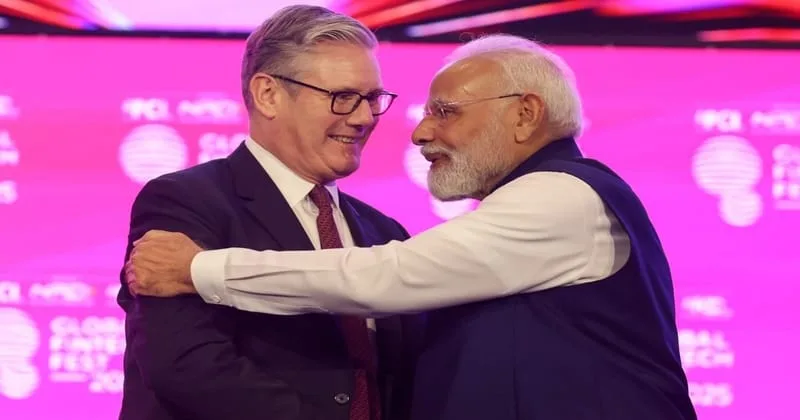
Glad to have taken part in the Global Fintech Fest 2025 in Mumbai with PM Keir Starmer. Platforms like this highlight our nation’s resolve to strengthen this sector and build new momentum for global welfare.@Keir_Starmer pic.twitter.com/3SjilFkWtw
— Narendra Modi (@narendramodi) October 9, 2025
The visit demonstrates a clear recalibration of Britain’s global priorities, emphasizing economic pragmatism, educational innovation, and diplomatic engagement with India. Starmer’s observations on India’s rapid development, combined with concrete investments and university expansions, suggest that the UK is seeking to deepen its footprint in one of the world’s fastest-growing economies.
As India continues its trajectory of growth and modernization, Britain is positioning itself as a key partner across multiple sectors. The combined impact of trade, education, and cultural collaboration represents a significant opportunity for both nations, with tangible benefits for workers, students, and businesses alike. Starmer’s visit may well be remembered as a turning point in India-UK relations, signaling a shift toward strategic engagement that balances economic, educational, and diplomatic interests.