



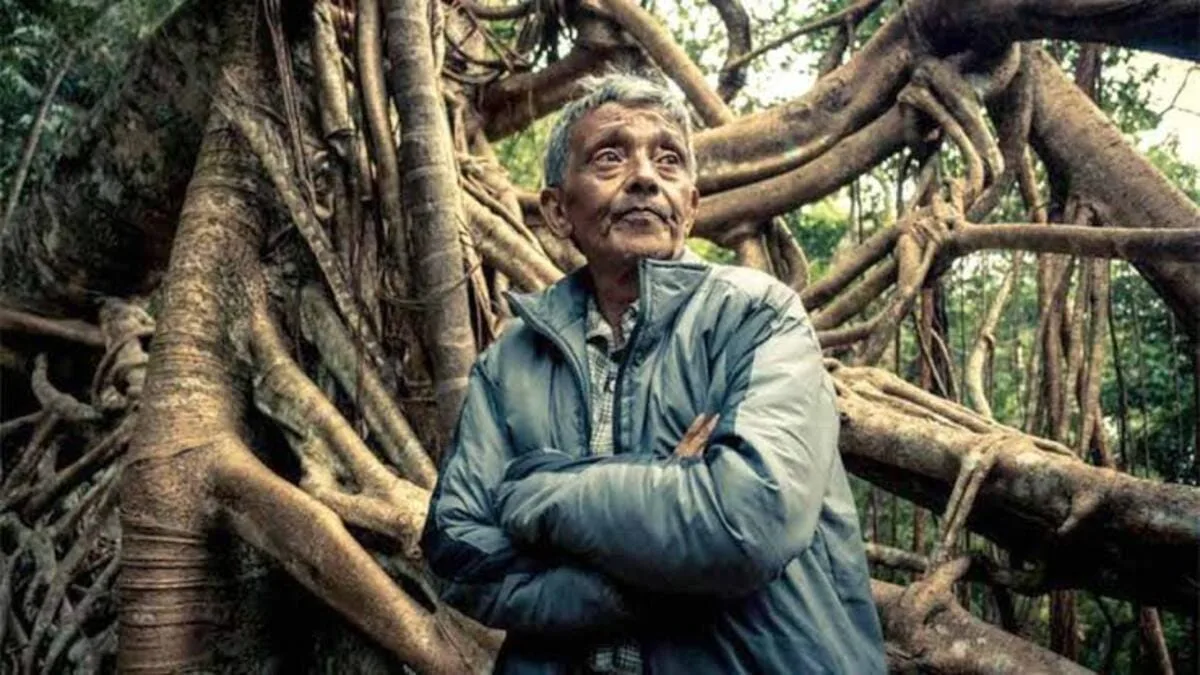
SIEJ: In the East Khasi Hills of Meghalaya, farmer Hally War has dedicated more than five decades to preserving one of India’s most remarkable examples of traditional engineering. By guiding the aerial roots of rubber fig trees across streams and difficult terrain, he has helped maintain living bridges that serve local communities while showcasing the Khasi people’s deep understanding of nature.
A resident of Siej village in the Sohra region, War learnt the technique from his grandfather when he was around 10 years old. What began as a childhood activity developed into a lifelong commitment to maintaining these natural structures and passing the traditional skill on to future generations. The Government of India recognised his contribution with the Padma Shri in 2026.
Learning the art of growing bridges
Hally War’s journey began with the knowledge passed down by his grandfather. As a child, he learnt how to guide the aerial roots of rubber fig trees so that they gradually extended across gaps and formed natural crossings.
Unlike conventional bridges built from concrete, steel or timber, living root bridges develop through the growth of trees and require sustained human care. The roots must be directed, supported and monitored over several years before they form a stable structure.
For War, learning the technique meant understanding both the behaviour of the trees and the surrounding landscape. His decades of experience have helped him continue a practice that requires patience, practical knowledge and regular maintenance.
The science behind Meghalaya’s living root bridges
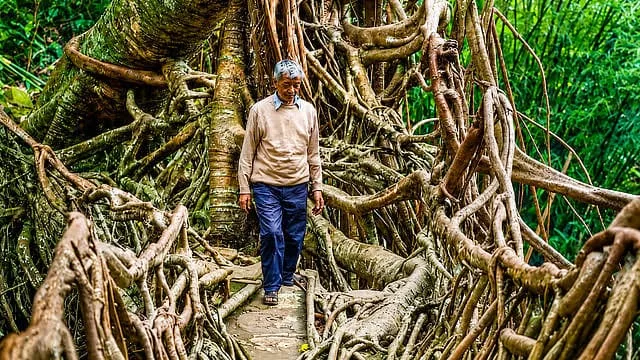
Known locally as Jingkieng Jri, living root bridges are created by training the aerial roots of rubber fig trees, scientifically known as Ficus elastica, across streams, rivers and ravines.
The Meghalaya Biodiversity Board explains that the roots are traditionally guided through hollowed betel nut trunks or bamboo supports. As they grow, they extend across the gap, intertwine and strengthen. Stones may be added to fill gaps, while steps and handrails can improve accessibility.
Developing a mature bridge takes considerable time. The process can take approximately 15 to 25 years, depending on the conditions and the structure being created. Once established and properly maintained, some living root bridges can remain functional for centuries.
These structures are particularly suited to Meghalaya’s landscape, which is characterised by heavy monsoon rainfall, steep valleys and numerous streams. Their continued growth allows them to adapt over time, making them a distinctive example of bioengineering developed through generations of local experience.
Preserving the Umkar Living Root Bridge
One of War’s best-known contributions is his work on the Umkar Living Root Bridge near Siej village. His efforts to nurture and maintain this natural crossing have helped sustain the traditional practice in the area.
Living root bridges are more than striking natural structures. They can provide practical routes across streams and connect places that would otherwise be difficult to reach. Their construction and maintenance also depend on community knowledge and an understanding of local vegetation and terrain.
Hally War’s work on the Umkar bridge and other crossings around Siej reflects the practical importance of this tradition. Maintaining these structures requires continued attention to the roots and the surrounding environment, ensuring that the bridges remain useful while the trees continue to grow.
Passing Khasi knowledge to younger generations
The survival of living root bridges depends on more than the existence of mature structures. The techniques used to create them must also be taught to people who can maintain existing bridges and develop new ones.
Hally War has helped mentor local families in root-bridge weaving, contributing to the transfer of knowledge between generations. This is particularly important as traditional skills can gradually disappear when younger people move away from village occupations or when practical expertise is no longer regularly taught.
Unlike knowledge that can be preserved entirely through written instructions, root-bridge construction requires hands-on experience. Learners must understand how to guide the roots, provide support during their growth and maintain the developing structure.
By sharing his experience with others, War has helped ensure that the practice remains part of community life rather than becoming merely a feature of the region’s cultural history.
Environmental conservation and local livelihoods
Hally War’s work is closely connected to the natural environment on which living root bridges depend. As a farmer, he cultivates crops including betel nuts, betel leaves and black pepper. His activities reflect the relationship between agriculture, local livelihoods and the landscape of Meghalaya.
Living root bridges depend on healthy trees and suitable growing conditions. Their preservation therefore requires communities to care for the surrounding vegetation and understand the local ecosystem.
The bridges have also become attractions for visitors interested in Meghalaya’s natural beauty and cultural heritage. Responsible tourism can create opportunities for local communities, but protecting the surrounding landscape remains essential to ensuring that these sites are not damaged by excessive visitor pressure. The tradition offers a practical example of how indigenous knowledge can contribute to sustainable development. Rather than relying entirely on manufactured materials, communities have developed a way of creating useful infrastructure through the careful management of living trees.
Padma Shri 2026 recognises grassroots contribution
On January 25, 2026, the Government of India announced Hally War as a Padma Shri recipient. The recognition brought national attention to his work in preserving the Khasi tradition of living root bridges and the indigenous knowledge associated with it. His achievement highlights the contributions of grassroots practitioners whose expertise is developed through years of experience within their communities. Such work may not involve large institutions or extensive resources, yet it can have lasting cultural and environmental significance.
India’s diverse communities possess traditional knowledge relating to agriculture, architecture, water management, medicine and biodiversity. Preserving these practices requires people who continue to practise them and share their skills with others.
Hally War’s work demonstrates how an individual can contribute to the preservation of cultural heritage through sustained effort. His recognition also draws attention to the Khasi community’s role in maintaining a distinctive form of traditional engineering.
A legacy rooted in tradition
Hally War’s journey from a young learner to a recognised practitioner illustrates the value of dedication and intergenerational knowledge. Over more than five decades, he has helped preserve a technique that combines practical engineering with an intimate understanding of nature. His contribution lies not only in maintaining living root bridges but also in helping younger villagers learn the skills needed to continue the tradition. As these techniques pass to another generation, the Khasi community’s distinctive approach to building with living trees can remain relevant in a changing world.
The Padma Shri has brought national recognition to War’s efforts, highlighting how the preservation of indigenous knowledge can serve both cultural heritage and environmental conservation.