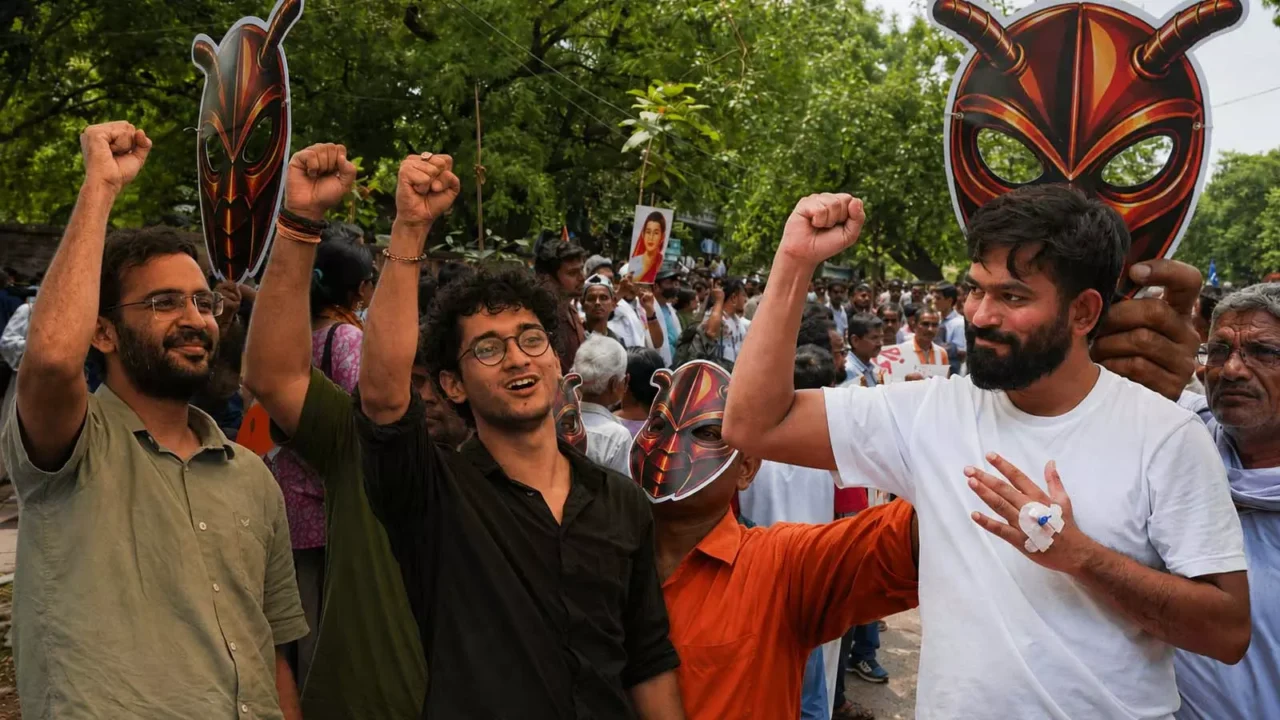
The Cockroach Janata Party (CJP) appears to understand one thing about modern politics better than most: in the age of social media, controlling the narrative can sometimes matter more than demonstrating genuine public support. Reels, livestreams, dramatic protest clips and emotionally charged slogans have become central to its political strategy. Every confrontation can become content, every slogan can become a hashtag, and every gathering can be presented as evidence of a growing political wave. But beneath this carefully amplified digital presence lies a question CJP cannot simply scroll past: who elected it to speak for India?
A loud online campaign may create the impression of a movement sweeping across the country, but visibility is not the same as widespread support. When the same protest footage is repeatedly circulated, a local demonstration can begin to look like a national uprising. When hashtags dominate timelines, it can appear that an entire country is speaking with one voice. Yet the people sharing, viewing or commenting on such content are not necessarily endorsing its message. A trending hashtag is not a public mandate, a viral video is not a national referendum, and a crowd in one location cannot automatically be presented as the voice of millions.
This is where CJP’s political messaging deserves closer scrutiny. If a movement wants to claim national relevance, it must demonstrate that its support extends beyond social media campaigns and carefully selected protest visuals.
Who are the people it represents?
How broad is its support beyond its most active online followers?
What evidence shows that its demands reflect the concerns of citizens across the country?
These are not unreasonable questions. They are essential questions for any group that seeks to turn online visibility into political authority.
India is far too vast and diverse to be spoken for by a single digital campaign. Its citizens live with different realities, speak different languages, hold different political beliefs and disagree on what the country needs.
CJP may be able to command a screen, dominate a conversation for a day or turn a protest into a viral spectacle. But none of that gives it the right to claim the voice of 1.4 billion Indians. Public trust must be earned, support must be demonstrated, and political legitimacy cannot be manufactured through repetition and outrage.
When protest becomes a performance for the camera
There is a troubling tendency in modern politics to turn every confrontation into content and every gathering into a declaration of revolution. CJP’s social media-driven approach raises questions about whether the spectacle of protest is becoming as important as the issues supposedly being raised.
The pattern is familiar: a confrontation produces footage, the footage generates engagement, and that engagement is presented as evidence of growing political momentum. The louder the campaign becomes online, the easier it is to create the impression that an entire country is caught up in the same anger.
But political mobilisation cannot be measured by decibels. Nor does the ability to generate outrage make a movement representative, responsible or right.
There is a difference between a movement that patiently builds public support through facts, arguments and peaceful democratic engagement and one that relies heavily on confrontation to sustain its visibility. The former seeks to persuade people. The latter risks turning political disagreement into a permanent spectacle.
CJP should be judged by the quality of its arguments, the credibility of its claims and the conduct of those associated with it, not by the number of clips circulating on social media.
The problem with a politics of threats and intimidation
Protest is an essential democratic right. Citizens must be able to question governments, criticise public institutions and demand answers from those in power. No political organisation should be denied that right merely because its views are unpopular.
But the right to protest does not come with a licence to threaten, intimidate or silence those who disagree. If individuals associated with CJP engage in such conduct, it deserves scrutiny and accountability based on verifiable evidence. Threats cannot be excused simply because they are presented as expressions of youthful anger or revolutionary determination.
Democracy depends on disagreement. It requires citizens to challenge one another through arguments, evidence and peaceful action. When intimidation replaces persuasion, public debate suffers and ordinary people can become reluctant to express their views.
The danger is that a culture of confrontation can begin to reward aggression over reason. The person who shouts the loudest gets the camera’s attention, while those who disagree quietly are pushed out of the conversation.
CJP must answer a question: does it want to persuade the Indian public, or does it want to create the impression that anyone who challenges its narrative is standing against a supposed revolution?
Can viral videos manufacture the impression of a national uprising?
Social media can make a local event appear much larger in the public imagination through repeated sharing, selective editing and the constant circulation of dramatic footage. A video of a crowd in one location may reach millions of screens, even though the gathering itself involved only a limited number of people.
CJP and opposition groups have used selected visuals to project a broader picture of political unrest. It also raises questions about whether camera angles and repeated circulation can exaggerate the apparent scale of demonstrations.
Yet the underlying warning is important. When the same images appear repeatedly across multiple accounts, viewers can mistake repetition for widespread participation. An event may dominate the online conversation without representing the experience or opinion of people elsewhere.
Imagine the danger of judging an entire country through a few minutes of footage. Millions of citizens may be going about their lives, concentrating on work, education, family and local concerns, while a particular protest dominates social media. Their silence does not mean they support the protest. Nor does it mean they oppose it. It simply means their views cannot be assumed.
India’s public mood cannot be measured by counting the videos that appear on a timeline.
The algorithm rewards outrage
Social media platforms often give greater visibility to content that triggers strong reactions. Anger, dramatic accusations and confrontational exchanges can prompt users to watch, comment and share. That creates an environment in which political actors have an incentive to keep audiences emotionally engaged.
For a group seeking attention, outrage can become a political resource. Every heated exchange offers another clip. Every accusation can become another post. Every confrontation can be presented as proof that a historic struggle is unfolding.
But outrage is not evidence. Repetition is not verification. And a large number of views does not establish that a claim is true.
CJP’s online messaging should therefore be examined with the same scepticism applied to any political campaign. Where was a video recorded? When did the event take place? Does the footage show the full context? Are the claims supported by independent sources? How many people actually participated, and what evidence exists of support beyond the online network?
Citizens should not have to choose between blindly accepting a viral narrative and dismissing every protest. They can recognise the right to dissent while demanding proof for sweeping claims made in the name of the public.
Sri Lanka and Bangladesh: Why context matters
There is a comparison between Sri Lanka’s 2022 economic crisis and Bangladesh’s 2024 political upheaval, showing that social media can shape how unrest is perceived far beyond the locations where events occur.
Both examples underline the importance of verifying information during periods of political tension. Social media can help people share genuine grievances and organise demonstrations. It can also accelerate the circulation of rumours, misleading material and footage presented without adequate context.
The lesson for India is not to dismiss every protest as manufactured. It is to resist attempts, by any political group, to turn selected images into definitive proof of a national crisis.
CJP’s online following is not a public mandate
If CJP claims to represent India’s youth or speak for the wider population, it must demonstrate the extent of that support rather than simply announce it.
How far does its support extend beyond social media? Are its demands backed by people across different regions and communities? What do independent accounts of its demonstrations reveal? Are its claims based on verifiable evidence, or are allegations being repeated until they acquire the appearance of truth?
These questions matter because India has no shortage of genuine public concerns. Young people worry about employment, education, examinations and their future. Families deal with rising expenses and everyday pressures. Citizens expect public institutions to function fairly and governments to answer difficult questions.
Such concerns deserve serious engagement, not political theatre that reduces every issue to a contest over who can generate the most outrage online.
CJP is free to put forward its arguments. But it must not confuse its own political messaging with the collective aspirations of an entire generation. Nor should it assume that criticism of its tactics amounts to opposition to the right to protest.
India is bigger than CJP’s echo chamber
India’s democracy belongs to its people, not to the group with the most viral videos, the angriest slogans or the most persistent online campaign.
Millions of Indians may never follow CJP, watch its reels or attend its protests. Others may disagree with its methods while supporting the right of its members to express their views. Still others may share some of its concerns but reject its political approach.
The danger of CJP’s digital politics lies in the gap between visibility and representation. A group can create the appearance of unstoppable momentum without establishing that it enjoys broad-based support. It can dominate a conversation without winning the confidence of those outside its immediate audience.
CJP can flood social media with reels, hashtags and angry slogans. It can turn confrontations into content and online attention into political theatre. But it cannot simply declare itself the voice of 1.4 billion Indians.
A nation as vast and diverse as India deserves better than the assumption that whoever dominates the digital noise speaks for everyone. Public trust must be earned through credible arguments, responsible conduct and demonstrable support, not manufactured through a never-ending cycle of outrage.
CJP may want India to see a revolution on every screen. But a viral campaign, however loud, does not make it a national movement.