Towards the end of Chaitra in the year 1899, the skies and air of Kolkata, the seat of British colonial administration, were gripped by the terrifying silence of a cremation ground. The deadly claws of the plague epidemic were ravaging the old quarters of North Kolkata. In the filthy, narrow lanes of Bagbazar, Shyampukur, Kumartuli and Chitpur, terror reigned supreme.
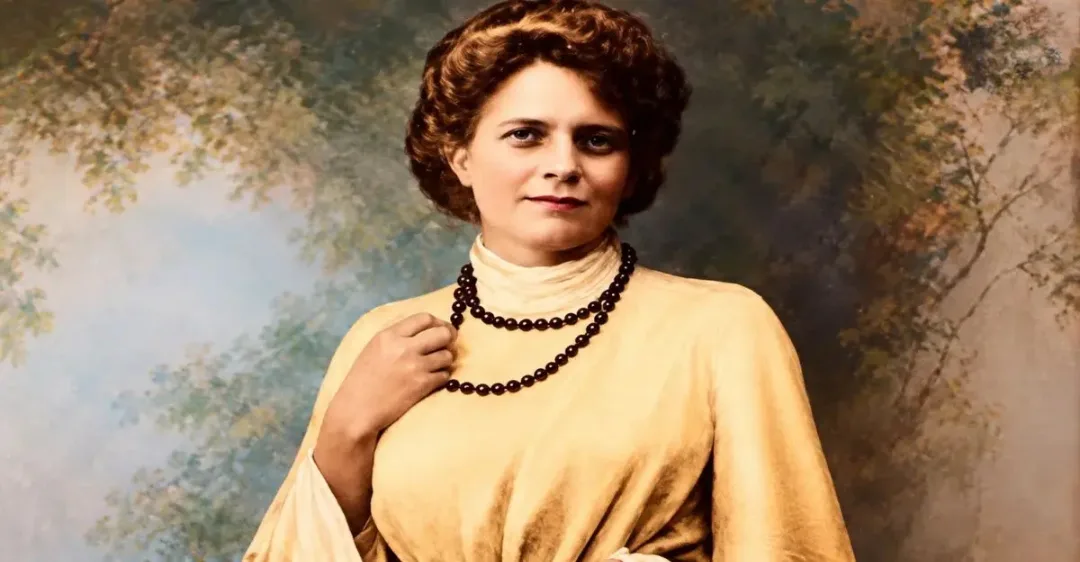
Fearing contagion, relatives abandoned the sick, doors were barred against fellow human beings and ruthless British municipal employees threatened to burn down the dwellings of the poor under the pretext of curbing the infection. At such a catastrophic moment, into the unhygienic, foul-smelling alleys of Bagbazar stepped a luminous lady of profound wisdom from the far-off town of Dungannon in Ireland—Margaret Elizabeth Noble (October 28, 1867 – October 13, 1911).
Broom in hand, basket and bucket on her shoulder, and a container of disinfectant ready, she descended onto the dusty streets of Kolkata. With no artificial social nobility and no alien hesitation, her delicate hands cleaned the filthy drains of North Kolkata, swept the mud-caked lanes and went from house to house embracing dying plague-stricken children with tender motherly affection. A young woman who could have spent a distinguished life in London’s affluent social circles, elite intellectual salons and literary gatherings surrendered her all at the feet of Mother India, consecrated in Swami Vivekananda’s unsullied ideal of renunciation. Swami Vivekananda lovingly named her ‘Nivedita’—literally, ‘the Dedicated One’.
Nivedita’s humanitarian and spiritual initiative during Kolkata’s plague crisis was not merely social service; it was a luminous proclamation of spiritual nationalism. When government relief was meager, Nivedita curtailed her own meals and distributed her modest personal savings to secure medicine and diet for the afflicted. Later, when Swami Vivekananda attained mahasamadhi in 1902, Nivedita did not confine her spiritual practice within the four walls of an ashram. With eyes of wisdom, she realized that without breaking the chains of political subjection, the spiritual, social, and political regeneration of the Indian populace was impossible.
Consequently, while on the one hand she lit the torch of Indian women’s awakening at the girls’ school in Bosepara Lane, Bagbazar, on the other hand, she inspired the revolutionary youth of Anushilan Samiti and Jugantar, becoming the unseen nerve center of India’s armed freedom struggle. Handing copies of the Bhagavad Gita, Anandamath, and the history of the French Revolution to young revolutionaries at the armed gymnasiums of Medinipur, facilitating the use of Acharya Prafulla Chandra Ray’s chemistry laboratory for revolutionaries preparing chemical explosives, or dedicating all her earnings and copyrights to Acharya Jagadish Chandra Bose’s struggle for international scientific recognition—Nivedita was the living symbol of modern India’s total nationalist revival.
Yet, in post-independence India’s historiography, university campuses and intellectual institutional circles, Sister Nivedita and her immortal contributions faced unprecedented opposition, defamation, vilification, and a well-planned axe of historical erasure from the Communist, Marxist, and later Naxalite ideological camps. The woman who synthesized the Irish Celtic nationalist tradition with Indian Vedanta to lay the foundation for an integral, Shakti-centered nationalism was branded by Marxist historians and Leftist politicians as a ‘Hindutva icon’, a ‘petty-bourgeois reactionary’, and an ‘unfounded myth’ or ‘legend’ in the history of armed revolution.
Theoretical conflict between Hindu nationalism and marxist dialectical materialism
Deep analytical review reveals that the hostility of Communists toward Sister Nivedita was not a mere personality-driven conflict, but was rooted in a fundamental ideological contradiction. The Indian nationalism that Nivedita represented was anchored in Upanishadic Vedanta, Shakta religious metaphors, the universal humanism of Ramakrishna-Vivekananda, and the consciousness of an undivided India (Akhand Bharat). This was completely antithetical to Marxist-Leninist or Maoist Dialectical Materialism.
Fundamental conflict between Nivedita’s ‘practical vedanta’ and the communist outlook
In Marxist philosophy, religion is considered the “opium of the people”, and culture or religious consciousness is viewed merely as a superstructure resting upon the economic base of class struggle. In this context, the nationalism championed by Nivedita—which called for worshipping the nation beyond a mere physical territory as ‘Mother of the Universe’ or ‘Goddess Kali’—was identified by Marxists as a grave danger signal.
In her deeply insightful works Kali the Mother (1900) and The Web of Indian Life (1904), Nivedita presented Indian culture as a self-reliant, cohesive, and spiritual force. She stated unequivocally that India’s strength lay in its spiritual roots and that this spirituality would unite the Indian nation against all foreign exploitation. However, adherents of dialectical materialism were accustomed to viewing Indian society strictly through the lens of ‘feudal exploitation’ and ‘class struggle.’ Consequently, they labeled Nivedita’s spiritual and political stance as unscientific, pseudo-science, and “bourgeois religious sub-consciousness”.
M.N. Roy’s marxist critique and rejection of religious metaphors
Manabendra Nath Roy (M.N. Roy), one of the founders of the Communist movement in India, who in his youth (as Narendranath Bhattacharya) had been inspired by Nivedita’s fiery nationalist ideals as part of Jugantar, later joined the international Communist movement and severely criticized Nivedita and Vivekananda’s followers in his famous theoretical treatise India in Transition (1922).
M.N. Roy explicitly wrote in his book that the nationalism propagated by Bankim Chandra, Vivekananda, and Nivedita was essentially “Religious Revivalism.” According to Roy, this religious revivalism misled Indian revolutionary forces, stalled the momentum of class struggle, and served the interests of bourgeois landlords. Roy further argued that the effort by Nivedita and others to color politics with spirituality posed a formidable obstacle to progressive social transformation.
Poaching revolutionaries into marxist cadres
When revolutionaries of Anushilan Samiti and Jugantar, imprisoned in the Andaman Cellular Jail and various detention camps during the 1920s and 1930s, came into contact with international Marxist literature, a significant section turned toward historical materialism. Hemchandra Kanungo, who was extremely close to Nivedita and worked with her politically in Medinipur and Kolkata, later strongly criticized the use of religious symbols during the initial phase of the movement in his serialized autobiographical memoir Banglar Biplab Kahini (later published in book form as Banglay Biplab Prachesta).
Kanungo wrote that the policy taught by Nivedita and her contemporaries—taking oaths in the name of Mother Kali or with hands on the Bhagavad Gita—alienated non-Hindu and lower-caste common people from the revolutionary struggle. Many cadres of Anushilan Samiti later joined the Revolutionary Socialist Party (RSP) and the Communist Party of India (CPI), denouncing the spiritual and nationalist path paved by Nivedita as “petty-bourgeois confusion”. An intelligence analysis of the Leftist ecosystem’s smear tactics reveals several distinct and systematic methods designed to systematically cloud and tarnish Nivedita’s legacy.
The Hindutva icon slander and attempts at communalization
Leftist and extremist media ecosystems attempted to portray Sister Nivedita as a distorted ‘Hindutva icon.’ Modern Leftist intellectuals and historians often quote Nivedita’s lectures or writings on “Aggressive Hinduism” out of context to claim that she sowed the seeds of militant religious nationalism in India.
In an article titled “Against Boiled Cabbage: Falling for Vivekananda” published in the London Review of Books, researcher Michael Ledger-Lomas remarked that Nivedita’s writings imagined an ancient Hindu nation that later became a vehicle for political violence. Communist political platforms weaponized such analyses in news media and intellectual discourse to project Nivedita as the original architect of aggressive religious communalism—ignoring that in her book Civic and National Ideals, Nivedita clearly wrote that India’s unity is universal, liberal, and synthesized from all races and religions.
Planned misinterpretation of the severance of ties with the Ramakrishna Mission
In 1902, following the passing of Swami Vivekananda, Sister Nivedita formally withdrew her name from the Ramakrishna Math and Mission. She voluntarily chose this seemingly independent path at the request of the then Mission President, Swami Brahmananda, in order to shield the Ramakrishna Mission from British government persecution, surveillance, and potential confiscation.
However, Leftist literature and academic discourses distorted this noble sacrifice. Communist historians presented it as evidence of Nivedita’s “militant political mania” or “doctrinal conflict with the Mission.” They spread propaganda that even the Ramakrishna Mission did not approve of Nivedita’s ‘militant politics’ and forced her out. This is a historical falsehood and misleading propaganda meant to turn Nivedita’s noble sacrifice into a discrediting controversy.
Erasure of history from universities and curricula
During the 34-year rule of the Left Front led by the Communist Party of India (Marxist) [CPI(M)] in West Bengal from 1977 to 2011, Nivedita was systematically marginalized in the state’s educational and cultural policies. Leftist historiography was heavily imposed on the history syllabi of Calcutta University, Jadavpur University, Presidency College, and the West Bengal Board of Secondary Education.
The Subaltern Studies and Marxist historiography of historians like Sumit Sarkar, Ranajit Guha, and Partha Chatterjee gained institutional hegemony. Sumit Sarkar, in his widely circulated and controversial book The Swadeshi Movement in Bengal, 1903–1908 (1973), dismissed Sister Nivedita’s revolutionary leadership and contributions to Anushilan Samiti as a planned “legend”.
Sumit Sarkar wrote that claims of Nivedita leading an underground revolutionary movement were merely a fairytale exaggerated from ordinary facts by emotional later biographers. The dismissal of Nivedita’s revolutionary role as a fairytale by a prominent historian relying on selective archival notes was a subtle institutional strategy to erase research and historical memory regarding Nivedita from the academic world. To cover up Nivedita’s multifaceted social, educational and revolutionary contributions, the Leftist intellectual establishment targeted three major areas—science, art and the intellectual struggle against British rule.
Plot to cover up Nivedita’s contribution to Indian science
The Left preferred to portray themselves as “scientifically minded and rational” while depicting Hindu thought as “superstitious.” Yet historical truth reveals that when India’s first modern scientist, Acharya Jagadish Chandra Bose, faced racial discrimination from the British scientific establishment and was denied patent recognition and international acclaim from the Royal Society, it was Nivedita who stood firmly by his side.
For years, Nivedita raised funds for J.C. Bose’s research, helped draft the initial blueprint for the Bose Institute, edited his research papers and books, and championed his discoveries in the international scientific community. Records from the Ramakrishna Mission Darjeeling and the Nivedita Heritage Trust, as well as research papers by Subir Ghosh, explicitly note that Nivedita arranged for Acharya Prafulla Chandra Ray’s chemistry laboratory to be used by revolutionaries of Anushilan Samiti and Jugantar for testing chemical explosives. Leftist historiography completely suppressed this groundbreaking synthesis of science and spiritual nationalism, because admitting it would collapse their manufactured narrative of “Hindu tradition versus modern science”.
Devaluation of the Bengal School of Art and ‘Bharat Mata’
In fine arts and culture, Nivedita’s profound contributions were deliberately kept unspoken. Inspiring Abanindranath Tagore to move away from blind European imitation toward traditional Indian artistic styles and her inspiration behind the painting of ‘Bharat Mata’, remain key pillars of India’s cultural movement. Partha Chatterjee, in his book The Nation and Its Fragments (1993), along with other Marxist art critics, interpreted this iconography and the Bengal School as “patriarchal and orthodox cultural hegemony of the elite Hindu bhadralok class.” They claimed that the art movement championed by Nivedita isolated Indian art from international modernity, trapping it in a religious ghetto. Thus, an attempt was made to smear Nivedita’s extraordinary contribution to the liberation of artistic expression.
Unmasking Curzon’s hypocrisy and historical silence
In 1905, when Viceroy Lord Curzon claimed in his convocation address at Calcutta University that “the highest ideal of truth is to a large extent a Western conception,” Sister Nivedita delivered a masterpiece of investigative journalism.
Nivedita meticulously combed through Lord Curzon’s own book, Problems of the Far East, and unearthed evidence where Curzon boasted about lying about his age and marital status to the President of the Korean Foreign Office to gain commercial advantages. Nivedita quoted the passage and published it anonymously in Amrita Bazar Patrika and The Statesman. The revelatory exposure sent shockwaves throughout British India, forcing Lord Curzon to apologize publicly.
Today, no Leftist history textbook mentions this historic act of investigative exposure. For Marxist historians, admitting that a spiritual female ascetic shattered the arrogance of British imperialism was deeply uncomfortable.
The 2017 Kolkata explosion and recent controversy
The most recent political-media confrontation surrounding Nivedita’s memory and legacy erupted publicly in 2017, on her 150th birth anniversary. In September 2017, the Sister Nivedita Mission Trust organized a Sister Nivedita Memorial Lecture at Mahajati Sadan, a government auditorium in Kolkata, with RSS Chief Mohan Bhagwat as the chief guest. However, on instructions from the state government, the venue booking was canceled at the last minute citing security reasons. News reports in Prothom Alo and Firstpost highlighted how this triggered nationwide debate and political uproar.
Later in October, at a different auditorium, Mohan Bhagwat quoted extensively from Nivedita’s works to emphasize the importance of Indian cultural nationalism. Meanwhile, Leftist intellectuals penned articles in The Wire and various periodicals claiming that right-wing forces were ‘hijacking’ Sister Nivedita for partisan interests.
This intense political tug-of-war proves that even a century after her death, Nivedita’s profound thought and image remain vibrant, powerful, and deeply alarming to the Leftist ideological camp.
She who gave her all to India
Despite decades of historical erasure, theoretical criticism and academic boycott by the Communist, Marxist and Naxalite camps, Sister Nivedita’s contribution could not be erased from the heart of India. Sankari Prasad Basu’s monumental four-volume work Nivedita Lokmata presents a vast repository of historical facts and documents that shatters the misleading propaganda of Sumit Sarkar and others in an instant.
The installation of an English Heritage Blue Plaque at Wimbledon in London, the release of a commemorative postage stamp by the Government of India and the preservation of Nivedita’s residence in Darjeeling under the care of the Ramakrishna Mission prove that history ultimately grants universal recognition to truth and sacrifice.
The immortal line carved upon Sister Nivedita’s epitaph remains the finest testament to her life and the ultimate answer to all her detractors: “Here lies Sister Nivedita who gave her all to India”.